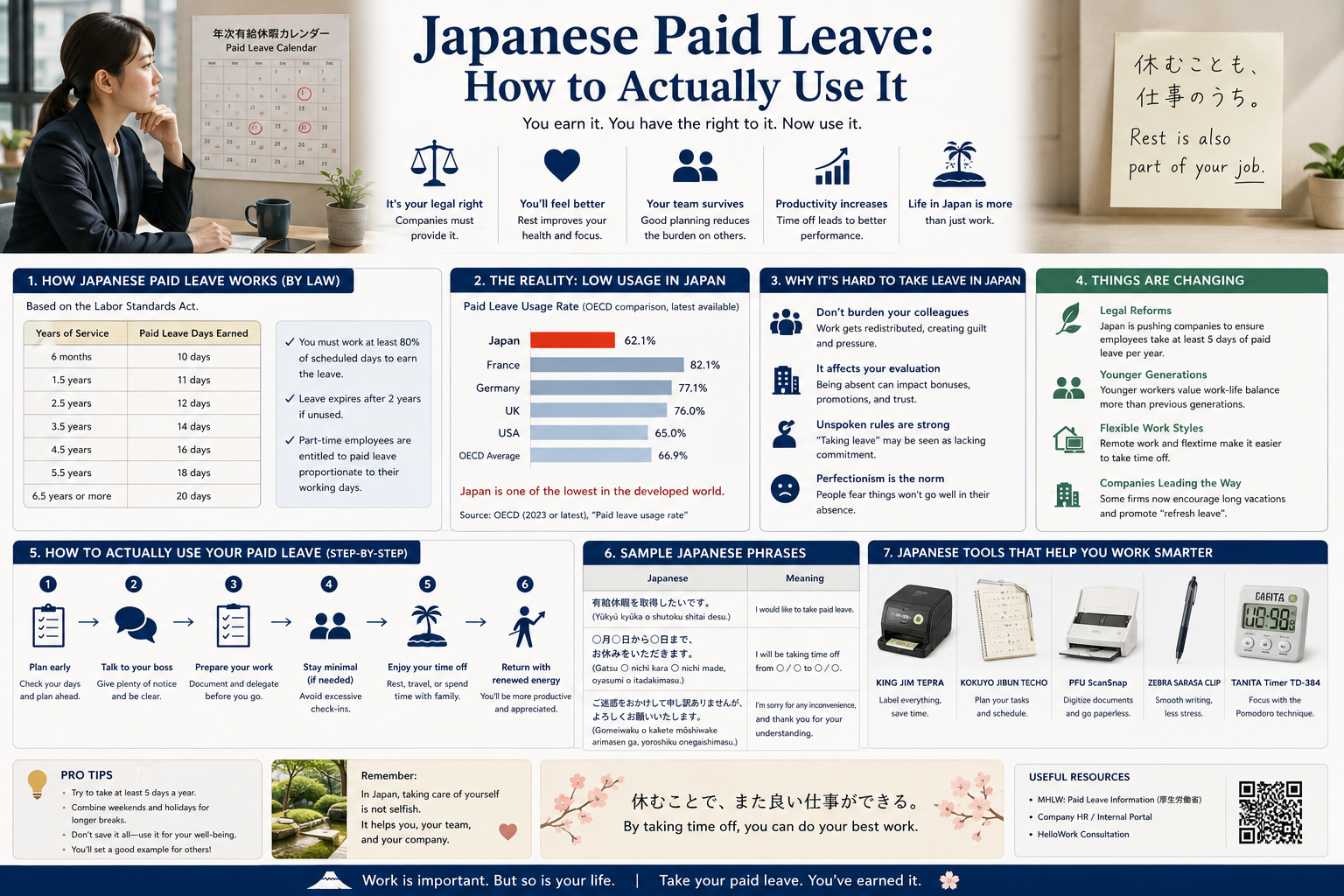
Japanese Paid Leave: How to Actually Use It
July 11, 2026 | Work Life | Japanese Best
Japanese workers often joke that their paid leave is like a luxury car they’re not allowed to drive. You earn it, it sits in your account, but using it feels complicated, risky, or simply against the unspoken rules. Yet the situation is changing—and understanding how Japanese paid leave actually works is essential if you’re considering work or study in Japan, or if you’re simply curious about why the nation’s work culture has such a distinctive feel.
Quick Summary
- Japanese employees receive 10 days of paid leave in their first year, increasing to 20 days by year six—but usage rates remain among the lowest in the developed world
- Taking time off is culturally discouraged; absent workers burden colleagues, and promotion can suffer if you’re seen as uncommitted
- The legal minimum is strict, but company culture and peer pressure often override official policy
- Recent reforms and younger generations are gradually shifting attitudes toward work-life balance
- Japanese-made productivity tools can help you manage workload and time more efficiently whilst navigating this unique culture
🛒 Shop Recommended Products
How Japanese Work Culture Works
Japanese companies operate on a principle called kaisha no tame ni—”for the sake of the company.” This means individual needs are subordinate to group harmony and collective success. Paid leave exists in law (the Labour Standards Act guarantees 10 days minimum), but culturally it’s often treated as a privilege rather than a right.
Taking leave means your colleagues must cover your work. In a culture that values consideration (kizukai) and avoiding burden (meiwaku) on others, requesting time off can feel selfish. Managers rarely deny leave outright, but they may hint that “now isn’t a good time” or that your absence will “cause problems.” This creates psychological pressure far more effective than any explicit rule.
Promotion and bonuses are often tied to perceived commitment. Workers who take their full entitlement risk being labelled as uncommitted or lacking team spirit—a serious liability in Japanese corporate hierarchies. Younger employees especially fear this stigma. The result: Japan consistently records paid leave usage rates of 50% or lower, despite generous statutory allowances.
A Typical Japanese Work Day
Understanding the daily grind helps explain why paid leave feels impossible. A typical office worker in Tokyo arrives around 8:30 a.m., often 15 minutes early to prepare their desk and greet colleagues. Work runs until 5:30 or 6:00 p.m. officially, but leaving exactly at closing time signals laziness. Most stay until 7:00 or 8:00 p.m., even if their tasks are finished.
Evenings often include nomikai (drinking socials with colleagues), which are semi-mandatory for relationship-building. Weekends may involve weekend work or mentally preparing for the week ahead. Many workers commute 60 minutes or more each way; a Zojirushi SM-SHE60AG Stainless Mug becomes essential for surviving the journey with hot tea.
Lunch is typically 12:00–1:00 p.m., often eaten at your desk whilst working. Holidays—when they occur—are frequently spent catching up on overdue tasks. This relentless routine makes taking two consecutive weeks off feel almost impossible. Your inbox will explode. Deadlines won’t pause. Colleagues will resent you, or so it feels.
How This Compares to Other Countries
France mandates 25 days of paid leave annually, and French workers use nearly 100% of their entitlement. Germany grants 20 days as standard. The United Kingdom provides 20–28 days. Japan’s 10–20 days looks reasonable on paper, but actual usage tells a different story.
American workers notoriously underuse leave—the US has no legal minimum—but those who do take time off face less social stigma than in Japan. The cultural difference is stark: Anglo-Saxon work cultures emphasise individual autonomy and work-life separation. Japanese culture emphasises group cohesion and organisational loyalty. That’s not a moral judgement; it’s simply how two different societies define professional obligation.
Interestingly, recent studies show that overworked Japanese employees are less productive, not more. Yet the culture persists. Visitors to Japan often notice the contrast: trains are packed at 8:00 a.m. and again at 9:00 p.m., but quiet during mid-afternoon. Everyone is at the office, whether or not they’re actually productive.
How It’s Changing
Japan’s government is actively pushing for change. In 2019, a new law required companies to ensure employees take at least five days of paid leave annually—a minimum floor, not an aspiration. This modest reform acknowledges the problem whilst respecting employer concerns about disruption.
Younger generations, particularly those educated abroad or working for foreign companies, increasingly expect work-life balance. Tech firms in Tokyo and start-ups often advertise flexible leave policies as a recruitment tool. Companies like Google Japan and Rakuten have successfully normalised remote work and time off without collapsing productivity.
The pandemic accelerated this shift. When offices closed, the myth that constant presence equals commitment crumbled. Remote workers delivered results without warming seats. By 2023, major firms including Toyota and Sony had formally adopted four-day work weeks or expanded leave policies.
Still, cultural change is glacial. Many mid-sized companies and traditional sectors (banking, law, insurance) maintain the old ways. Taking extended leave remains rare outside tech and internationalist firms. The tension between legal rights and cultural expectations persists.
Making the Most of Your Entitlement
If you’re working in Japan, use your five mandated days strategically. Plan during quiet periods (August and the New Year holidays, when many firms close anyway). Request time off in writing, well in advance, and frame it respectfully: not as a demand, but as a preference you’re hoping to accommodate.
Document your tasks before leaving. Leave detailed instructions. Offer to handle urgent matters remotely. Show consideration for those covering your work. This approach respects the unspoken rules whilst asserting your legal right.
Keep a detailed planner to track your work and remaining leave balance. The Pilot FriXion Clicker 0.5mm is ideal for planning because you can adjust schedules without creating a messy, error-filled notebook—professional appearance matters in Japanese offices. Its erasable gel ink writes smoothly like premium pens but rubs clean with gentle heat, letting you reorganise plans as priorities shift.
When you’re actually at the office, efficiency matters. The Zebra Sarasa Clip 0.5mm is Japan’s most beloved everyday pen for good reason: its fast-drying ink means your notes won’t smudge across your hand, and it’s reliable enough that you’ll finish tasks faster, freeing up time for the personal projects that make leave meaningful.
FAQ
Can I legally refuse unpaid overtime before taking leave?
Yes. The Labour Standards Act specifies maximum working hours. However, refusing will likely damage relationships with your manager.
What if my company pressures me not to take leave?
Document everything. Contact a labour union or the Labour Standards Inspection Office (rōdō kijun kyoku). Retaliation for taking legal leave is illegal, though proving it can be difficult.
Is sick leave separate from paid leave?
This varies by company. Some firms treat them separately; others deduct sick days from your paid leave balance. Check your contract.
How much leave should I actually take?
Five to ten days annually is realistic without career damage at most companies. Two weeks signals you’re either leaving or foreign.
Do companies carry over unused leave?
By law, unused leave expires after two years. Some companies allow limited carryover; most don’t. Use it or lose it.
Recommended Japanese Products
The products below are directly relevant to this article and used by Japanese families.
| Product | Brand | Best For | Link |
|---|---|---|---|
| Pilot FriXion Clicker 0.5mm | Pilot | Students, planners, and anyone who needs flexibility to correct mistakes | Pilot FriXion Clicker 0.5mm |
| Zebra Sarasa Clip 0.5mm | Zebra | Students and office workers who write quickly and need fast-drying ink | Zebra Sarasa Clip 0.5mm |
| Zojirushi SM-SHE60AG Stainless Mug | Zojirushi | Daily commuters who want reliable, durable coffee/tea on the go | Zojirushi SM-SHE60AG Stainless Mug |
Pilot FriXion Clicker 0.5mm
The world’s bestselling erasable pen — writes like a smooth gel but rubs out cleanly with heat.
Best for: Students, planners, and anyone who needs flexibility to correct mistakes
🛒 Pilot FriXion Clicker 0.5mm on Amazon
Zebra Sarasa Clip 0.5mm
Japan’s favourite everyday gel pen — fast-drying, smooth, and available in gorgeous colours.
Best for: Students and office workers who write quickly and need fast-drying ink
🛒 Zebra Sarasa Clip 0.5mm on Amazon
Zojirushi SM-SHE60AG Stainless Mug
Zojirushi’s most popular commuter mug — slim, spill-proof, and keeps drinks hot for 6 hours.
Best for: Daily commuters who want reliable, durable coffee/tea on the go
🛒 Zojirushi SM-SHE60AG Stainless Mug on Amazon
More From Japanese Best
- Cost of Living in Tokyo in 2025: A Real Breakdown
- What Japanese Families Eat for Dinner
Disclosure: As an Amazon Associate, Japanese Best earns from qualifying purchases. This does not affect our recommendations. We only feature products we genuinely believe are worth your consideration.
Editorial Disclaimer
The views, opinions, and recommendations in this article are the author’s own and reflect personal experience living in Japan. They do not constitute professional, financial, or purchasing advice of any kind.
Product availability, pricing, and specifications are subject to change without notice. Japanese Best makes no warranties — express or implied — regarding the accuracy or completeness of this content, and accepts no liability for any decisions made based on it. Always verify details directly with the retailer or manufacturer before purchasing.

コメント