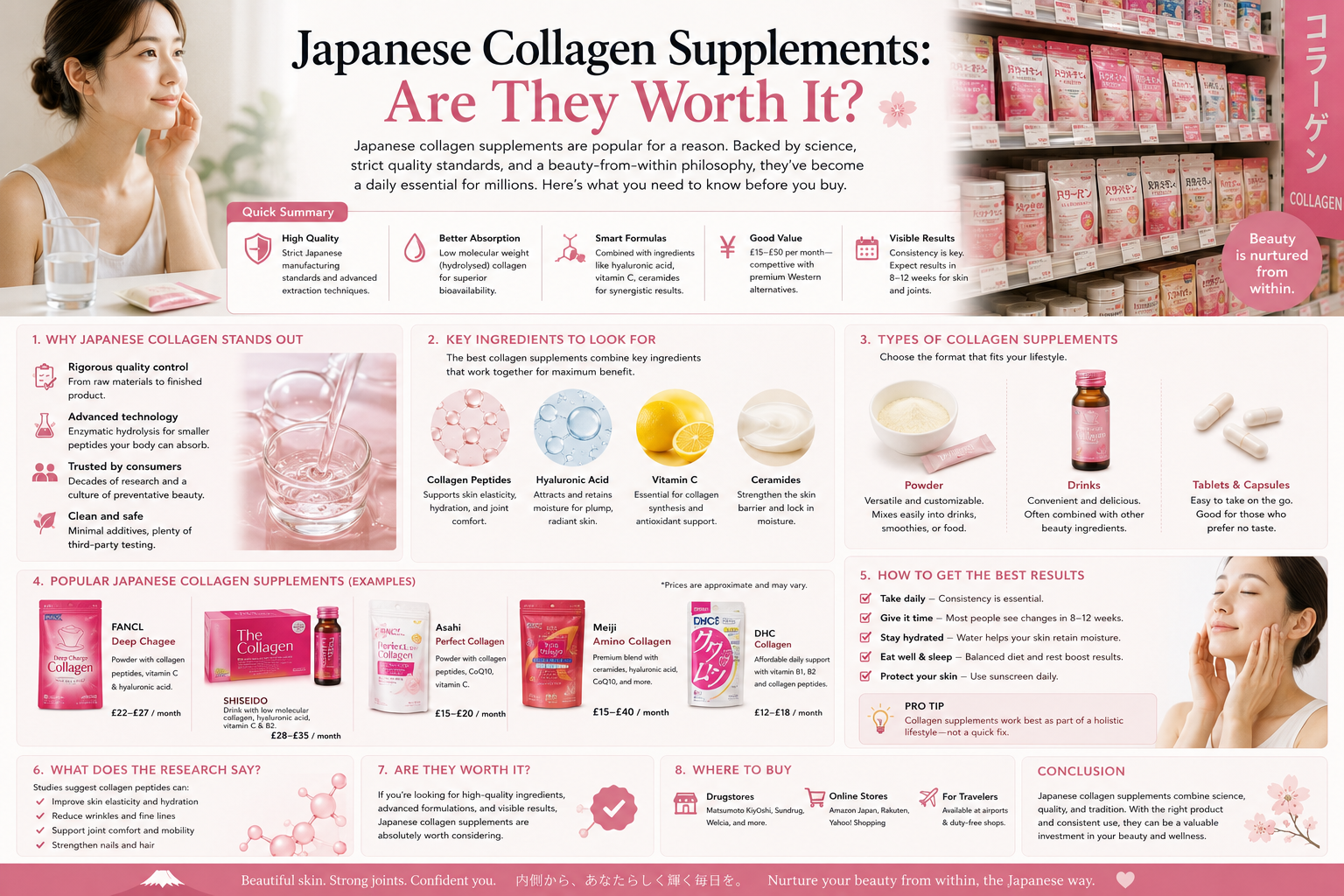
Japanese Collagen Supplements: Are They Worth It?
July 11, 2026 | Products | Japanese Best
Japanese skincare and wellness products have earned a formidable reputation worldwide, and collagen supplements sit firmly at the heart of this phenomenon. Walk into any drugstore in Tokyo’s Shibuya district or browse Japan’s dominant e-commerce platforms, and you’ll find entire sections dedicated to collagen in various forms—powders, drinks, and capsules. Japanese consumers have long prioritised beauty from within, viewing supplements not as luxury items but as essential maintenance. This cultural approach, combined with Japan’s rigorous quality standards and innovative formulations, has created a market where collagen supplements genuinely stand out. But with hundreds of options available, which ones deliver real results, and are they truly worth your investment?
Quick Summary
- Japanese collagen supplements benefit from strict manufacturing standards and advanced extraction techniques that exceed many Western competitors
- Most effective products combine collagen with complementary ingredients like hyaluronic acid, vitamin C, and ceramides for synergistic results
- Prices range from £15 to £50 per month, making quality Japanese supplements competitive with premium Western alternatives
- Japanese consumers prioritise bioavailability and low molecular weight (hydrolysed) collagen for maximum absorption
- Results typically appear after 8–12 weeks of consistent use, particularly for skin elasticity and joint comfort
Quick Comparison Table
| Product | Type | Key Ingredients | Price Range | Best For |
|---|---|---|---|---|
| FANCL Deep Charge Collagen | Powder | Fish collagen, hyaluronic acid | £25–£35 | Daily skin hydration |
| Shiseido The Collagen | Drink | Marine collagen, coenzyme Q10 | £30–£45 | Anti-ageing boost |
| Asahi Dear Natura Style Collagen | Powder | Porcine collagen, vitamin C | £18–£28 | Budget-conscious users |
| DHC Collagen | Capsule | Marine collagen, elastin | £20–£30 | Convenience-focused |
| Meiji Amino Collagen | Powder | Fish collagen, amino acids | £22–£32 | Sports recovery |
Why Japanese Products Stand Out
Japan’s approach to collagen supplements reflects decades of research and consumer feedback. Japanese manufacturers prioritise hydrolysed (low molecular weight) collagen, which studies suggest offers superior absorption compared to standard collagen. The country’s Pharmaceutical Affairs Law enforces stringent quality controls that many overseas producers simply don’t match. Tokyo-based laboratories conduct extensive stability testing and purity assessments before products reach shelves.
Beyond manufacturing rigour, Japanese formulations often incorporate traditional ingredients alongside modern science. You’ll find hyaluronic acid, ceramides, and plant extracts combined with marine collagen in ways that feel thoughtfully designed rather than randomly assembled. This reflects Japanese aesthetic philosophy—attention to detail and respect for ingredients. Additionally, Japanese companies invest heavily in bioavailability research. They understand that consuming collagen means little if your body can’t absorb it effectively. Price-for-value, a Japanese collagen supplement typically offers superior peptide purity and concentration than equivalently priced Western options.
Top Picks — Detailed Reviews
FANCL Deep Charge Collagen
FANCL, a skincare powerhouse based in Yokohama, has dominated Japan’s collagen market for nearly three decades. Their Deep Charge Collagen combines 6,000mg of fish-derived collagen with hyaluronic acid and ceramides in an easy-to-mix powder format. Each sachet dissolves quickly in water or juice, with a subtle peach flavour that doesn’t overwhelm. The FANCL Deep Charge Collagen uses a proprietary extraction method that maintains peptide integrity throughout processing.
Users report visible improvements in skin hydration and elasticity within 6–8 weeks. The addition of ceramides—lipids crucial for skin barrier function—makes this particularly effective for those with dry or sensitive skin. At around £30 per month for daily use, it sits comfortably in the mid-range. Japanese consumers often purchase multiple boxes during seasonal sales at Matsukiyo drugstores across the country.
Shiseido The Collagen
Shiseido, Japan’s oldest cosmetics company, brings serious scientific credibility to the supplement market. The Collagen stands apart as a ready-to-drink formula, available in elegant 50ml bottles that slot easily into busy routines. Each bottle delivers 1,000mg of marine collagen alongside coenzyme Q10—a potent antioxidant that supports cellular energy production.
What makes Shiseido The Collagen distinctive is its focus on anti-ageing rather than basic hydration. The addition of coenzyme Q10 addresses fine lines and skin firmness from multiple angles. The drink format means faster absorption compared to powders, though you’ll pay a premium—approximately £35–£45 monthly if consumed daily. Many Japanese executives and beauty professionals favour this product for its convenience and sophisticated positioning. Shiseido’s Ginza flagship store in Tokyo stocks the full range.
Asahi Dear Natura Style Collagen
For budget-conscious shoppers unwilling to compromise on quality, Asahi’s Dear Natura Style line offers genuine value. This powder formula contains 5,000mg of porcine collagen (which some research suggests may offer better joint support than marine sources) alongside vitamin C for collagen synthesis support. The unflavoured version mixes seamlessly into smoothies or soups without altering taste.
The Asahi Dear Natura Style Collagen costs approximately £20–£25 monthly, making it Japan’s most accessible quality option. Asahi, a beverage giant, applies the same quality oversight to supplements as to their famous Mitsuya Cider and Wilkinson drinks. Japanese families frequently purchase this product in bulk from discount retailers like Donki in Akihabara, where you’ll find twenty-box bundles at favourable prices.
DHC Collagen
DHC, the supplement specialist found in virtually every Japanese pharmacy, offers a capsule-based collagen solution for those who dislike mixing powders. Their formula combines marine collagen with elastin—a complementary protein that works alongside collagen to maintain skin elasticity. The capsule format makes dosing straightforward: typically three capsules daily with water.
The DHC Collagen appeals to busy professionals and travellers who value simplicity. At around £25 monthly, it represents reasonable value for a branded Japanese product. DHC’s direct-sales model in Japan means competitive pricing and frequent promotions. The company’s Tokyo headquarters operates a customer service centre renowned for detailed product guidance.
Meiji Amino Collagen
Meiji, famous for yoghurt and nutritional products across Japan, applies food-science expertise to their collagen supplement. Amino Collagen combines fish-derived collagen with eight essential amino acids—the building blocks your body uses to reconstruct collagen naturally. This approach targets not just external supplementation but internal synthesis.
The Meiji Amino Collagen costs approximately £25–£30 monthly and works particularly well for those pursuing sports recovery or muscle maintenance alongside skin health. Athletes and fitness enthusiasts across Japan favour this product specifically for its amino acid profile. Meiji’s wide distribution through supermarkets like Aeon makes it consistently available and competitively priced.
What Japanese Buyers Look For
Japanese consumers evaluate supplements through a distinctly different lens than Western shoppers. They prioritise third-party testing certifications, often checking for approval from Japan’s Ministry of Health, Labour and Welfare before purchase. Ingredient transparency matters enormously—Japanese buyers want to know exact collagen sources, molecular weights, and extraction methods.
Sensory experience also factors significantly. The product must taste pleasant and mix easily; poor mixability signals low quality to Japanese consumers. They research extensively via product reviews on platforms like Rakuten and Amazon.co.jp, where detailed feedback from thousands of users influences purchasing decisions. Packaging design carries weight too—elegant, minimal packaging suggests quality and precision. Finally, Japanese buyers expect consistent results within a defined timeframe, typically 8–12 weeks, and feel comfortable committing to multi-month courses if the first month shows promise.
Buying Guide
Start with identifying your primary goal. Seeking general skin hydration? FANCL Deep Charge Collagen offers excellent value. Focusing on anti-ageing and fine lines? Shiseido The Collagen’s coenzyme Q10 addition justifies the premium. Need joint support alongside skin benefits? Asahi Dear Natura Style’s porcine collagen deserves consideration.
Next, assess your lifestyle. If mornings rush, DHC Collagen’s capsules demand no preparation. If you enjoy rituals and mixing drinks, powders from FANCL or Meiji provide satisfying routines. Budget matters—allocate £20–£50 monthly depending on income and priorities. Purchase initially from reputable retailers: Amazon UK now stocks authentic Japanese products, as do specialist beauty retailers importing directly from Tokyo.
Commit to at least eight weeks before evaluating results. Take baseline photographs of skin condition and note any changes in elasticity, hydration, or joint comfort. Many Japanese users keep simple journals tracking subtle improvements. Consistency matters far more than product switching—taking collagen five days weekly delivers dramatically inferior results compared to daily supplementation.
FAQ
How long before I see results?
Most users notice improved skin hydration within 4–6 weeks, with elasticity improvements appearing by week 8–12. Joint comfort may improve more gradually, over 12–16 weeks.
Which collagen source works best—marine or porcine?
Marine collagen absorbs slightly faster, whilst porcine offers better joint support. Both deliver benefits; choose based on your primary goal.
Can I take collagen with other supplements?
Yes, collagen pairs well with hyaluronic acid, vitamin C, and omega-3 supplements. Avoid excessive vitamin A supplements, which may interfere with collagen synthesis.
Are Japanese supplements more expensive than alternatives?
Quality Japanese supplements cost similarly to premium Western brands but typically offer superior bioavailability and purity, making them better value.
Do I need to refrigerate powdered collagen?
Keep sealed packets in cool, dry cupboards away from direct sunlight. Once opened, use within 30 days.
Is it worth buying Japanese products over cheaper alternatives?
For most use cases, yes — if you plan to use the product daily or for many years. Japanese products tend to have a longer useful lifespan, which often makes the total cost of ownership lower than a cheaper alternative replaced every 2–3 years. That said, always match the product to your actual needs.
How long do Japanese products typically last?
With proper care, quality Japanese products are designed for 10 years or more of daily use. This is not incidental — it reflects what Japanese domestic consumers expect.
Where can I buy authentic Japanese products online?
The safest options are Amazon (from the brand’s official store or well-reviewed sellers), direct brand websites, or authorised international retailers. Avoid unverified marketplace listings for high-value items.
Final Verdict
Japanese collagen supplements genuinely justify their international reputation. They combine rigorous manufacturing standards, scientifically-informed formulations, and decades of consumer feedback into products that deliver measurable results. Whether you choose FANCL’s hydration-focused formula, Shiseido’s anti-ageing sophistication, or Asahi’s budget-friendly reliability, you’re accessing skincare science refined through millions of Japanese consumers’ experiences. The key lies not in finding the “best” product universally, but in selecting the option that aligns with your specific goals, lifestyle, and budget. Start with one, commit fully for twelve weeks, and you’ll understand precisely why Japanese women have long considered quality collagen supplementation non-negotiable maintenance rather than optional indulgence.
Recommended Japanese Products
- FANCL Deep Charge Collagen
- Shiseido The Collagen
- Asahi Dear Natura Style Collagen
- DHC Collagen
- Meiji Amino Collagen
Seen in Everyday Life in Tokyo

A Real-Life Note from Japan

What I Often See in Japanese Stores

More From Japanese Best
- What to Buy at Daiso: A Practical Guide
- What Japanese Families Eat for Dinner
Disclosure: As an Amazon Associate, Japanese Best earns from qualifying purchases. This does not affect our recommendations. We only feature products we genuinely believe are worth your consideration.
Editorial Disclaimer
The views, opinions, and recommendations in this article are the author’s own and reflect personal experience living in Japan. They do not constitute professional, financial, or purchasing advice of any kind.
Product availability, pricing, and specifications are subject to change without notice. Japanese Best makes no warranties — express or implied — regarding the accuracy or completeness of this content, and accepts no liability for any decisions made based on it. Always verify details directly with the retailer or manufacturer before purchasing.
コメント