How to Use a Japanese Whetstone (2026)
Published on June 13, 2026 | Japanese Best
Introduction
A Japanese whetstone is the standard way to keep a Japanese-style kitchen knife genuinely sharp — pull-through sharpeners and rod steels don’t reproduce the thin, precise edge these knives are ground for. This guide covers the type of stone to start with, the grit numbers that actually matter, and the sharpening steps themselves.
Types of Whetstones
Natural whetstones vs. man-made (synthetic) whetstones
Natural stones are quarried and have been used in Japan for centuries, but usable natural stones are increasingly scarce and expensive, and their grit is inconsistent stone-to-stone. Man-made whetstones (aluminium oxide or silicon carbide bonded into a stone) dominate the market today because their grit is consistent, they’re widely available, and they cost a fraction of a comparable natural stone. Almost every home sharpener today — and most professionals — use man-made stones.
Combination stones vs. single-grit stones
A combination stone has two different grits bonded back-to-back (for example 1000/6000), letting one stone cover both sharpening and polishing. A single-grit stone is one grit only, offering more consistent flatness and performance at that grit but requiring multiple stones to cover a full sharpening progression.
Grit Numbers Explained
- Grit #220–#600 (Arato / coarse stone): Used only for repairing a damaged or very dull edge, or reshaping the bevel. Not needed for routine maintenance.
- Grit #1000–#2000 (Nakato / medium stone): The stone most home sharpeners use for regular sharpening. If you only own one stone, this is the grit to own.
- Grit #3000 and above (Shiageto / finishing stone): Used after a medium stone to refine and polish the edge. Optional for kitchen knives, more relevant for straight razors and specialty blades.
Choosing a Stone for Your Situation
- First-time sharpener: A 1000/6000 combination stone covers routine sharpening and a light polish in a single purchase.
- Knife showing visible dullness or small chips: Start on a coarser stone (around #400–#600) to repair the edge before moving to a medium stone.
- Sharpening frequently and wanting the best edge retention per session: A dedicated single-grit medium stone designed for fast, consistent cutting is a reasonable upgrade once you’re comfortable with the basic technique.
What You’ll Need
- A whetstone appropriate to your situation (see above)
- A non-slip stone holder or a damp towel underneath the stone to stop it sliding
- A shallow container of water (for stones that require soaking) or a spray bottle (for splash-and-go stones — check the manufacturer’s instructions, as soaking times vary by stone)
- A flattening stone or flattening plate for periodic maintenance
Step-by-Step: How to Sharpen
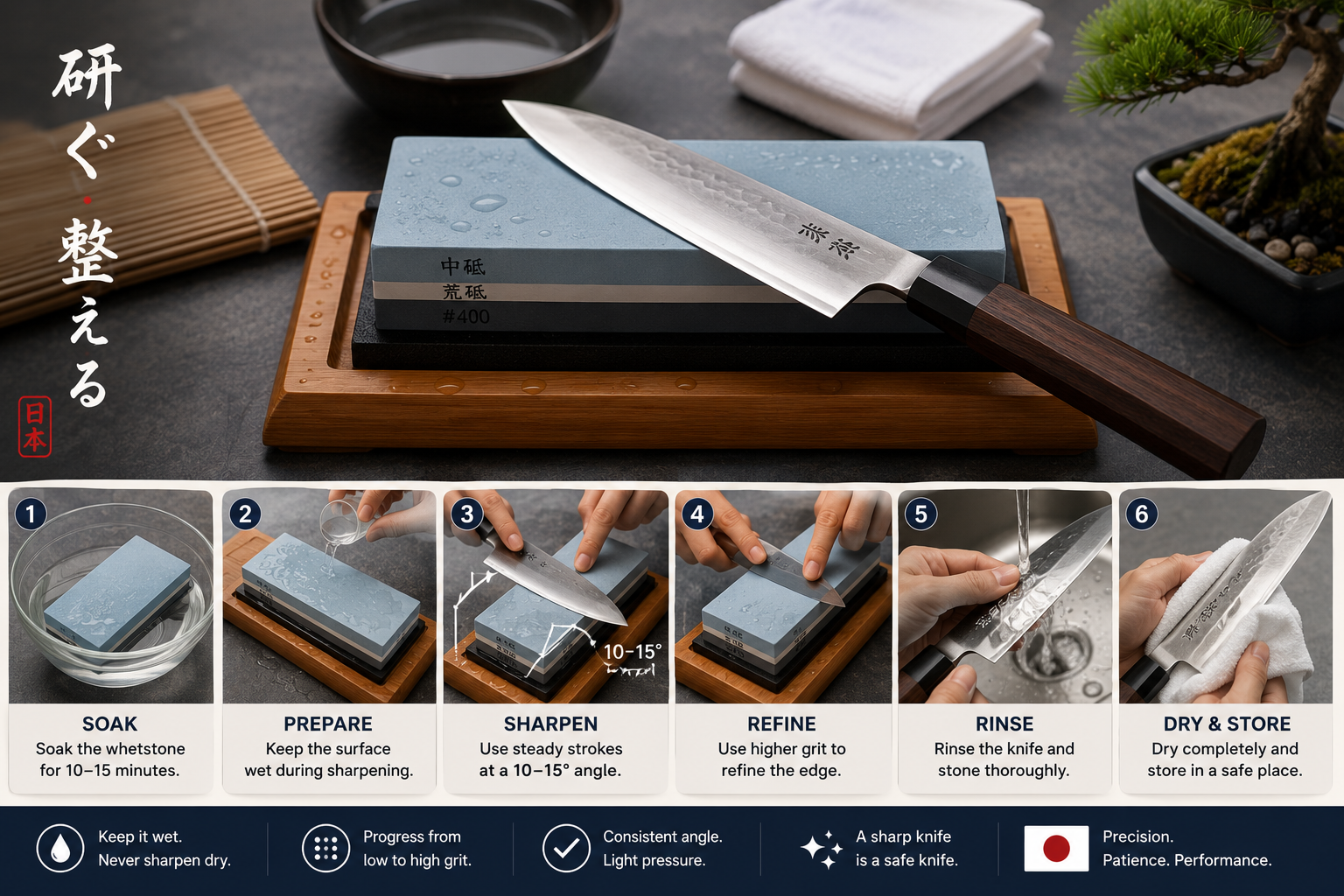
- Prepare the stone. Soak or splash it with water according to the manufacturer’s instructions. A dry stone will not cut properly and can damage the blade’s edge.
- Set the angle. Japanese single-bevel knives are typically sharpened on one side only, at a shallow angle; Western-style double-bevel knives are sharpened on both sides, usually around 15–20 degrees per side. Check the knife manufacturer’s recommendation if you’re unsure.
- Sharpen in one direction. Push the blade edge-first across the stone in smooth, consistent strokes, maintaining the same angle throughout. Avoid sawing back and forth at inconsistent angles.
- Check for a burr. After several strokes on one side, run a finger (carefully, away from the edge) along the opposite side to feel for a thin burr — this tells you that side has been fully sharpened.
- Repeat on the other side (for double-bevel knives) until a matching burr forms.
- Move to a finer grit if you’re using more than one stone, and repeat with lighter pressure to remove the burr and refine the edge.
- Rinse and dry the knife immediately after sharpening — do not let it air-dry, particularly with carbon-steel blades, which can rust quickly.
Flattening (Face Dressing) Your Stone
Whetstones wear unevenly with use, becoming dished in the centre. A stone that isn’t flat will sharpen inconsistently and can round over an edge instead of sharpening it evenly. Check flatness periodically with a straightedge, and flatten the stone using a dedicated flattening stone or flattening plate, rubbing in a figure-eight pattern under water until the surface is even again. How often this is needed depends on how often the stone is used — frequent users may flatten every few sharpening sessions.
Storage
- Allow the stone to dry fully before storing it — storing a wet stone in a closed container can promote mould growth on some stone types.
- Store away from freezing temperatures if the stone has absorbed water, since freezing can crack a saturated stone.
- Keep the stone in a stable, flat position rather than resting on an edge, to avoid chipping.
Safety Notes
- Always sharpen with the edge moving away from your fingers, and keep fingers clear of the stroke path.
- Use a stone holder or non-slip surface — a stone that shifts mid-stroke is a common cause of cuts.
- Keep the blade and stone wet throughout sharpening; a dry stone increases the chance of the blade skipping.
- Dry and put away knives immediately after sharpening rather than leaving them on a counter or in a sink.
What to Avoid
- Using a bone-dry stone: reduces cutting efficiency and can create uneven wear.
- Sharpening at an inconsistent angle: produces a rounded, less effective edge rather than a clean bevel.
- Skipping stone flattening entirely: a dished stone makes it difficult to sharpen the full length of the blade evenly.
- Using a single very coarse stone for routine touch-ups: removes more metal than necessary and shortens the knife’s usable life over time.
Frequently Asked Questions
How often should I sharpen my knife on a whetstone?
This depends entirely on use frequency and cutting surface — there’s no single correct interval. A common approach is to strop or lightly hone between uses and do a full whetstone sharpening only when the knife noticeably struggles to cut, rather than on a fixed schedule.
Do I need a coarse, medium, and fine stone, or can I use just one?
A single medium-grit (around #1000) stone, or a #1000/#6000 combination stone, is sufficient for routine kitchen knife maintenance. Coarse stones are only needed for repairing damage, and very fine finishing stones are optional beyond that point.
Can I use a Japanese whetstone on a Western (non-Japanese) knife?
Yes. Whetstones sharpen any steel blade; the main consideration is matching the sharpening angle to how that particular knife was originally ground, which varies by knife rather than by stone.
Summary
Most home cooks only need one well-chosen medium-grit stone and a consistent, careful technique — the stone type matters less than maintaining a steady angle and keeping the stone properly flattened over time.
If you don’t yet own a whetstone, see our guide to the Best Japanese Whetstones for specific product recommendations.
Last updated: June 2026
Official Sources
Note: King whetstones are manufactured by Matsunaga Stone Co., Ltd. (Osaka). We could not confirm a live official company website for Matsunaga Stone Co., Ltd. in this pass, so no link is included for King pending further verification.
Disclosure: As an Amazon Associate, Japanese Best earns from qualifying purchases. This does not affect our recommendations. We only feature products we genuinely believe are worth your consideration.
Editorial Disclaimer
This article does not constitute professional, financial, or purchasing advice of any kind.
Product availability, pricing, and specifications are subject to change without notice. Japanese Best makes no warranties — express or implied — regarding the accuracy or completeness of this content, and accepts no liability for any decisions made based on it. Always verify details directly with the retailer or manufacturer before purchasing.

コメント