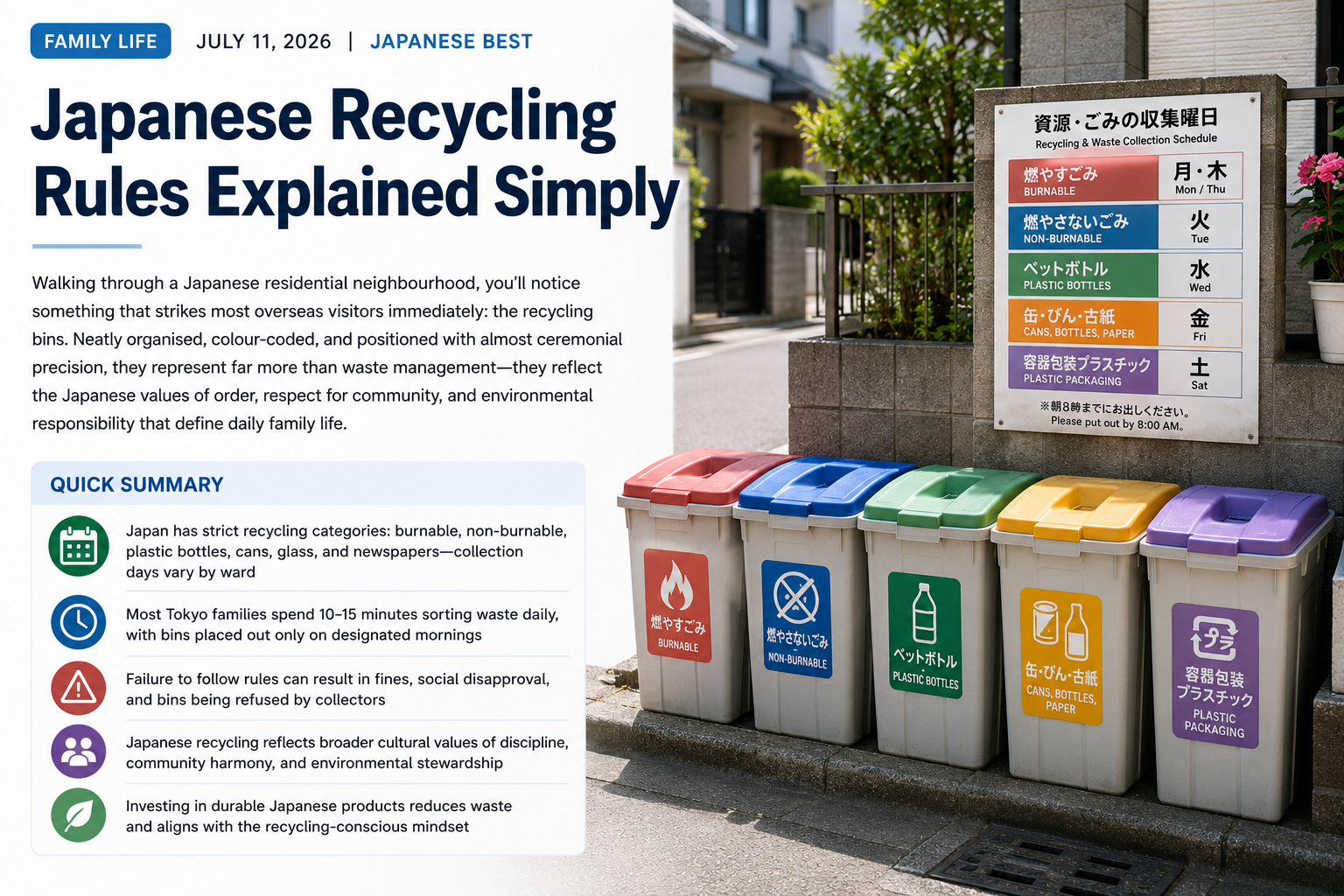
Japanese Garbage Sorting Guide for Beginners
July 11, 2026 | Family Life | Japanese Best
If you’ve ever lived in Japan or visited for more than a few days, you’ve probably noticed something striking: rubbish bins are almost nowhere to be found on the streets. Yet Japanese cities are famously clean. The secret isn’t magic—it’s meticulous garbage sorting. For overseas families moving to Japan or simply curious about how Japanese households actually function, understanding the rubbish system is one of the most practical and revealing glimpses into Japanese daily life. It’s a window into Japanese values around respect, community, and environmental responsibility. This guide will walk you through exactly how it works, so you’re never confused about what goes where.
Quick Summary
- Japan divides rubbish into 4–10 categories depending on your municipality (combustible, non-combustible, plastics, glass, metals, and more)
- Collection days are strict: missed your day, and your rubbish stays for another week—your neighbours will notice
- Labelling in Japanese is mandatory in most wards; English labels help but aren’t always accepted
- Tokyo’s system is typical but varies by ward; rural areas and Osaka have different rules
- Preparation matters: rinsing containers, removing labels, and flattening boxes are non-negotiable
🛒 Shop Recommended Products
The Basics: What Most Japanese Families Do
Japanese households typically sort rubbish into four main categories: moeru gomi (combustible waste—food scraps, paper, textiles), moenai gomi (non-combustible—ceramics, small appliances), purashikku (plastic packaging), and bin/kan (glass and metal cans). Many areas add a fifth category for PET bottles. Each category has its own collection day, and missing it means your rubbish sits at home for seven days until the next cycle.
Most Japanese families keep a small sorting station near the kitchen—usually a compact shelf or cabinet with labelled bags for each category. Labels are written in black marker on white tape, clearly visible. Preparation is essential: food containers must be rinsed (a sink habit that becomes automatic), plastic bags emptied of their contents, and cardboard boxes broken down flat. This isn’t just preference; it’s expected by your local ward office and your neighbours. The system reflects a broader cultural principle: mottainai (respect for resources) and consideration for the sanitation workers who collect and process the rubbish.
A Typical Week in a Japanese Home
Monday might be combustible day—food scraps, paper towels, soiled napkins all go out. By Wednesday, non-combustible day arrives, and ceramic dishes or broken kitchen items get collected. Friday is often plastic-packaging day. Saturday or Sunday brings glass and metal cans. A typical family of four generates roughly three or four bags per week across all categories, far less than many Western households, partly because Japanese packaging is often minimal and recyclable.
Living in Japan naturally trains you to think before you buy. You’ll notice yourself choosing products with less packaging, using fabric bags instead of plastic, and composting food scraps. Families often keep a small container for vegetable peelings and leftovers, which gets added to the combustible bin. If you forget what day is what, nearly every household posts a laminated collection calendar on their fridge, colour-coded by waste type. Digital reminder apps also exist—many ward offices send SMS alerts on collection mornings.
What This Looks Like in a Real Tokyo Home
Let’s step into a typical Minato Ward apartment in central Tokyo. The kitchen has three bags hanging from a compact stand: one marked moeru gomi (usually a light-blue or yellow designated bag), one for purashikku, and one for bin/kan. The family buys their official collection bags from the local convenience store (about ¥200 for a roll of 10), which is a quiet way local government funds waste management.
Every Tuesday morning, the family takes out their combustible bag at 8 a.m.—not earlier, as this invites crows and stray cats. By Friday, the plastic and recyclables are out. The apartment building has a designated collection point in the lobby, not scattered on the street. This is standard across Tokyo’s 23 wards, though Minato, Chiyoda, and Shibuya have slightly stricter rules than outer wards. For larger items—a broken bicycle, an old futon, furniture—residents must contact the ward’s 粗大ごみ (sodai gomi, bulky waste) office, pay a fee of ¥200–¥3,000 depending on size, and schedule a pickup.
Many Tokyo families keep a small notebook or use their smartphone to track what’s been collected, so nothing is forgotten. The consistency and predictability are almost meditative once you adjust to the routine.
How It Differs From Other Countries
Compared to most Western countries, Japanese sorting is far more granular. In the UK or US, households typically separate recyclables (mixed) from general waste. Japan treats glass, metal, plastic, and PET bottles as distinct categories, and non-combustible waste is separate from combustibles. Germany has a similar level of detail, but Japan’s system is stricter: mislabelling or putting items in the wrong category can result in your bag being left behind with a note, humiliating in a collectivist society.
Another key difference is no street bins. Western cities have public rubbish bins on high streets; Japanese cities don’t. This trains residents to carry rubbish home and sort it properly, rather than disposing casually. The system also assumes you’ll bring home your shopping in bags you’ve brought yourself—most Japanese shops charge ¥3–¥5 for plastic bags, or none exist at all. This cultural shift alone confuses many overseas visitors but becomes second nature quickly.
Composting is less common in Japanese homes than in parts of Europe, though food waste bins are increasingly available in urban areas. Most combustible waste, including food scraps, goes into the regular collection system.
FAQ
What happens if I put rubbish out on the wrong day?
Your bag will be left behind, usually with a note explaining the error. You’ll then need to dispose of it on the correct day, and your neighbours will have noticed—this is genuinely embarrassing in Japanese culture.
Do I need to write my name on my rubbish bag?
In most Tokyo wards, yes. It helps the ward track any sorting violations and links accountability to households.
Can I throw away large items with regular rubbish?
No. Items larger than about 30 cm must be registered as sodai gomi (bulky waste) and collected separately, usually for a fee.
What if I have a lot of cardboard boxes?
Break them down flat, tie them together with string, and put them out on the designated day. Never put them loose.
Are there rules about bag colour?
Yes—each ward specifies approved bag colours. Tokyo wards typically use light blue or yellow for combustibles, and clear bags for recyclables so officials can see the contents.
Living in Japan teaches you that rubbish sorting is more than environmental responsibility—it’s a form of respect. For your household, your building, your ward, and ultimately Japan itself. Once you’ve adjusted to the rhythm, it becomes automatic, and you’ll find yourself looking at your own country’s waste system with fresh eyes, appreciating how thoughtful design can shift behaviour without force.
Recommended Japanese Products
The products below are directly relevant to this article and used by Japanese families.
| Product | Brand | Best For | Link |
|---|---|---|---|
| Pilot FriXion Clicker 0.5mm | Pilot | Students, planners, and anyone who needs flexibility to correct mistakes | Pilot FriXion Clicker 0.5mm |
| Zebra Sarasa Clip 0.5mm | Zebra | Students and office workers who write quickly and need fast-drying ink | Zebra Sarasa Clip 0.5mm |
| Zojirushi SM-SHE60AG Stainless Mug | Zojirushi | Daily commuters who want reliable, durable coffee/tea on the go | Zojirushi SM-SHE60AG Stainless Mug |
Pilot FriXion Clicker 0.5mm
The world’s bestselling erasable pen — writes like a smooth gel but rubs out cleanly with heat.
Best for: Students, planners, and anyone who needs flexibility to correct mistakes
🛒 Pilot FriXion Clicker 0.5mm on Amazon
Zebra Sarasa Clip 0.5mm
Japan’s favourite everyday gel pen — fast-drying, smooth, and available in gorgeous colours.
Best for: Students and office workers who write quickly and need fast-drying ink
🛒 Zebra Sarasa Clip 0.5mm on Amazon
Zojirushi SM-SHE60AG Stainless Mug
Zojirushi’s most popular commuter mug — slim, spill-proof, and keeps drinks hot for 6 hours.
Best for: Daily commuters who want reliable, durable coffee/tea on the go
🛒 Zojirushi SM-SHE60AG Stainless Mug on Amazon
More From Japanese Best
- Cost of Living in Tokyo in 2025: A Real Breakdown
- What Japanese Families Eat Every Week
Disclosure: As an Amazon Associate, Japanese Best earns from qualifying purchases. This does not affect our recommendations. We only feature products we genuinely believe are worth your consideration.
Editorial Disclaimer
The views, opinions, and recommendations in this article are the author’s own and reflect personal experience living in Japan. They do not constitute professional, financial, or purchasing advice of any kind.
Product availability, pricing, and specifications are subject to change without notice. Japanese Best makes no warranties — express or implied — regarding the accuracy or completeness of this content, and accepts no liability for any decisions made based on it. Always verify details directly with the retailer or manufacturer before purchasing.

コメント