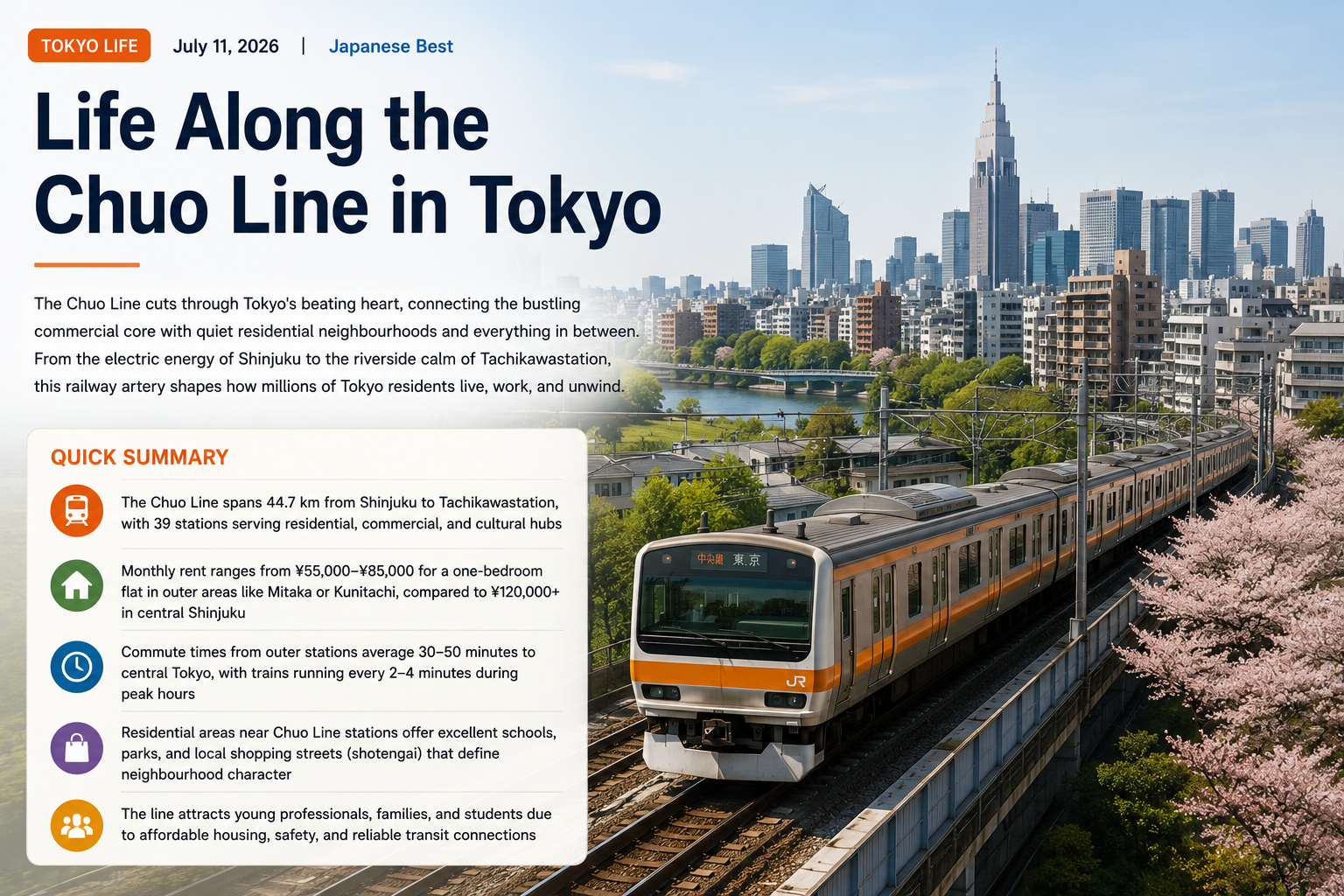
Life Along the Chuo Line in Tokyo
July 11, 2026 | Tokyo Life | Japanese Best
The Chuo Line cuts through Tokyo’s beating heart, connecting the bustling commercial core with quiet residential neighbourhoods and everything in between. From the electric energy of Shinjuku to the riverside calm of Tachikawastation, this railway artery shapes how millions of Tokyo residents live, work, and unwind. Living along the Chuo Line means embracing a uniquely Tokyo experience: predictable trains, affordable housing relative to other central areas, and access to some of the city’s most vibrant and authentic communities. Whether you’re a remote worker seeking affordable rent, a student hunting for student-friendly areas, or a visitor curious about how real Tokyoites spend their days, understanding life on the Chuo Line reveals the true rhythm of the capital.
Quick Summary
- The Chuo Line spans 44.7 km from Shinjuku to Tachikawastation, with 39 stations serving residential, commercial, and cultural hubs
- Monthly rent ranges from ¥55,000–¥85,000 for a one-bedroom flat in outer areas like Mitakaor Kunitachi, compared to ¥120,000+ in central Shinjuku
- Commute times from outer stations average 30–50 minutes to central Tokyo, with trains running every 2–4 minutes during peak hours
- Residential areas near Chuo Line stations offer excellent schools, parks, and local shopping streets (shotengai) that define neighbourhood character
- The line attracts young professionals, families, and students due to affordable housing, safety, and reliable transit connections
🛒 Shop Recommended Products
What You’ll Actually Find and Experience
The Chuo Line is Tokyo’s everyday backbone. Step onto a platform during rush hour—typically 7:30–9:30 am and 5:30–7:30 pm—and you’ll witness the organised chaos that defines the capital: salarymen in dark suits, schoolchildren in navy uniforms, and elderly residents with shopping bags boarding in seamless waves. The trains themselves are immaculate; graffiti is virtually non-existent, and staff bow as passengers exit.
Beyond the stations, neighbourhoods differ dramatically by distance from Shinjuku. Near Shinjuku itself, narrow izakayas (casual bars) and ramen shops pulse with after-work crowds. Move outward to areas like Nakano or Kichijoji, and you’ll find quirky vintage shops, independent cafés, and thriving creative communities. Further still—towards Musashi-Kosugi, Hachioji, or Tachikawastation—residential streets quieten, parks expand, and supermarkets anchor compact shopping centres. This variety means the Chuo Line isn’t just a transit route; it’s a cross-section of Tokyo life itself.
The Details: Prices, Hours, Practical Information
Fares on the Chuo Line range from ¥170 for a short hop to ¥460 for a maximum journey. A monthly unlimited travel pass (teikiken) costs ¥9,810, representing significant savings for daily commuters. Trains run from approximately 5:15 am to midnight, with frequency peaking at four trains per minute during commute hours.
Monthly rent varies sharply by distance and station prestige. A compact one-bedroom (1K or 1DK) in Kunitachi averages ¥60,000; in Mitaka, expect ¥70,000; but move closer to Shinjuku, and prices jump to ¥120,000 or more. Utility bills—gas, water, electricity—typically total ¥10,000–¥15,000 monthly. Convenience stores (konbini) operate 24/7 and sell affordable meals: a proper bento box costs ¥500–¥800. Ramen at a local shop runs ¥800–¥1,200. A coffee at a chain café, ¥400–¥600.
Most residential Chuo Line stations have supermarkets (often Aeon, Inageya, or Hanamaru) that close by 10 pm. Pharmacies cluster near stations. Mobile networks are universal; SIM-only plans from brands like IIJmio or Rakuten cost ¥2,000–¥3,500 monthly.
What Locals Think About It
Ask residents, and you’ll hear consistent themes. The Chuo Line is reliable—delays are rare, and when they occur, announcements are immediate and courteous. The trade-off? It gets crowded. During peak hours, trains reach crush capacity, and etiquette matters: stand on the left side of escalators in Tokyo, avoid phone calls, and never eat on the train unless eating a sold item from inside the station.
Longer-term residents appreciate the neighbourhoods’ gradual progression. Shinjuku residents love the energy but endure high costs and noise. Those in Nakano or Kichijoji celebrate the balance of accessibility and calm. Outer-area residents—particularly families—praise the space: parks like Musashi-Kosugi Park and the serene temple grounds at various shrines offer weekend retreats. Students favour areas like Kunitachi (Tokyo University of Agriculture) and Tachikawastation (surrounded by universities), where youth culture and affordability intersect.
The Line’s consistency breeds loyalty. Many Tokyoites spend years—even decades—in the same neighbourhood, developing deep ties with local shopkeepers and regular haunts.
Tips for Visitors and New Residents
For visitors: Buy a Suica or Pasmo card at any convenience store or station. Load it with ¥2,000–¥5,000 and tap at gates. You can use it on any Tokyo train, bus, or convenience store purchase, removing friction entirely. Download Google Maps or Hyperdia; both are essential for navigation.
For new residents: Arriving in summer? Prepare for humidity beyond most Western experiences; lightweight, breathable clothing is essential. Register at your local ward office (ku-yakusho) within 14 days of arrival—you’ll need a residence certificate for bank accounts and contracts. Join a local community group (machizukumi); many organise seasonal festivals and offer practical advice.
For daily commuting, invest in tools that make the journey easier. Many commuters rely on a Zojirushi SM-SHE60AG Stainless Mug by Zojirushi—a slim, spill-proof commuter mug that keeps tea or coffee hot for six hours, perfect for the packed morning trains. For work or study during commute time, a Pilot FriXion Clicker 0.5mm by Pilot transforms your notebook into a flexible planning tool; its erasable gel ink lets you adjust plans and notes without creating a mess. If you’re commuting with frequent distractions—or simply want peace during the journey—the Sony WH-1000XM5 by Sony offers industry-leading noise cancellation, allowing you to focus on work, podcasts, or simply rest amid the city’s constant motion.
Frequently Asked Questions
Is the Chuo Line safe? Absolutely. Tokyo is one of the world’s safest cities. The only real risks are pickpockets during peak hours—keep bags secure and avoid displaying expensive items.
Can I afford to live on a visa? Yes, if you’re willing to live in outer areas or share housing. A private room in a shared house (sharedapartment) in places like Hachioji might cost ¥40,000–¥50,000.
What’s the best station for expats? Shinjuku and Nakano attract international communities and have English-speaking establishments, but expect higher costs. Kunitachi and Tachikawaare more authentically local.
Do I need a car? No. Tokyo’s public transport is thorough; most residents avoid driving.
What should I know about noise? Outer residential areas are generally quiet. Shinjuku and entertainment districts remain lively until late, which some love and others resent.
Living along the Chuo Line is less about choosing one “best” neighbourhood and more about finding where you fit within Tokyo’s intricate tapestry. The Line’s geographic span mirrors the city’s social spectrum: from the neon-soaked ambition of central hubs to the tree-lined tranquility of suburban quietude. Newcomers often find their footing gradually, discovering that the rhythm of train arrivals, seasonal festivals, and familiar shopkeepers create a sense of belonging that rivals any other metropolis. Whether you’re riding for a weekend or settling for years, the Chuo Line tells the story of how Tokyo actually lives.
Recommended Japanese Products
The products below are directly relevant to this article and used by Japanese families.
| Product | Brand | Best For | Link |
|---|---|---|---|
| Zojirushi SM-SHE60AG Stainless Mug | Zojirushi | Daily commuters who want reliable, durable coffee/tea on the go | Zojirushi SM-SHE60AG Stainless Mug |
| Pilot FriXion Clicker 0.5mm | Pilot | Students, planners, and anyone who needs flexibility to correct mistakes | Pilot FriXion Clicker 0.5mm |
| Sony WH-1000XM5 | Sony | Frequent travellers, remote workers, and audiophiles who want the best ANC | Sony WH-1000XM5 |
Zojirushi SM-SHE60AG Stainless Mug
Zojirushi’s most popular commuter mug — slim, spill-proof, and keeps drinks hot for 6 hours.
Best for: Daily commuters who want reliable, durable coffee/tea on the go
🛒 Zojirushi SM-SHE60AG Stainless Mug on Amazon
Pilot FriXion Clicker 0.5mm
The world’s bestselling erasable pen — writes like a smooth gel but rubs out cleanly with heat.
Best for: Students, planners, and anyone who needs flexibility to correct mistakes
🛒 Pilot FriXion Clicker 0.5mm on Amazon
Sony WH-1000XM5
Sony’s flagship ANC headphones — industry-leading noise cancellation and exceptional sound.
Best for: Frequent travellers, remote workers, and audiophiles who want the best ANC
More From Japanese Best
- What Japanese Families Eat for Dinner
- What to Buy at Daiso: A Practical Guide
Disclosure: As an Amazon Associate, Japanese Best earns from qualifying purchases. This does not affect our recommendations. We only feature products we genuinely believe are worth your consideration.
Editorial Disclaimer
The views, opinions, and recommendations in this article are the author’s own and reflect personal experience living in Japan. They do not constitute professional, financial, or purchasing advice of any kind.
Product availability, pricing, and specifications are subject to change without notice. Japanese Best makes no warranties — express or implied — regarding the accuracy or completeness of this content, and accepts no liability for any decisions made based on it. Always verify details directly with the retailer or manufacturer before purchasing.
コメント