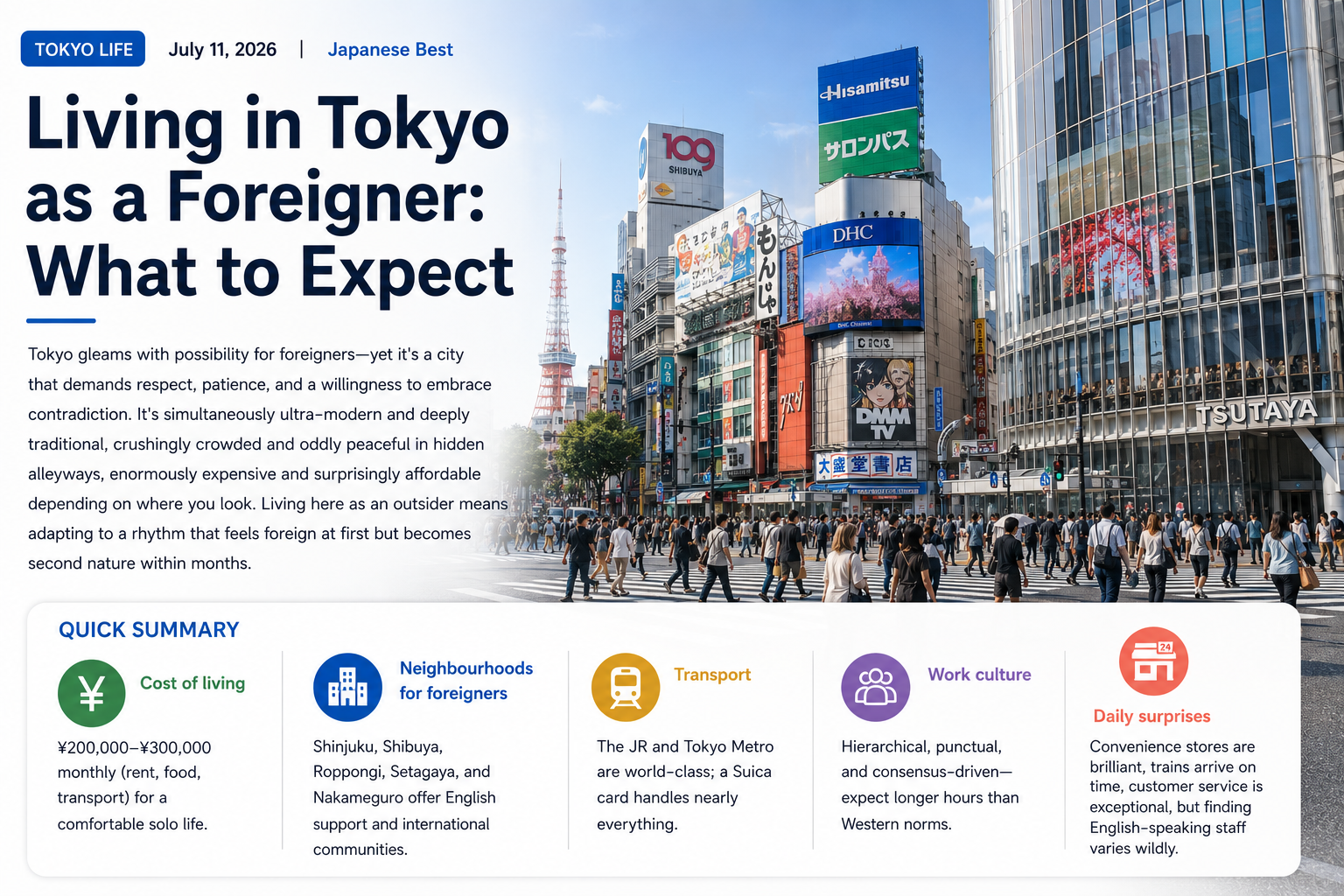
Living in Tokyo as a Foreigner: What to Expect
July 11, 2026 | Tokyo Life | Japanese Best
Tokyo gleams with possibility for foreigners—yet it’s a city that demands respect, patience, and a willingness to embrace contradiction. It’s simultaneously ultra-modern and deeply traditional, crushingly crowded and oddly peaceful in hidden alleyways, enormously expensive and surprisingly affordable depending on where you look. Living here as an outsider means adapting to a rhythm that feels foreign at first but becomes second nature within months.
Quick Summary
- Cost of living: ¥200,000–¥300,000 monthly (rent, food, transport) for a comfortable solo life
- Neighbourhoods for foreigners: Shinjuku, Shibuya, Roppongi, Setagaya, and Nakameguro offer English support and international communities
- Transport: The JR and Tokyo Metro are world-class; a Suica card handles nearly everything
- Work culture: Hierarchical, punctual, and consensus-driven—expect longer hours than Western norms
- Daily surprises: Convenience stores are brilliant, trains arrive on time, customer service is exceptional, but finding English-speaking staff varies wildly
🛒 Shop Recommended Products
What You’ll Actually Find and Experience
Tokyo’s reality diverges sharply from its tourist gloss. Yes, Shibuya Crossing is magnificent, but most of your time won’t be there. You’ll spend it on commuter trains packed during rush hour (7–9 a.m.), hunting for an apartment in concrete buildings with paper-thin walls, and discovering that many restaurants have no English menus.
The city operates on an unspoken social contract: follow the rules, respect personal space despite physical proximity, and maintain quiet dignity in public. Train etiquette is sacred—no phone calls, no loud conversations, no eating except designated areas. Violate these and you’ll feel the weight of disapproving silence.
Neighbourhoods each have distinct personalities. Shinjuku pulses with energy and neon; Shibuya attracts youth culture; Setagaya feels residential and calm; Harajuku celebrates quirky fashion. Choose your base carefully, because your neighbourhood will shape your Tokyo experience profoundly.
The Details: Prices, Hours, and Practical Information
Rent dominates your budget. A modest one-bedroom apartment in central wards (Minato, Shibuya) costs ¥120,000–¥180,000 monthly; outer wards like Nakano or Suginami run ¥60,000–¥90,000. Real estate agents require guarantor references, deposits, and advance rent payments—expect paperwork friction.
Groceries are surprisingly reasonable. Supermarkets like Aeon and local shotengai (shopping streets) offer competitive prices. A lunch set at a casual restaurant: ¥800–¥1,200. Coffee at a chain café: ¥400–¥600. Fine dining runs ¥5,000–¥15,000 per person.
Transport costs ¥2,000–¥3,000 monthly for unlimited travel within central zones via Suica card. The Tokyo Metro and JR lines are eerily punctual—average delays measured in seconds, not minutes.
Working hours typically span 9 a.m. to 6 p.m., with unpaid overtime common. Shops stay open later than Western equivalents; many convenience stores operate 24/7. Government offices close at 5 p.m. sharp.
When you’re commuting daily on Tokyo’s packed trains, a reliable, spill-proof mug becomes essential. The Zojirushi SM-SHE60AG Stainless Mug is the commuter’s gold standard—keeps your tea or coffee hot for six hours, fits snugly into bag side pockets, and won’t leak in a crowded carriage.
What Locals Think About It
Tokyo residents are simultaneously proud and exhausted. Many harbour ambivalent feelings about their own city—they love its efficiency, culture, and opportunities but resent its expense and relentless pace. Older generations often lament that Tokyo has lost its soul to corporate development; younger generations see it as the only place worth living in Japan.
Locals respect foreigners who make genuine effort with the language and customs. Broken Japanese and polite behaviour open doors; entitled attitudes close them instantly. The phrase “sumimasen” (excuse me / I’m sorry) becomes your most valuable tool.
Interestingly, Tokyo residents often envy foreign expatriates’ perspective—the ability to observe rather than be fully consumed by the treadmill. Many locals will ask you earnestly, “Do you really like living here?”
Tips for Visitors and New Residents
Learn basic Japanese phrases—not for fluency, but for respect. Convenience store staff appreciate a polite “arigatou gozaimasu.”
Get a Suica card immediately—it’s accepted on all trains, buses, and many shops. Contactless payment is ubiquitous; cash usage is declining.
Join online expat communities (Facebook groups, Reddit’s r/Tokyo) for flat-hunting advice, work recommendations, and social connection.
Embrace the seasons. Cherry blossoms (late March–early April) draw crowds; summer humidity is oppressive; autumn is golden; winter is dry and crisp.
Expect initial culture shock. Homesickness peaks around month two. By month four, Tokyo begins feeling normal. By month twelve, you’ll struggle to explain why you love it—you just do.
If you’re taking notes or planning your move, the Pilot FriXion Clicker 0.5mm is Tokyo’s unofficial pen of choice. It writes smoothly like premium gel ink but erases cleanly with heat—perfect for revising apartment checklists, job application plans, or language notes without messy corrections.
For those working remotely or travelling frequently between Tokyo and other cities, the Sony WH-1000XM5 headphones are indispensable. Tokyo’s noise environment—train rumble, construction, pachinko parlour cacophony—becomes manageable with industry-leading noise cancellation. The sound quality justifies the investment for anyone spending significant time in transit.
Frequently Asked Questions
Is Tokyo safe? Exceptionally. Violent crime is rare; petty theft uncommon. Women travel alone safely on trains and streets at any hour.
Can I live without speaking Japanese? Barely. You’ll survive in central business districts with English, but integration requires language effort.
What’s the visa situation? Tourist visas last 90 days. Working requires a sponsor (employer or visa agency). Rules change annually—consult official immigration resources.
Is Tokyo lonely? Initially, yes. But the expat community is substantial, and Tokyo’s density means social opportunities abound if you’re proactive.
Should I own a car? Almost never. Public transport is superior, parking costs ¥30,000+ monthly, and congestion makes driving miserable.
Recommended Japanese Products
The products below are directly relevant to this article and used by Japanese families.
| Product | Brand | Best For | Link |
|---|---|---|---|
| Zojirushi SM-SHE60AG Stainless Mug | Zojirushi | Daily commuters who want reliable, durable coffee/tea on the go | Zojirushi SM-SHE60AG Stainless Mug |
| Pilot FriXion Clicker 0.5mm | Pilot | Students, planners, and anyone who needs flexibility to correct mistakes | Pilot FriXion Clicker 0.5mm |
| Sony WH-1000XM5 | Sony | Frequent travellers, remote workers, and audiophiles who want the best ANC | Sony WH-1000XM5 |
Zojirushi SM-SHE60AG Stainless Mug
Zojirushi’s most popular commuter mug — slim, spill-proof, and keeps drinks hot for 6 hours.
Best for: Daily commuters who want reliable, durable coffee/tea on the go
🛒 Zojirushi SM-SHE60AG Stainless Mug on Amazon
Pilot FriXion Clicker 0.5mm
The world’s bestselling erasable pen — writes like a smooth gel but rubs out cleanly with heat.
Best for: Students, planners, and anyone who needs flexibility to correct mistakes
🛒 Pilot FriXion Clicker 0.5mm on Amazon
Sony WH-1000XM5
Sony’s flagship ANC headphones — industry-leading noise cancellation and exceptional sound.
Best for: Frequent travellers, remote workers, and audiophiles who want the best ANC
More From Japanese Best
- What Japanese Families Eat for Dinner
- What to Buy at Daiso: A Practical Guide
Disclosure: As an Amazon Associate, Japanese Best earns from qualifying purchases. This does not affect our recommendations. We only feature products we genuinely believe are worth your consideration.
Editorial Disclaimer
The views, opinions, and recommendations in this article are the author’s own and reflect personal experience living in Japan. They do not constitute professional, financial, or purchasing advice of any kind.
Product availability, pricing, and specifications are subject to change without notice. Japanese Best makes no warranties — express or implied — regarding the accuracy or completeness of this content, and accepts no liability for any decisions made based on it. Always verify details directly with the retailer or manufacturer before purchasing.
コメント