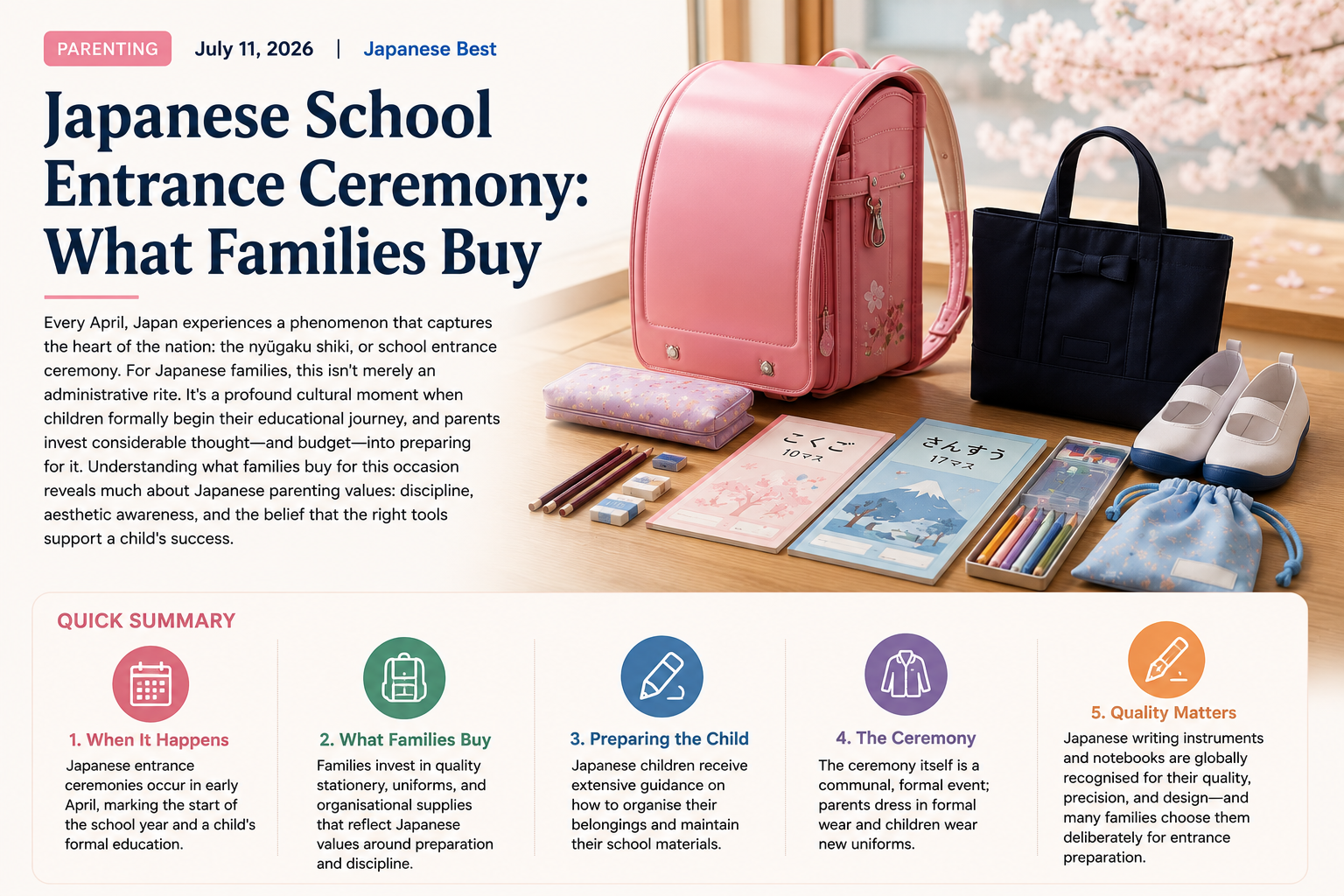
Japanese School Entrance Ceremony: What Families Buy
July 11, 2026 | Parenting | Japanese Best
Every April, Japan experiences a phenomenon that captures the heart of the nation: the nyūgaku shiki, or school entrance ceremony. For Japanese families, this isn’t merely an administrative rite. It’s a profound cultural moment when children formally begin their educational journey, and parents invest considerable thought—and budget—into preparing for it. Understanding what families buy for this occasion reveals much about Japanese parenting values: discipline, aesthetic awareness, and the belief that the right tools support a child’s success.
Quick Summary
- Japanese entrance ceremonies occur in early April, marking the start of the school year and a child’s formal education
- Families invest in quality stationery, uniforms, and organisational supplies that reflect Japanese values around preparation and discipline
- Japanese children receive extensive guidance on how to organise their belongings and maintain their school materials
- The ceremony itself is a communal, formal event; parents dress in formal wear and children wear new uniforms
- Japanese writing instruments and notebooks are globally recognised for their quality, precision, and design—and many families choose them deliberately for entrance preparation
🛒 Shop Recommended Products
How Japanese Parents Approach This
Japanese parents view school entrance as a watershed moment requiring intentional preparation. Unlike many Western cultures that may see it as a natural transition, Japanese families treat the nyūgaku shiki with ceremonial weight. Mothers and fathers spend weeks selecting uniforms, shoes, socks, and school bags that meet exact specifications provided by the school. This isn’t excessive—it’s a reflection of omotenashi (considerate service) and respect for institutional belonging.
The financial investment is substantial. A complete school uniform package in Tokyo can cost ¥15,000–¥30,000, and stationery kits often add another ¥5,000–¥10,000. Parents also invest in named labels, desk organizers, and writing implements. This preparation serves a psychological purpose: it signals to the child that this transition matters, and that care taken in small details reflects care for one’s education. Japanese parents often accompany these purchases with gentle instruction on responsibility and respect for belongings.
What Japanese Kids Experience
For Japanese children, the entrance ceremony is both thrilling and daunting. Many arrive at school for the first time wearing their pristine new uniform—often navy or grey—and carrying a structured school bag (randoseru). The ceremony itself, held in the school gymnasium or hall, is formal and moving. Children sit with their new classmates, parents watch from the rear, and the headmaster welcomes them with speeches about growth and community.
What distinguishes the Japanese approach is what follows. Children receive explicit instruction on how to organise their desk, where to store their belongings, and why this matters. Teachers demonstrate the correct way to hold a pencil, position a notebook, and arrange writing implements in order of use. This isn’t seen as micromanagement; it’s foundational education. Children learn that precision and order support learning. By the end of the first week, most children have internalised these systems and can manage their materials independently.
At School vs At Home
At school, children’s stationery and supplies follow strict guidelines. Most Japanese schools provide a list specifying pen type, notebook size, and even eraser brand. Homes, however, offer flexibility. Many families maintain a “study corner” with a small desk, a desk light, and a curated selection of supplies. Parents often choose premium stationery for home use—not to show off, but because quality tools encourage consistent practice.
The contrast is intentional. School demands uniformity and structure; home encourages personalisation within boundaries. A child might use a standard blue ballpoint pen at school but have access to coloured pens and a premium notebook at home for creative writing or sketching. This dual approach teaches contextual awareness: different environments have different norms, and adapting to them is a sign of maturity, not constraint.
Real-Life Examples from Tokyo
In central Tokyo, the entrance season transforms stationery shops. Akihabara’s electronics district and the Ginza Stationery Centre overflow with parents and grandparents selecting supplies. One typical Tokyo family, the Yamaguchis, spent ¥45,000 total: ¥20,000 on the uniform, ¥12,000 on a structured bag, ¥8,000 on stationery, and ¥5,000 on accessories like name labels and a desk organizer.
Their daughter’s stationery selection included a set of pencils, erasers, and rulers, plus a ruled notebook for daily lessons. For the home study space, they chose a premium writing instrument—a smooth, reliable pen that would encourage daily practice. The Yamaguchis’ approach is typical: they balance institutional requirements with personal investment in tools that signal, to their daughter, that learning is valued and worthy of quality resources.
How This Compares to Western Parenting
Western parents often approach school entrance more pragmatically. A backpack, some basic pens, and a notebook may suffice. Japanese parents, by contrast, invest in systems. This reflects deeper cultural differences. In Japan, entrance to school is conceptualised as entry into a social organism; one must be equipped not just academically but socially and practically. The ritual of purchase and preparation is itself an educational act—it teaches patience, attention to detail, and respect for institutional life.
Additionally, Western cultures often celebrate individualism in school supplies; children may choose cartoon characters or bright colours. Japanese schools typically encourage restraint and uniformity. This isn’t repressive; it’s understood as fostering group harmony and reducing socioeconomic visibility. A child from a wealthy family uses the same basic supplies as one from a modest background, fostering equality.
Recommended Writing Instruments and Notebooks
When selecting supplies for entrance preparation, Japanese families prioritise quality and reliability. The Pilot FriXion Clicker 0.5mm is particularly popular among parents preparing children for school. This erasable gel pen writes smoothly like premium stationery but allows mistakes to be rubbed out cleanly with gentle heat, making it ideal for children still developing writing confidence. It’s precision-engineered and reliable—exactly what Japanese parents seek.
For everyday note-taking and homework, many families choose the Zebra Sarasa Clip 0.5mm. This is Japan’s bestselling everyday gel pen, favoured for its fast-drying ink and smooth writing. Children benefit from the quick-drying formula, which prevents smudging, and the ergonomic clip. It’s available in multiple colours, allowing for colour-coding systems that Japanese teachers often recommend.
For notebooks, the MUJI A5 Kraft Notebook (6mm ruled) represents minimalist Japanese design at its finest. The cream paper reduces eye strain, the subtle 6mm ruling provides structure without visual clutter, and the kraft cover is durable. Many Japanese parents select this for home study journals, allowing children to practise daily writing in a calming, distraction-free format. MUJI’s philosophy of “no unnecessary design” aligns perfectly with Japanese educational values.
FAQ
Q: Do all Japanese schools require uniforms?
A: Most public primary schools do not; uniforms become standard in middle school. However, many private schools and urban institutions require them from reception onwards.
Q: How much should a family budget for entrance preparation?
A: Budget ¥30,000–¥50,000 (approximately £150–£250) for a complete setup, including uniform, bag, stationery, and accessories.
Q: Are entrance ceremonies mandatory for parents?
A: Yes, parental attendance is expected. It’s considered a sign of respect for the institution and support for one’s child.
Q: What’s the significance of the April timing?
A: Japan’s fiscal and school year both begin in April. It aligns with the traditional Japanese calendar marker and ensures all children enter school simultaneously.
The Japanese school entrance ceremony is far more than a bureaucratic process—it’s a carefully choreographed introduction to institutional life, where preparation, quality, and intention converge. Families who invest thoughtfully in stationery and supplies aren’t being excessive; they’re participating in a time-honoured cultural practice that signals to their children: your education matters, and we’ve prepared with care.
Recommended Japanese Products
The products below are directly relevant to this article and used by Japanese families.
| Product | Brand | Best For | Link |
|---|---|---|---|
| Pilot FriXion Clicker 0.5mm | Pilot | Students, planners, and anyone who needs flexibility to correct mistakes | Pilot FriXion Clicker 0.5mm |
| Zebra Sarasa Clip 0.5mm | Zebra | Students and office workers who write quickly and need fast-drying ink | Zebra Sarasa Clip 0.5mm |
| MUJI A5 Kraft Notebook (6mm ruled) | MUJI | Minimalists, daily journal writers, and people who dislike visual clutter | MUJI A5 Kraft Notebook (6mm ruled) |
Pilot FriXion Clicker 0.5mm
The world’s bestselling erasable pen — writes like a smooth gel but rubs out cleanly with heat.
Best for: Students, planners, and anyone who needs flexibility to correct mistakes
🛒 Pilot FriXion Clicker 0.5mm on Amazon
Zebra Sarasa Clip 0.5mm
Japan’s favourite everyday gel pen — fast-drying, smooth, and available in gorgeous colours.
Best for: Students and office workers who write quickly and need fast-drying ink
🛒 Zebra Sarasa Clip 0.5mm on Amazon
MUJI A5 Kraft Notebook (6mm ruled)
Minimal, functional, and beloved — MUJI’s cream-paper notebook is a Japanese everyday essential.
Best for: Minimalists, daily journal writers, and people who dislike visual clutter
🛒 MUJI A5 Kraft Notebook (6mm ruled) on Amazon
More From Japanese Best
- What Japanese Families Eat for Dinner
- What to Buy at Daiso: A Practical Guide
Disclosure: As an Amazon Associate, Japanese Best earns from qualifying purchases. This does not affect our recommendations. We only feature products we genuinely believe are worth your consideration.
Editorial Disclaimer
The views, opinions, and recommendations in this article are the author’s own and reflect personal experience living in Japan. They do not constitute professional, financial, or purchasing advice of any kind.
Product availability, pricing, and specifications are subject to change without notice. Japanese Best makes no warranties — express or implied — regarding the accuracy or completeness of this content, and accepts no liability for any decisions made based on it. Always verify details directly with the retailer or manufacturer before purchasing.
コメント