Japanese Elementary School Sports Day Guide (2026)
June 28, 2026 | Parenting | Japanese Best
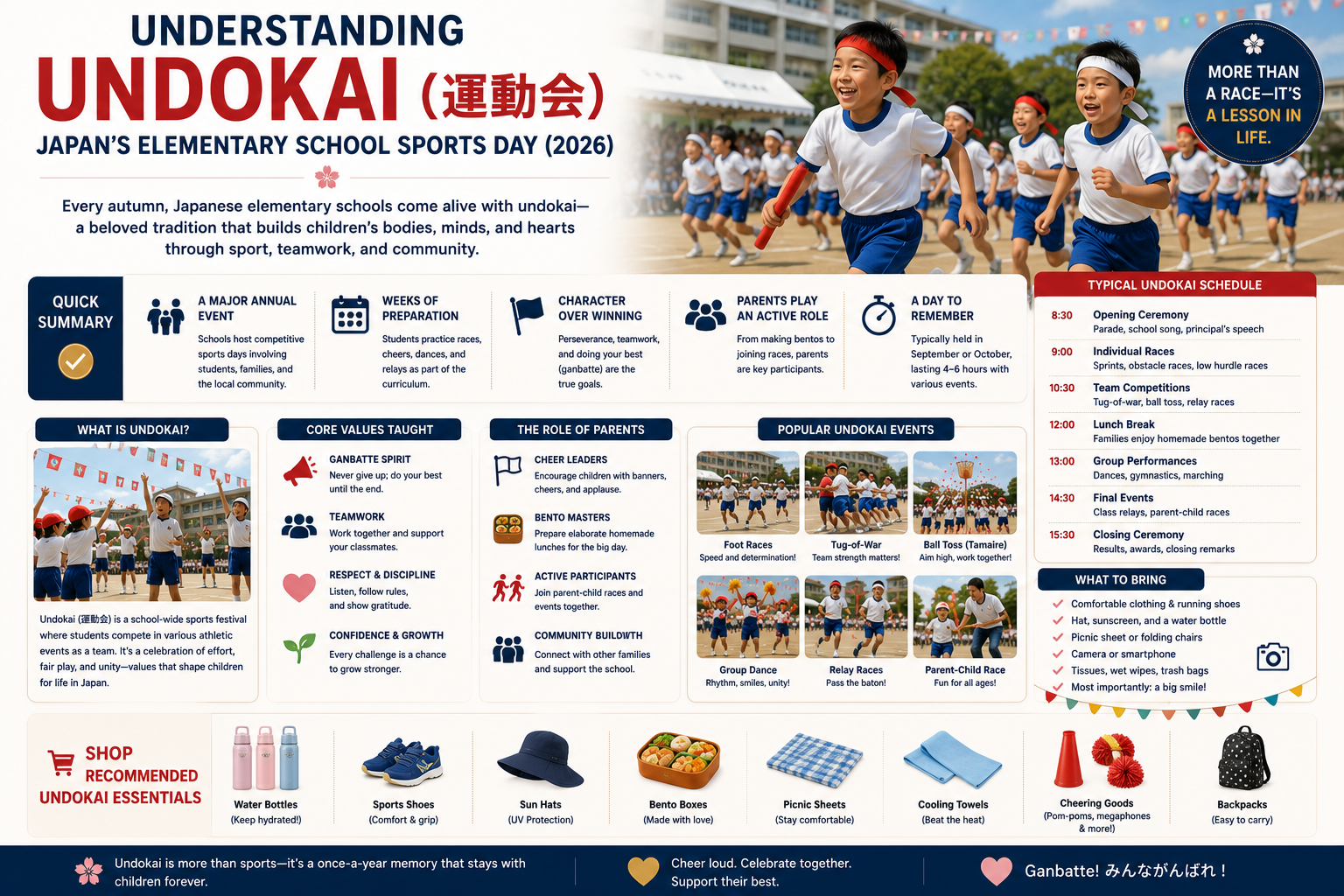
Every autumn, Japanese elementary schools transform their playgrounds into stages of friendly competition. Parents line the sidelines with handmade banners, children dress in house colours, and the entire community gathers for undokai (運動会)—the legendary sports day. Unlike the casual school sports days you might remember, undokai is a deeply significant event in Japanese childhood, blending athletic competition with character building, teamwork, and cultural ritual. If you’re raising children in Japan or simply curious about how Japanese schools approach physical education and community, understanding undokai reveals much about Japanese parenting philosophy.
Quick Summary
- Undokai is a major annual event where elementary schools host competitive sports days involving entire families and the local community
- Preparation spans weeks, with students learning cheers, choreography, and relay techniques as part of the curriculum
- Character development matters more than winning—perseverance, teamwork, and doing your best (ganbatte) are the core values
- Parents play an active role, preparing elaborate bentos, attending rehearsals, and participating in parent-child races
- The event typically happens in September or October and lasts 4–6 hours, with races, relays, dances, and group performances
🛒 Shop Recommended Products
How Japanese Parents Approach Undokai
Japanese parents treat undokai as far more than a school event—it’s a family obligation and a window into their child’s growth. Weeks beforehand, mothers begin planning nutritious yet visually appealing bentos, ensuring their child has energy throughout the day. Many parents request time off work, as attendance is considered essential. Fathers often volunteer to help set up equipment or mark out running lanes.
The philosophy centres on ganbatte (頑張って)—doing your absolute best, regardless of outcome. Parents rarely emphasise winning; instead, they praise effort, courage, and improvement. If a child comes last in a race but tried hard, that’s celebrated. This reflects broader Japanese parenting culture, where resilience and persistence trump individual achievement. For more background, see Wikipedia’s entry on undokai. Parents also understand that undokai teaches children how to function within a group—a value deeply rooted in Japanese society. Attending means showing solidarity with the school community, not simply cheering for your own child.
What Japanese Kids Experience
Children begin preparing for undokai months in advance. PE lessons shift focus entirely to undokai training: students learn relay baton passes, synchronise group dances, memorise chants, and practise formations. For many children, this is their first real taste of sustained teamwork with real stakes. They’re divided into coloured house groups (typically red and white, or four houses), and inter-house rivalry builds genuine excitement.
The experience is intensely social. Older students mentor younger ones, reinforcing hierarchy and responsibility. Children who struggle with running still participate—there are “fun races” designed so everyone crosses a finish line. This inclusion philosophy ensures no child feels excluded or humiliated. On the day itself, children march onto the playground in uniform, stand for opening ceremonies featuring the national anthem and school pledge, then compete in events ranging from short-distance races to elaborate choreographed dances. Watching your classmates excel or struggle creates lasting memories. Many Japanese adults recall their undokai experiences decades later, underscoring the event’s cultural weight.
At School vs At Home
At school, undokai preparation is mandatory curriculum. Teachers incorporate it into PE, music (for cheers and dances), and even art (designing house banners). The entire school day revolves around it for weeks. This isn’t extracurricular—it’s considered as important as maths or literacy. Teachers observe which children show leadership, struggle with coordination, or need emotional support, using these insights for parent-teacher conferences.
At home, parents create supporting rituals. Children wear their house colour proudly, practise their race techniques in the park, and talk endlessly about undokai. Mothers might sew custom wristbands or prepare special snacks. The night before, families have early dinners and ensure good sleep. Morning routines shift: children wear their school undokai uniform, and parents pack elaborate multi-tiered bentos featuring rice shaped like flowers, perfectly arranged vegetables, and protein. These aren’t expensive or complicated—they reflect care and attention. Many mothers use erasable pens like the Pilot FriXion Clicker to label food portions or create checklists, allowing for flexible planning as details change.
Real-Life Examples from Tokyo
In central Tokyo, Minato-ku’s Azabu Elementary hosts undokai in late September, drawing over 500 families to a local sports ground. The event runs 8:30 AM to noon, with opening ceremonies featuring all 600 students marching in perfect formation. Races include traditional sprints, three-legged races with parents, and an entire segment where mothers compete (often hilariously, in office clothes). The climax is the relay race—the year’s most anticipated event, where house pride reaches fever pitch. Families book picnic spots days in advance, and the local convenience store runs out of bentos by 9 AM.
In Shibuya, another school incorporates traditional Japanese elements: children perform taiko (drum) routines, and the final event is a tug-of-war using a rope spanning the entire field. Parents and grandparents watch from bleachers, recording videos for relatives abroad. The school typically provides water stations but families bring their own drinks—many use insulated Zojirushi lunch jars to keep beverages cool. Afterwards, families picnic together, and children receive participation medals regardless of placement.
How This Compares to Western Parenting
Western sports days often emphasise individual achievement and competitive ranking. Parents typically drop children off, attend briefly if at all, and focus on their own child’s performance. Undokai inverts this: the event exists to build community and teach belonging. Individual medals matter far less than house pride.
Western schools might hold sports days annually but with less curricular integration. Undokai, by contrast, is woven into teaching—PE classes explicitly train for it, and teachers assess character development through participation. Western parents rarely wear house colours or prepare elaborate bentos; Japanese parents see these acts as expressions of commitment to their child’s experience.
The language differs too. A Western child might ask, “Did I win?” A Japanese child asks, “Did our house do well?” and “Did I ganbatte?” This reflects collectivist versus individualist values. Neither approach is superior—they simply reflect cultural priorities.
FAQ
When does undokai happen?
Usually September or October, scheduled around weather. Schools announce dates weeks in advance.
Do foreign families need to attend?
Attendance is expected. However, international schools in Japan often modify the format to suit their communities.
What if my child doesn’t like sports?
Undokai includes non-competitive events like cheers, dances, and fun races designed for all abilities. Teachers support anxious children individually.
Can parents bring cameras?
Yes, though schools sometimes restrict video recording during certain events to protect privacy.
How much does it cost?
Nothing—it’s a school event. Parents voluntarily contribute time and homemade food.
What should children wear?
School-issued undokai uniforms (typically house-coloured bibs over PE kit). Schools provide these or specify what to wear.
Undokai captures something essential about Japanese education: the belief that school is about growing capable, resilient, community-minded people, not just acquiring knowledge. For parents raising children in Japan, attending and supporting undokai isn’t optional—it’s how you demonstrate investment in your child’s social and emotional development. For those observing from abroad, it offers a window into why Japanese society values harmony, persistence, and collective effort so deeply.
Seen in Everyday Life in Tokyo
A Real-Life Note from Japan
What I Often See in Japanese Stores
Related Japanese Products
The products below came up naturally in the context of this article. We only recommend items that genuinely connect to the topic.
| Product | Brand | Best For | Amazon |
|---|---|---|---|
| Pilot FriXion Clicker 0.5mm | Pilot | Students, planners, and anyone who needs flexibility to correct mistakes | Search on Amazon |
| Zebra Sarasa Clip 0.5mm | Zebra | Students and office workers who write quickly and need fast-drying ink | Search on Amazon |
| Zojirushi Stainless Lunch Jar (Bento Box) | Zojirushi | Office workers and students who want hot lunches without needing a microwave | Search on Amazon |
Pilot FriXion Clicker 0.5mm
The world’s bestselling erasable pen — writes like a smooth gel but rubs out cleanly with heat.
Best for: Students, planners, and anyone who needs flexibility to correct mistakes
Zebra Sarasa Clip 0.5mm
Japan’s favourite everyday gel pen — fast-drying, smooth, and available in gorgeous colours.
Best for: Students and office workers who write quickly and need fast-drying ink
Zojirushi Stainless Lunch Jar (Bento Box)
Japan’s most reliable insulated bento jar — keeps lunch hot for hours without a microwave.
Best for: Office workers and students who want hot lunches without needing a microwave
More From Japanese Best
Disclosure: As an Amazon Associate, Japanese Best earns from qualifying purchases. This does not affect our recommendations. We only feature products we genuinely believe are worth your consideration.
Editorial Disclaimer
The views, opinions, and recommendations in this article are the author’s own and reflect personal experience living in Japan. They do not constitute professional, financial, or purchasing advice of any kind.
Product availability, pricing, and specifications are subject to change without notice. Japanese Best makes no warranties — express or implied — regarding the accuracy or completeness of this content, and accepts no liability for any decisions made based on it. Always verify details directly with the retailer or manufacturer before purchasing.


コメント