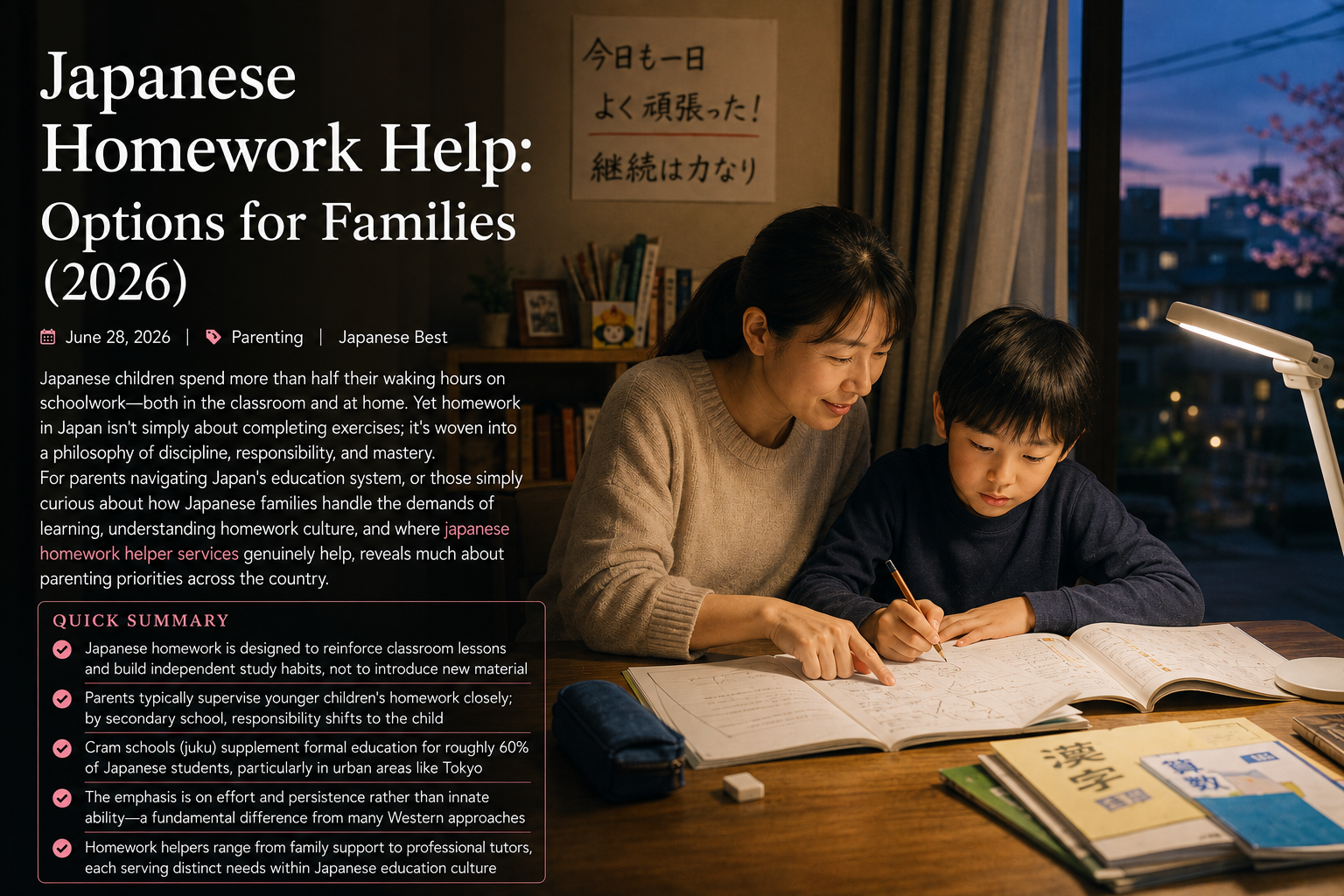
Japanese Homework Help: Options for Families (2026)
June 28, 2026 | Parenting | Japanese Best
Japanese children spend more than half their waking hours on schoolwork—both in the classroom and at home. Yet homework in Japan isn’t simply about completing exercises; it’s woven into a philosophy of discipline, responsibility, and mastery. For parents navigating Japan’s education system, or those simply curious about how Japanese families handle the demands of learning, understanding homework culture, and where japanese homework helper services genuinely help, reveals much about parenting priorities across the country.
Quick Summary
- Japanese homework is designed to reinforce classroom lessons and build independent study habits, not to introduce new material
- Parents typically supervise younger children’s homework closely; by secondary school, responsibility shifts to the child
- Cram schools (juku) supplement formal education for roughly 60% of Japanese students, particularly in urban areas like Tokyo
- The emphasis is on effort and persistence rather than innate ability—a fundamental difference from many Western approaches
- Homework helpers range from family support to professional tutors, each serving distinct needs within Japanese education culture
How Japanese Parents Approach This
Japanese parents view homework as a shared responsibility between school and home, but with clear boundaries. The expectation isn’t that parents solve problems for their children; rather, they create conditions for success—a quiet workspace, consistent routine, and encouragement to persist through difficulty.
In households across Japan, homework time typically follows a predictable pattern. After school, children have a snack, play briefly, then settle into their studies between 3:00 and 5:00 p.m. Parents don’t hover constantly, but they’re present—nearby, available for clarification, watching for signs of struggle. This reflects the cultural value of gaman, the ability to endure difficulty with patience and grace.
For younger primary school children (ages 6–9), parental involvement is more hands-on. Parents check completed work, verify that answers make sense, and sometimes sit alongside their child. By middle school (ages 12–15), the dynamic shifts. Japanese parents deliberately step back, believing their teenager must develop autonomy. This isn’t neglect; it’s intentional trust-building. Parents still monitor progress, but the child owns their learning.
What Japanese Kids Experience
Japanese students face a different homework landscape than many international peers. The workload isn’t necessarily heavier in raw hours—studies suggest Japanese primary students complete 1–2 hours daily—but the purpose differs. Homework reinforces what teachers have already taught, building automaticity and deep understanding rather than introducing new concepts.
Children experience homework as non-negotiable. It’s not framed as optional enrichment; it’s part of the school contract. Teachers assign work thoughtfully, and families complete it consistently. Missing homework carries social and academic consequences, so completion becomes a given.
The psychological experience is often one of quiet perseverance. Japanese classrooms emphasise that mistakes are learning opportunities, not failures. A child who struggles with a maths problem isn’t “bad at maths”—they simply haven’t mastered it yet. This subtle language difference, repeated daily, shapes how students approach difficulty. Rather than avoiding challenge, many Japanese children develop genuine comfort with sustained effort.
Homework also connects to broader cultural practices. Tidying one’s desk, arranging materials neatly, and keeping a well-organised notebook aren’t peripheral skills—they’re part of the academic discipline itself. The process matters as much as the product.
At School vs At Home
Japanese teachers design homework with full knowledge of home support levels. They assume children have space to work and a parent or guardian who can provide basic supervision. This assumption shapes what gets assigned.
In-class time focuses on teaching method and understanding. The teacher might spend 40 minutes explaining long division, checking for comprehension through questioning, and working through several examples together. Homework then becomes practice—10–15 problems using the method already taught. The child isn’t discovering concepts at home; they’re consolidating them.
At home, the child’s job is clear: complete the assigned work independently, using notes and textbooks if needed. Parents verify completion and check for obvious errors, but they don’t re-teach concepts. If a child struggles significantly, the conversation often leads to recommendations for juku (cram school) rather than additional parental tutoring.
This division of labour is deliberate. Teachers feel confident assigning work because they know Japanese families will ensure completion. Parents feel confident their child is learning because teachers assign work purposefully. The system depends on mutual trust and clearly understood roles.
Real-Life Examples from Tokyo
In central Tokyo, homework culture takes specific forms. A Year 3 student (age 8) at a public school in Minato ward typically receives 30–60 minutes of homework daily—arithmetic practice, hiragana and kanji writing, and reading comprehension. The child works at the dining table whilst a parent prepares dinner nearby, available for clarification but not intervention.
By Year 7 (age 12), the same student might spend 90 minutes on homework across five subjects. A parent might glance at completed work, but the teenager increasingly manages their own schedule. Many Tokyo families now use juku as well—with roughly 70% of secondary students attending cram schools in the city. These aren’t remedial; they’re supplementary, offering exam preparation and enrichment.
In areas outside Tokyo, homework loads often remain lighter and juku attendance lower, reflecting both school philosophy and family finances — worth knowing before comparing japanese homework helper services across regions. Rural prefectures like Shimane see less emphasis on competitive entrance exams, resulting in calmer homework routines.
How This Compares to Western Parenting
The contrast with Western education systems is stark. In the UK and USA, homework often introduces new material, sometimes before classroom instruction. Parents frequently help with content, problem-solving, and research. There’s broader acceptance of homework being “optional” or adjusted based on family circumstances.
Japanese homework is standardised. Every child receives similar assignments. Parents might support, but they don’t personalise or reduce expectations based on perceived ability. This reflects a cultural belief that all children can succeed through effort—a profound difference from ability-based grouping common in Western schools.
Western parents often feel pressure to augment education with tutoring and enrichment activities. Japanese families view homework and juku differently: homework is non-negotiable duty; juku is strategic investment for competitive exams, not remedial support.
The pace differs too. Japanese students move through curriculum more slowly, building deeper mastery. Western students often cover more ground more quickly, sometimes at the expense of automaticity.
FAQ
Do Japanese kids really have no homework sometimes?
No. Homework is consistent and expected daily, even during holidays in some schools.
What if a child refuses to do homework?
It’s rare, but serious. Teachers and parents address it together as a responsibility issue, not a preference.
Are Japanese parents strict about homework?
They’re consistent rather than harsh. The tone is supportive persistence, not punishment.
What’s the difference between homework and juku?
Homework reinforces taught material; juku provides exam prep and enrichment beyond the school curriculum.
Understanding Japanese homework culture reveals a parenting philosophy built on consistency, trust, and belief in effort’s transformative power. For families navigating Japan’s education system, this perspective offers both challenge and clarity—the expectation is high, but the support structure is clear.
Seen in Everyday Life in Tokyo

A Real-Life Note from Japan

What I Often See in Japanese Stores

What japanese homework helper services do families actually use?
Most Japanese families rely on a mix of parental supervision at home and juku (cram schools) rather than one-on-one tutoring services. Paid tutoring is usually reserved for exam preparation in the final years of middle and high school, not everyday homework help.
Shop Japanese Products
If you’re inspired by what Japanese families use in this area, you can find a wide range of authentic Japanese products on Amazon:
Shop Related Japanese Products on Amazon
More From Japanese Best
Disclosure: As an Amazon Associate, Japanese Best earns from qualifying purchases. This does not affect our recommendations. We only feature products we genuinely believe are worth your consideration.
Editorial Disclaimer
The views, opinions, and recommendations in this article are the author’s own and reflect personal experience living in Japan. They do not constitute professional, financial, or purchasing advice of any kind.
Product availability, pricing, and specifications are subject to change without notice. Japanese Best makes no warranties — express or implied — regarding the accuracy or completeness of this content, and accepts no liability for any decisions made based on it. Always verify details directly with the retailer or manufacturer before purchasing.
コメント