Japanese School Club Activities (Bukatsu) Explained (2026)
June 28, 2026 | Parenting | Japanese Best
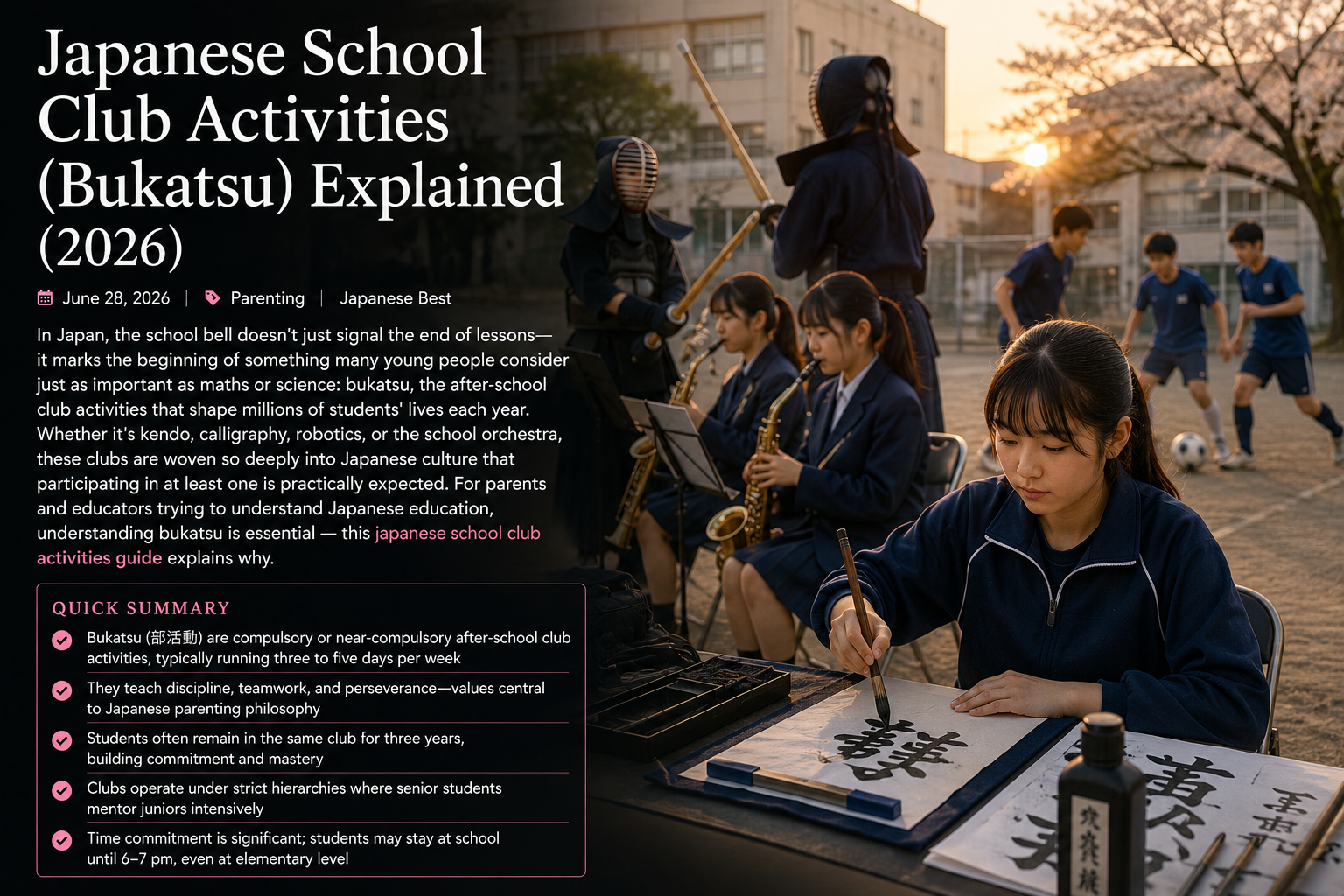
In Japan, the school bell doesn’t just signal the end of lessons—it marks the beginning of something many young people consider just as important as maths or science: bukatsu, the after-school club activities that shape millions of students’ lives each year. Whether it’s kendo, calligraphy, robotics, or the school orchestra, these clubs are woven so deeply into Japanese culture that participating in at least one is practically expected. For parents and educators trying to understand Japanese education, understanding bukatsu is essential — this japanese school club activities guide explains why.
Quick Summary
- Bukatsu (部活動) are compulsory or near-compulsory after-school club activities, typically running three to five days per week
- They teach discipline, teamwork, and perseverance—values central to Japanese parenting philosophy
- Students often remain in the same club for three years, building commitment and mastery
- Clubs operate under strict hierarchies where senior students mentor juniors intensively
- Time commitment is significant; students may stay at school until 6–7 pm, even at elementary level
How Japanese Parents Approach This
Japanese parents view bukatsu as far more than optional extracurriculars. They see them as essential character-building institutions where children learn gaman (perseverance), respect for authority, and the importance of group harmony. Most parents actively encourage—sometimes insist—that their children join a club, viewing it as a rite of passage rather than a hobby.
This reflects a deeper parenting philosophy: that schools should nurture the whole person, not just academic ability. Parents understand that staying late at school, returning home tired, and dedicating weekends to club tournaments is the normal cost of a Japanese education. Many parents drive their children to weekend competitions across Tokyo or Osaka without question, treating it as parental duty. Failure to join a club, conversely, can raise eyebrows among both educators and other parents—though this attitude is gradually softening in urban centres.
What Japanese Kids Experience
For students, bukatsu is often the most memorable part of school life. A child joining the tennis club at age 12 will likely spend the next three years training with the same 15–20 peers, building bonds that last into adulthood. Morning practice sessions begin at 7 am, before classes; afternoon sessions run until 6 or 7 pm. On Saturdays, tournaments or intense training camps (gasshuku) are common, sometimes lasting entire weekends.
The hierarchy is rigid and uncompromising. Third-year students (aged 17–18) are absolute leaders; first-years perform menial tasks like preparing equipment, cleaning facilities, and serving tea to seniors. This isn’t punishment—it’s the traditional system of senpai-kohai (senior-junior) relationships. Younger members accept this without question, understanding they’ll eventually command the same respect. Despite the intensity, students report that their club becomes a second family. Friendships forged in the pressure-cooker environment of daily practice are often lifelong.
At School vs At Home
The contrast between school club culture and home life is stark. At school, club members are expected to be disciplined, obedient, and self-sacrificing. At home, many of these same children might be pampered—their mother preparing elaborate meals, doing their laundry, and managing their schedules around club commitments. This isn’t contradiction in Japanese parenting; it’s balance. Schools instil public virtue; families provide private nurture.
Parents rarely question a coach’s authority. If a child complains about an overly strict club leader or excessive training, the typical response isn’t to intervene but to encourage the child to persevere. The reasoning: learning to endure hardship builds character. However, explicit bullying or dangerous practices do provoke parent action, and recent decades have seen growing scrutiny of overzealous coaches, particularly in high schools.
Real-Life Examples from Tokyo
In central Tokyo, a typical middle school might offer 20–30 clubs: badminton, calligraphy, photography, traditional tea ceremony, English conversation, and several sports teams. At a school in Minato ward, the boys’ volleyball club meets daily from 3:30–6 pm and travels to prefectural tournaments on alternate weekends. Members pay ¥3,000–¥5,000 annually for uniforms, equipment, and transportation. The club’s three third-year students act as apprentice coaches, drilling younger members relentlessly.
Simultaneously, the calligraphy club—considered more “cultural”—meets twice weekly for two hours, focusing on traditional brush technique. Yet expectations are equally high: students prepare for national competitions and are judged by their ability to replicate classical forms with precision. Both clubs demand commitment; the path chosen often reflects family values and student temperament — exactly the kind of detail any japanese school club activities guide should flag for newly arrived families.
How This Compares to Western Parenting
Western after-school programmes typically emphasise choice, individual development, and fun. A child joins tennis because they like tennis; they quit when interest wanes. Japanese bukatsu operates on opposite principles: commitment, collective identity, and endurance through difficulty.
Western parents often manage their child’s schedule tightly, balancing multiple activities to maximise opportunities. Japanese parents typically accept that one club will dominate their child’s non-academic life for years. Western coaches are expected to be encouraging and inclusive; Japanese coaches may use harsh criticism as motivation, believing it toughens resilience. This doesn’t mean Japanese coaches lack compassion—many develop deep, lifelong bonds with students—but their pedagogical approach prioritises growth through challenge over growth through affirmation.
FAQ
Do students have to join a club?
Technically, no. Officially, bukatsu is optional. In practice, especially in smaller towns and at middle-school level, social pressure makes non-participation unusual. Urban schools and progressive institutions offer more genuine choice.
What happens during summer and winter breaks?
Many clubs intensify training during school holidays. Residential training camps (gasshuku) are standard, particularly for competitive teams. These can last a week or more.
Can a student quit their club?
Quitting mid-year is possible but socially difficult and sometimes actively discouraged. Formally leaving typically happens only at the end of an academic year. Students who wish to focus on exam preparation may negotiate early departure.
Are there clubs at elementary school?
Yes, though less formally than at middle or high school. Elementary clubs are generally less time-intensive and more exploratory.
Japanese school club activities remain a uniquely powerful force in shaping young people’s character and memories. For overseas parents seeking to understand Japanese education, recognising bukatsu’s central role—and the values it embodies—is essential. It’s far more than extracurricular; it’s the cultural backbone of how Japan develops its young citizens.
Seen in Everyday Life in Tokyo
A Real-Life Note from Japan
What I Often See in Japanese Stores
What does a japanese school club activities guide need to cover for new families?
At minimum: the time commitment (often 3–5 days a week until 6–7pm), the senpai-kohai hierarchy new students will encounter, and how strongly clubs are treated as compulsory rather than optional in most schools.
Shop Japanese Products
If you’re inspired by what Japanese families use in this area, you can find a wide range of authentic Japanese products on Amazon:
Shop Related Japanese Products on Amazon
More From Japanese Best
Disclosure: As an Amazon Associate, Japanese Best earns from qualifying purchases. This does not affect our recommendations. We only feature products we genuinely believe are worth your consideration.
Editorial Disclaimer
The views, opinions, and recommendations in this article are the author’s own and reflect personal experience living in Japan. They do not constitute professional, financial, or purchasing advice of any kind.
Product availability, pricing, and specifications are subject to change without notice. Japanese Best makes no warranties — express or implied — regarding the accuracy or completeness of this content, and accepts no liability for any decisions made based on it. Always verify details directly with the retailer or manufacturer before purchasing.
コメント