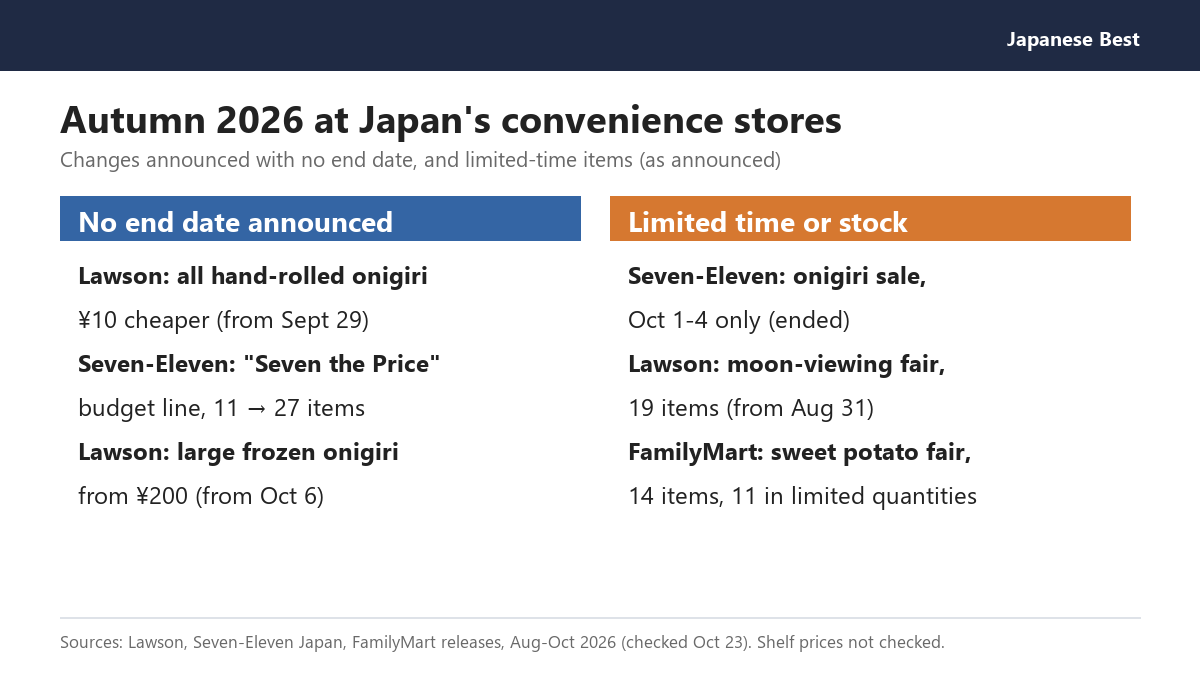
From the three chains’ own press releases, August–October 2026. Releases checked October 23, 2026. We did not check shelf prices or stock in stores.
Japan’s convenience stores — konbini — change their shelves with the seasons, and each chain announces what is coming in press releases. Read together, the autumn 2026 announcements from the three largest chains, Seven-Eleven, FamilyMart and Lawson, show two layers of the konbini at once: everyday prices that the chains are trying to hold down, and a calendar of seasonal food that comes and goes in a few weeks. Telling the two apart matters if you are shopping in Japan: some of the price changes below were announced with no end date, and some lasted only a few days.
Price cuts with no end date, and what lasted only a few days
| Change | Chain | Type | What the release says (checked October 23, 2026) |
|---|---|---|---|
| ¥10 off all hand-rolled onigiri | Lawson | Price revision from September 29 | No end date announced; we did not check shelf prices |
| “Seven the Price” budget line grows from 11 to 27 items | Seven-Eleven | Product line, rolling out from the week of October 5 | Roll-out announced; availability by store not checked |
| Large frozen onigiri, about 160 g, from ¥200 | Lawson | New products from October 6 | Launched October 6; no end date announced |
| Onigiri flat-price sale (¥150 and ¥100 before tax) | Seven-Eleven | Four-day sale, October 1–4 | Ended |
| Moon-viewing (tsukimi) fair, 19 items | Lawson | Seasonal fair from August 31, in stages | End date not announced; may no longer be on sale |
| Sweet potato fair, 14 items | FamilyMart | Seasonal fair from September 22; 11 items in limited quantities | End date not announced; limited items may be sold out |
1. Onigiri: a price cut with no end date, and a short sale
The rice ball (onigiri) is the konbini staple, and in autumn 2026 two chains cut its price in different ways.
Lawson: ¥10 off every hand-rolled onigiri, from September 29. Announced on August 24 as a price revision, the cut applies to all of Lawson’s hand-rolled (temaki) onigiri at its stores nationwide, including regional items, with no change to the products. Lawson announced no end date for the new prices; we have not checked prices in stores. Examples from Lawson’s release (tax included):
| Onigiri | Before | From Sept 29 | Cut (our calculation) |
|---|---|---|---|
| Tuna mayonnaise | ¥181 | ¥171 | 5.5% |
| Kishū nankō plum | ¥194 | ¥184 | 5.2% |
| Hokkaidō Hidaka kelp | ¥194 | ¥184 | 5.2% |
| Bonito flakes (okaka) | ¥194 | ¥184 | 5.2% |
| Grilled red salmon | ¥221 | ¥211 | 4.5% |
| Spicy cod roe (mentaiko) | ¥235 | ¥225 | 4.3% |
Lawson gives two reasons: the market price of rice has fallen, and rice consumption has dropped while prices were high. It cites the Rice Stable Supply Support Organization: average rice consumption per person was 4,435 g a month in fiscal 2025, down 6.1% on the year before, and 4,518 g in June 2026, still below the fiscal 2024 average of 4,722 g.
Seven-Eleven: a four-day flat-price sale, October 1–4 (now over). On October 1–2, five hand-rolled onigiri sold for a flat ¥150 before tax; on October 3–4, six gin-shari musubi sold for a flat ¥100 before tax. With Japan’s 8% reduced tax rate for food, that was about ¥162 and ¥108 (our calculation). Seven-Eleven’s stated reason was customers’ growing wish to save money “amid prolonged inflation”. The release also says the gin-shari musubi line sold more than 85 million units between June and September 20, 2026.
Lawson: bigger frozen onigiri. On October 6, Lawson launched two frozen onigiri of about 160 g: a grilled soy-sauce onigiri (¥200) and chicken rice (¥216), tax included. Lawson says its large room-temperature onigiri sold about 113% of the previous year’s level from March to August 2026, and that frozen onigiri reduce food waste and need one delivery a day instead of two.
2. A budget line grows
On September 28, Seven-Eleven announced that Seven the Price, its lower-priced private-brand line, will grow from 11 to 27 products at its stores nationwide, rolling out from the week of October 5. Examples (tax included): potato salad 500 g, ¥429.84; apple-flavoured drink 900 ml, ¥127.44; bacon pieces 203 g, ¥321.84. Seven-Eleven says it cuts costs with fewer colours in the packaging design, shared packaging, simpler products and more efficient production and delivery, and links the expansion to continuing rises in food and household prices.
3. Moon viewing (tsukimi) on the shelves
Tsukimi is the custom of viewing the autumn moon. In 2026 the mid-autumn moon (中秋の名月) fell on September 25, two days before the astronomical full moon on September 27, according to the National Astronomical Observatory of Japan.
In konbini food, the moon usually appears as an egg. Lawson’s release describes toppings of egg-yolk-style filling “likened to the moon”, soft-boiled eggs, and custard shaped to suggest the full moon. Its “Tsukimi Fair” put 19 products on sale in stages from August 31, at about 14,000 stores. Examples (tax included):
| Product | Price | The “moon” |
|---|---|---|
| Moon-viewing carbonara potato salad | ¥333 | Egg-yolk-style topping |
| Moon-viewing abura soba (soupless noodles) with spicy soy sauce | ¥599 | Egg-yolk-style topping |
| Chicken tsukune rice bowl with a soft egg | ¥646 | Soft-boiled egg |
| Custard pudding tart | ¥254 | Cream shaped as a full moon |
| Moon-viewing minced-meat cutlet | ¥168 | Egg-yolk sauce inside |
Lawson writes that in recent years “tsukimi products” have become established as an autumn seasonal tradition (秋の風物詩), a seasonal event that fast-food and other restaurant chains now promote actively, in burgers, rice bowls, noodles and sweets. In other words, the konbini fair is one part of a wider autumn menu season, not something unique to one chain.
4. Sweet potato season
From September 22, FamilyMart ran its “Oimo Harvest Festival” (Famima no Oimo Shūkakusai), held every autumn since 2021, at about 16,500 stores. It featured 14 sweet potato products: a croissant, pastries, cakes, a dorayaki, a choux puff, a pizza sandwich, two ice creams, chips and chocolate-coated imo-kenpi (sweet potato sticks).
Our count from FamilyMart’s list:
- Prices ran from ¥180 to ¥330 (tax included); the median was about ¥237.
- 12 of the 14 named the sweet potato variety, and all 12 used Beni Haruka (紅はるか).
- 11 of the 14 were sold in limited quantities, so they may already be gone from some stores.
FamilyMart’s release also cites its own survey of 1,005 customers in August 2026, in which over 70% said they were attracted to sweet potato sweets combined with other ingredients.
What this tells you about konbini in 2026
| Layer | Seven-Eleven | FamilyMart | Lawson |
|---|---|---|---|
| Everyday prices (no end date announced) | Seven the Price: 11 → 27 items | — | Hand-rolled onigiri ¥10 cheaper; large frozen onigiri from ¥200 |
| Short promotions | Onigiri sale, Oct 1–4 (ended) | — | — |
| Seasonal calendar | — | Sweet potato fair, 14 items (11 in limited quantities) | Tsukimi fair, 19 items |
| Stated reason for lower prices | Prolonged inflation; customers want to save | — | Lower rice prices; falling rice consumption |
Our reading: in autumn 2026, the chains’ own words put price first. Two of the three explained new products by pointing to household budgets or rice prices, and the changes announced without an end date are in everyday items — onigiri, a budget line, frozen food. The seasonal fairs carried on as in earlier years, built around autumn customs (the moon) and autumn ingredients (sweet potato), and are sold for a few weeks or until stock runs out.
If you are shopping in Japan: prices in the releases are tax-included at the 8% reduced rate for food; seasonal and limited-quantity items differ by store and region and can disappear without notice (several items above were not sold in Okinawa or in some store formats); and a price you saw online may have been a sale that has already ended.
Not tasted or surveyed: we did not buy or try these products, and we did not visit stores. Product names in English are our translations, not official names. Seven-Eleven and FamilyMart also sold other autumn items that were not in the releases listed below and are not covered here.
Sources
- Lawson — Hand-rolled onigiri price revision from September 29, 2026 (August 24, 2026)
- Lawson — Large frozen onigiri, from October 6, 2026
- Lawson — Tsukimi fair, from August 31, 2026 (August 28, 2026)
- Seven-Eleven Japan — Onigiri flat-price sale, October 1–4, 2026 (September 24, 2026)
- Seven-Eleven Japan — Seven the Price expands to 27 items (September 28, 2026)
- FamilyMart — Oimo Harvest Festival 2026 (September 17, 2026)
- National Astronomical Observatory of Japan — The night sky in September 2026 (mid-autumn moon on September 25)
Related: What’s in season in Japan: Tokyo market data by month
(All releases checked 2026-10-23.)
Comments