Data: Japan National Tourism Organization (JNTO), release of October 21, 2026 (figures to September 2026). Checked October 24, 2026. Next JNTO release: November 18, 2026.
Japan received 3,103,700 visitors in September 2026, 5.0% fewer than in September 2025, according to JNTO’s estimate. It was the second month in a row below the previous year. From January to September, arrivals totalled about 30.73 million, 2.9% fewer than in the same months of 2025 but 14.3% more than in 2024. This page sets out who is coming, who is not, and what the national figures can and cannot tell a traveller. Every figure is from JNTO; percentages marked as ours are our calculations.
What JNTO counts
JNTO’s “visitor arrivals” (訪日外客数) start from foreign nationals entering Japan, as counted by the Ministry of Justice. Foreign residents whose main home is Japan, such as permanent residents, are excluded; cruise and transit passengers who land are included. So are expatriate staff, their families and students arriving or re-entering. Aircraft and ship crews are not counted. Each entry counts once, so someone who enters Japan twice is counted twice.
In other words, the figure is not the number of tourists. In July 2026, the latest month with a breakdown by purpose, 3,192,300 of the 3,442,310 arrivals (about 93%) were recorded as tourists, 85,258 as business visitors and 164,752 as “other”.
JNTO publishes each month three times: an estimate the following month (rounded to the nearest hundred), a provisional figure two months later, and a final figure from July of the next year. On this page, August and September 2026 are estimates, January to July 2026 are provisional, and 2025 is final. Every comparison is between the same months of each year under the same definition, as in JNTO’s own release; the 2026 figures may still be revised.
Month by month: 2026 compared with 2025
| Month | 2025 | 2026 | Change |
|---|---|---|---|
| January | 3,781,629 | 3,597,881 | −4.9% |
| February | 3,258,491 | 3,466,848 | +6.4% |
| March | 3,497,755 | 3,619,159 | +3.5% |
| April | 3,909,128 | 3,692,364 | −5.5% |
| May | 3,693,587 | 3,560,256 | −3.6% |
| June | 3,377,985 | 3,148,754 | −6.8% |
| July | 3,437,118 | 3,442,310 | +0.2% |
| August | 3,428,406 | 3,098,900 (estimate) | −9.6% |
| September | 3,267,228 | 3,103,700 (estimate) | −5.0% |
| January–September | 31,651,327 | 30,730,200 (estimate) | −2.9% |
Six of the nine months were below 2025, but every month still had more than three million arrivals. In both years, April was the busiest month so far.
Who is coming, and who is not
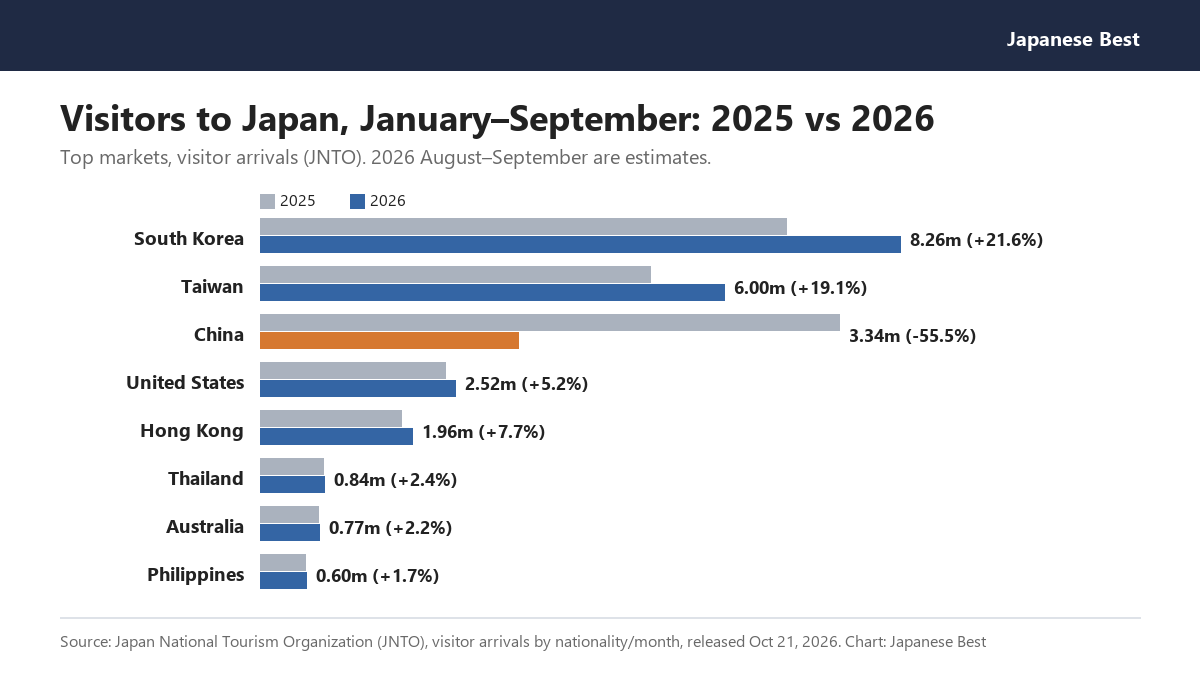
The chart at the top of this page shows the eight largest markets. The table lists the ten largest, ranked by arrivals in January–September 2026.
| Market | Jan–Sep 2025 | Jan–Sep 2026 | Change | Share of all arrivals (2025 → 2026) |
|---|---|---|---|---|
| South Korea | 6,793,644 | 8,262,700 | +21.6% | 21.5% → 26.9% |
| Taiwan | 5,036,711 | 5,997,600 | +19.1% | 15.9% → 19.5% |
| China | 7,487,508 | 3,335,500 | −55.5% | 23.7% → 10.9% |
| United States | 2,397,825 | 2,522,800 | +5.2% | 7.6% → 8.2% |
| Hong Kong | 1,822,616 | 1,963,300 | +7.7% | 5.8% → 6.4% |
| Thailand | 815,804 | 835,400 | +2.4% | 2.6% → 2.7% |
| Australia | 755,278 | 771,900 | +2.2% | 2.4% → 2.5% |
| Philippines | 591,305 | 601,300 | +1.7% | 1.9% → 2.0% |
| Vietnam | 529,810 | 551,100 | +4.0% | 1.7% → 1.8% |
| Canada | 494,656 | 518,900 | +4.9% | 1.6% → 1.7% |
2026 figures are rounded to the nearest hundred because they include estimates; changes and shares are our calculations from JNTO’s monthly table.
What the table shows:
- The overall fall is a China effect. Arrivals from China fell by more than half, from about 7.49 million to about 3.34 million. Leave China out and arrivals from everywhere else were 13.4% higher than in January–September 2025 (our calculation: 30,730,200 minus 3,335,500 from China is 27.39 million in 2026, against 31,651,327 minus 7,487,508, or 24.16 million, in 2025).
- South Korea is now by far the largest market, with more than a quarter of all arrivals, followed by Taiwan. In 2025 China had been the largest.
- Many smaller markets also grew, including Mexico (+25.8%), India (+19.0%), Malaysia (+12.1%), Indonesia (+10.3%), Singapore (+9.6%) and France (+6.6%).
What JNTO says about the causes, and what it does not
For September 2026, JNTO’s release gives these reasons, and we report only these:
- Overall: athletes and officials came for the Asian Games in Aichi, but higher air fares linked to the situation in the Middle East, reduced flights and typhoon cancellations pushed many markets below 2025.
- China: JNTO notes that since November 2025 the Chinese government has several times advised against travel to Japan, and that flights were reduced.
- South Korea: a record for September, which JNTO links to continued interest in Japan, the Chuseok holidays and more airline seats.
- Taiwan: also a September record, linked to a four-day holiday and more airline seats. JNTO lists seven markets with September records: South Korea, Taiwan, Singapore, India, Mexico, Russia and the Middle East.
JNTO describes these as factors, not as measured effects. It does not say how many fewer people came because of any one of them, and neither can we.
What the national total cannot tell you about crowds
A smaller national total does not mean a particular place is quieter, and this figure cannot tell you either way. Arrivals are counted at the border, for the whole country. They say nothing about where visitors went, how long they stayed, or how busy a particular temple, station or street was. A smaller total can coexist with crowded hotspots if visitors concentrate in the same places, and the mix of markets has changed: different markets travel at different times and to different places.
What the figures do support:
- Japan is still receiving more than three million visitors a month, about 14% more than in the same months of 2024.
- Holidays in the main markets matter. September 2026 records for Korea and Taiwan coincided with holidays there, according to JNTO.
- If you want to know about a specific place, look for that place’s own counts (for example a prefecture’s tourism statistics), not the national total.
How we will update this page
JNTO’s next release, on November 18, 2026, will give the October 2026 estimate and provisional figures for August. We will update the tables after each monthly release and replace estimates with provisional figures as they are published.
Sources
- JNTO — Visitor arrivals statistics: “Visitor arrivals by nationality/month, 2003–2026” (Excel, released October 21, 2026) and the September 2026 estimate press release (Japanese)
- JNTO — Statistics FAQ: definition of visitor arrivals; estimate, provisional and final figures
- JNTO — Visitor arrivals by country/area and purpose, July 2026 (provisional), on the statistics page above
Related: Tax-free shopping in Japan: the refund system from November 1, 2026 · Japan’s capsule toy boom in 2026

Comments