Data: MEXT guide on food education (2019), MEXT surveys (as of May 1, 2023, and the fiscal 2025 sample survey), School Lunch Act, MEXT page on the April 2026 support. Checked October 23, 2026.
In Japan, lunch at elementary school is usually not something children bring from home. Almost every pupil eats a school lunch, and the Ministry of Education’s guidance for teachers describes pupils on “lunch duty” serving it to their own class. It is called kyūshoku (給食). This page explains how a school lunch period is meant to work, who decides what is on the tray, how much of the food comes from the local area, where the custom came from, and, briefly, what changed in April 2026.
What is on the tray
A full lunch (完全給食) in MEXT’s definition is a staple (rice or bread), milk, and side dishes. In MEXT’s survey as of May 1, 2023, 98.8% of elementary schools (18,532 of 18,755) and 89.8% of junior high schools served a full lunch, covering 99.2% and 90.0% of pupils respectively. In schools that serve rice, rice meals were served on average 3.6 times a week.
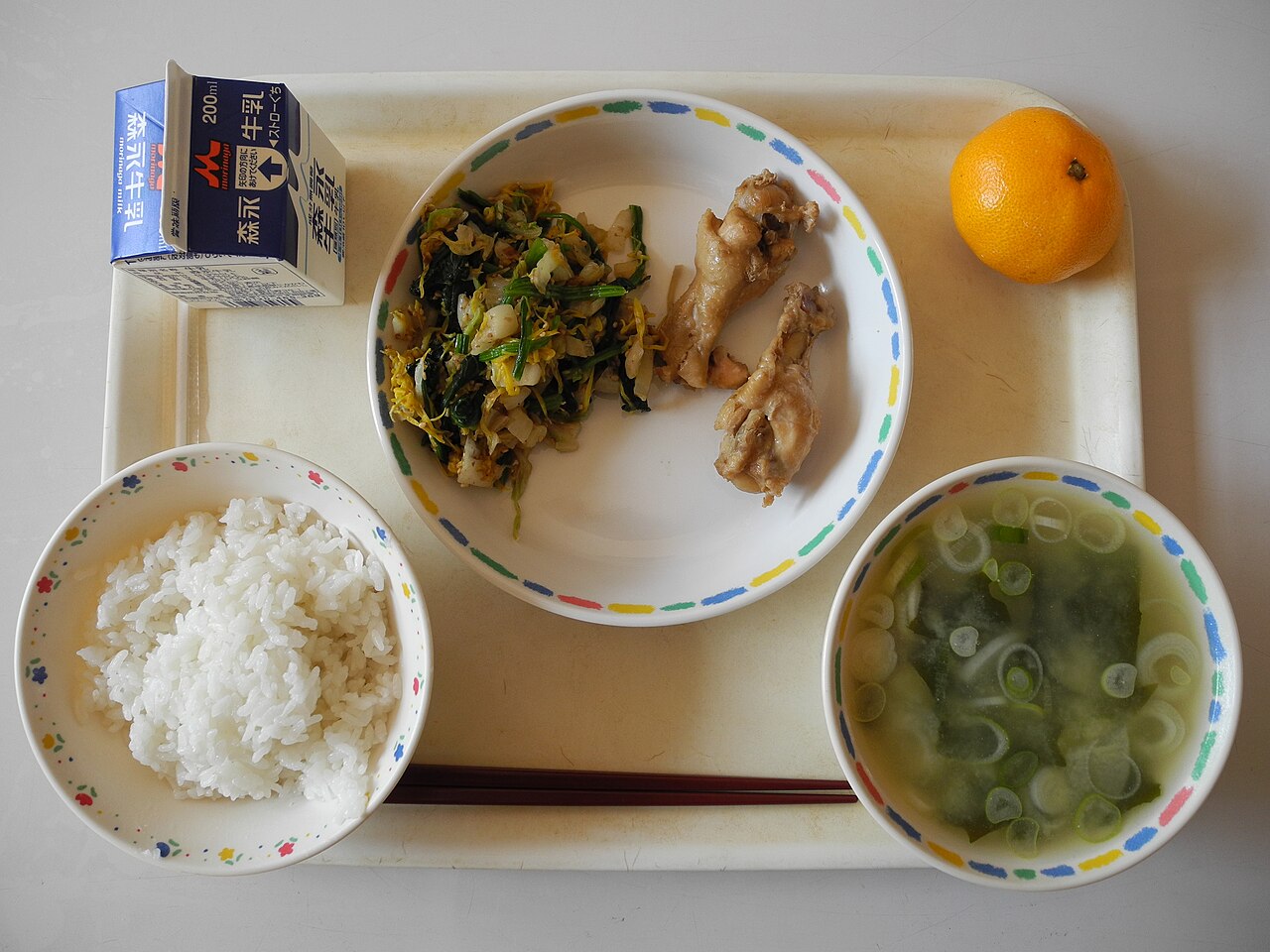
The photo at the top of this page was taken in November 2011 and shows one example from one school, not a current menu: rice, a carton of milk, a mikan (mandarin orange), miso soup with wakame, stir-fried vegetables and chicken. Menus differ by city and by day.
How lunch time works
MEXT’s guide for teachers on food education describes lunch time as part of education, not a break, and sets out what schools are asked to teach from “preparation to clearing up”. In outline:
- Lunch duty (給食当番). Pupils on duty serve the food to the class. Each day the class teacher checks that they have no symptoms such as diarrhoea, fever or vomiting, are dressed hygienically and have washed their hands, and swaps them out if not.
- Serving. While food is being served, the other pupils wait quietly in their seats so that dust does not get into the food. Pupils on duty learn to divide the food so that everyone gets a fair portion and to set the dishes out correctly.
- Before eating. The class checks the menu — staple, main dish, side dish — and the names of the dishes, then says “itadakimasu”.
- While eating. Pupils learn how to hold the bowl and chopsticks, how dishes are arranged and how to sit, in a relaxed atmosphere with enough time to eat.
- Clearing up. Everyone clears up together, sorting waste according to the school’s and the local area’s rules.
Behind the scenes, a person designated by the school tastes the food (検食) at least 30 minutes before the children eat it, and schools follow their own written procedures to prevent food reaching a child with an allergy by mistake.
How exactly this looks differs from school to school; the list above is what MEXT asks schools to aim for, not a description of every classroom.
Who plans the menu
Menus are planned by nutrition teachers (栄養教諭) and other staff according to national school lunch intake standards (学校給食摂取基準) set under Article 8 of the School Lunch Act. MEXT explains that the standards are based on the health ministry’s Dietary Reference Intakes for Japanese, and that school lunch tries, where it can, to make up for nutrients that children are thought to get too little of at home. Nutrition teachers also check how much is eaten and how much is left, and use that in planning.
Local food and tradition
The School Lunch Act lists seven goals for school lunch. Besides health and good eating habits, they include fostering sociability and a cooperative spirit, understanding that food depends on nature and on the people who produce and distribute it, and deepening understanding of Japan’s and each region’s traditional food culture (our translation). MEXT’s guide says that using local produce (地場産物) and serving local dishes (郷土食) and dishes for seasonal events (行事食) helps children understand their area’s culture and traditions.
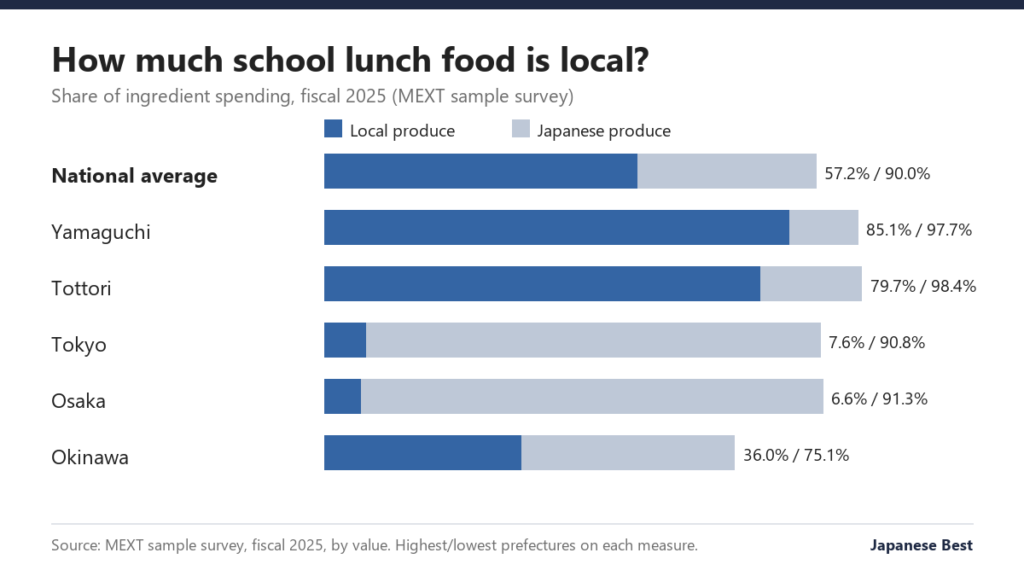
MEXT estimates how much of school lunch ingredients, by value, are local produce and Japanese produce from a sample survey: about one in 50 public schools that cook their own lunches and one in 50 shared lunch kitchens, chosen at random, report the ingredients they used over five days in June and five days in November. The figures below are that survey’s results for fiscal 2025, nationally and by prefecture. They are estimates based on the sampled schools and kitchens, not a count of every school’s purchases:
| Local produce | Japanese produce | |
|---|---|---|
| National average (survey) | 57.2% | 90.0% |
| Yamaguchi (highest local share) | 85.1% | 97.7% |
| Tottori (highest Japanese share) | 79.7% | 98.4% |
| Tokyo | 7.6% | 90.8% |
| Osaka (lowest local share) | 6.6% | 91.3% |
| Okinawa (lowest Japanese share) | 36.0% | 75.1% |
In the survey’s national average, Japanese-produced ingredients accounted for 90.0% of school lunch ingredient spending in fiscal 2025. The share of locally produced ingredients, however, varied considerably between prefectures: from 85.1% in Yamaguchi to 6.6% in Osaka, with Tokyo and Osaka the only two below 10%. The Japanese-produce share also differed by prefecture, though less, from 98.4% in Tottori to 75.1% in Okinawa. Each prefecture’s figure is also a survey result, based only on the schools and kitchens sampled in that prefecture, so small differences between prefectures should not be read too closely.
Where kyushoku came from
MEXT’s guide traces Japanese school lunch to 1889, at Chūai Elementary School, a private school in the town of Tsuruoka in Yamagata Prefecture, where meals were given free to poor children as religious charity. In December 1946 a joint notice from the education, health and agriculture ministries made school lunch part of school education. The School Lunch Act of 1954 gave it a legal basis, and a major revision in 2008 added the promotion of food education (食育) in schools as a goal.
Who pays for the food
Article 11 of the School Lunch Act splits the cost. The school’s founder (for a public school, the city or town) pays for facilities, equipment and certain running costs. The rest, mainly the food, is the “school lunch fee”, paid by parents. In 2023, the average monthly fee at public elementary schools serving a full lunch was ¥4,688 (¥5,367 at junior high schools). MEXT calculates the fee as the yearly cost of ingredients divided by 11 months; at 192 lunches a year, that is about ¥269 per lunch (our calculation).
The 2026 change, briefly
Since April 2026, the national government funds part of the cost at public elementary schools under what MEXT calls a “fundamental reduction of the school lunch fee burden” (学校給食費の抜本的な負担軽減), a name it chose over the informal “free school lunch”.
| Item | What MEXT says |
|---|---|
| Standard amount (full lunch) | ¥5,200 per child per month for 11 months (¥6,200 at special-needs schools); ¥4,800 for milk and side dishes; ¥1,200 for milk only |
| How it is paid | The national government funds cities and towns, which use it to buy ingredients |
| Parents’ application | Generally not needed |
| If the city’s cost is higher | The city can still charge parents the difference |
Our calculation: ¥5,200 a month is about ¥298 per lunch at 192 lunches a year, above the 2023 national average fee. But in five prefectures — Fukushima (¥5,314), Toyama (¥5,311), Niigata (¥5,265), Tokushima (¥5,256) and Nagano (¥5,250) — the 2023 average was already above ¥5,200, and food prices have risen since. So whether a family still pays something depends on the city. The MEXT page covers public elementary schools; for junior high school fees, check with your city.
If your family is moving to Japan
- At a public elementary school, lunch is part of the school day, and your child may take turns on lunch duty. For anything the school asks you to bring for lunch time, follow the school’s own list.
- Tell the school about any food allergy before your child starts; schools follow written procedures for allergies.
- Since April 2026, most of the ingredient cost at public elementary schools is covered by national support, usually without any application. Whether you pay a difference depends on your city.
Not surveyed on site: we have not visited schools or eaten school lunch for this article. Everything here is from MEXT documents and the law text.
Related: Japan’s school year and entrance season
Sources
- MEXT — Guide on food education in schools, 2nd revised edition (March 2019), Chapter 5: food education at lunch time (PDF, Japanese) (checked 2026-10-23)
- MEXT — Share of local and Japanese produce in school lunch ingredients, fiscal 2025: sample survey results (PDF, Japanese) (checked 2026-10-24, all 47 prefectures)
- MEXT — School lunch nutrition survey: outline, including how schools are sampled and the survey days (Japanese) (checked 2026-10-24)
- MEXT — School lunch survey as of May 1, 2023: results tables (PDF) (published June 2024)
- e-Gov — School Lunch Act, Articles 2, 8 and 11
- MEXT — Fundamental reduction of the school lunch fee burden (from April 2026) (checked 2026-10-21)
Top photo: “Jinego Elementary School school lunch” by Douglas P Perkins (Wikimedia Commons), CC0; resized by Japanese Best. The chart is credited in its caption.

Comments