Last checked: October 3, 2026 | Understand Japan | Japanese Best
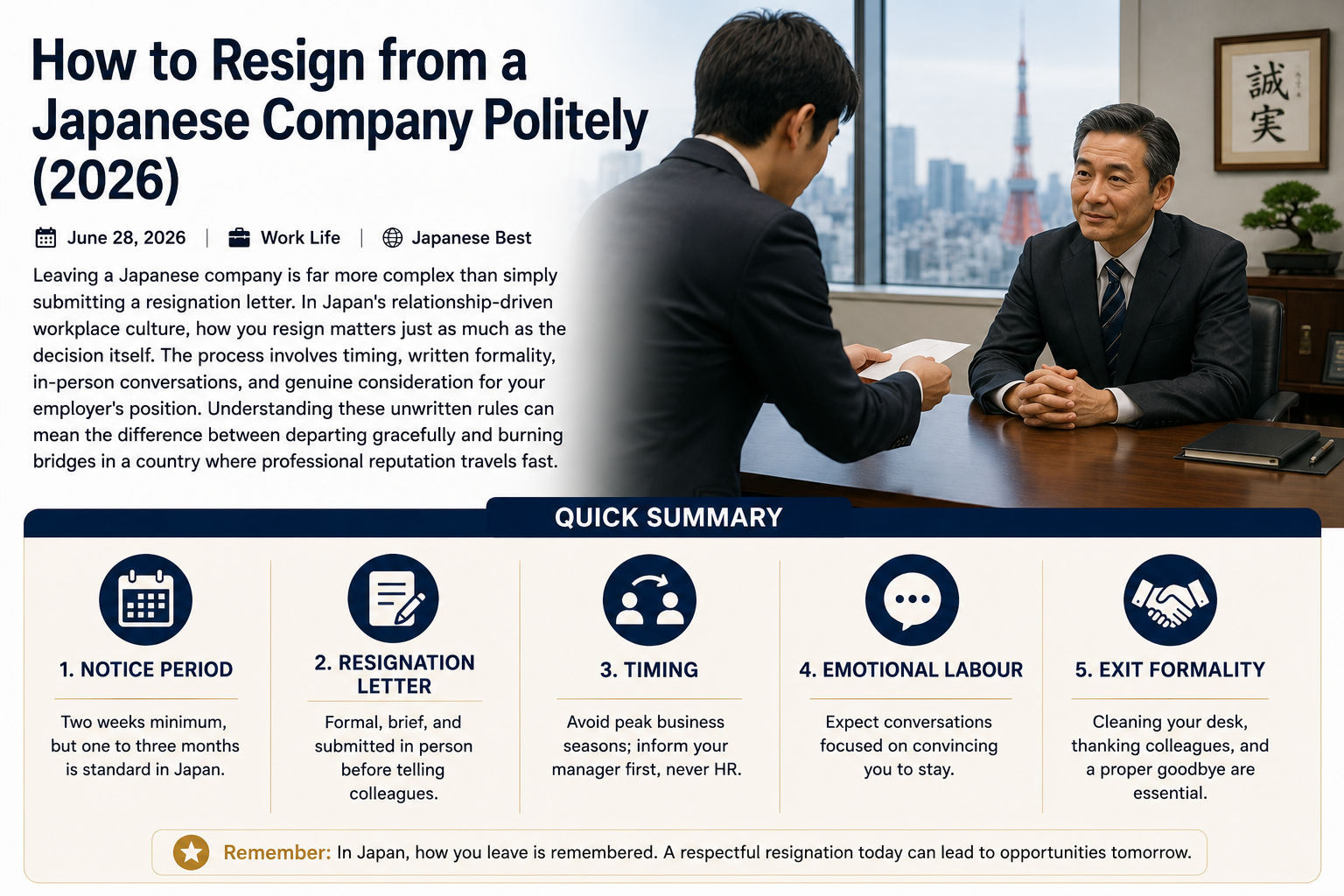
This page sets out the parts of leaving a job in Japan that you can check for yourself: what Japanese law says about notice, what your employer must give you when you leave, and the immigration notification foreign employees must file. It is general information based on the law texts and government pages linked below, not legal advice.

How much notice the law requires
| Situation | Rule | Legal basis |
|---|---|---|
| Employee resigns, no fixed contract term | Either party may give notice at any time. Employment ends two weeks after notice is given. | Civil Code, Article 627(1) |
| Employee resigns, fixed-term contract | Either party may end the contract immediately only if there is an unavoidable reason. If that reason arose through one party’s own fault, that party is liable for damages. | Civil Code, Article 628 |
| Actual working conditions differ from those stated at hiring | The employee may end the contract immediately. If they moved home for the job and return within 14 days, the employer must pay the necessary travel costs. | Labour Standards Act, Article 15 |
| Employer dismisses an employee | At least 30 days’ notice, or at least 30 days’ average wages in lieu (with limited exceptions). | Labour Standards Act, Article 20 |
The 30-day rule applies to dismissal by the employer. It is not the notice period for an employee who resigns; that is the Civil Code’s two-week rule. Your company’s work rules (就業規則) or contract may ask for longer notice. If the rules and the law appear to conflict in your case, you can raise it with the free government consultation service listed below.
What your employer must provide when you leave
- Certificate of employment (退職証明書): if you ask, the employer must issue without delay a certificate stating your period of employment, type of work, position, wages or reason for leaving. It may only include the items you request (Labour Standards Act, Article 22).
- Final wages and your money: if you ask, the employer must pay wages owed and return deposits, savings and other money belonging to you within seven days (Labour Standards Act, Article 23).
Foreign employees: notify immigration within 14 days
If you hold one of the following statuses, you must notify the Immigration Services Agency within 14 days of your contract with your employer ending, and again within 14 days of signing with a new employer (Immigration Control and Refugee Recognition Act, Article 19-16, item 2):
- Highly Skilled Professional (i)(a)/(b), (ii)(a)/(b)
- Researcher
- Engineer / Specialist in Humanities / International Services
- Nursing Care
- Entertainer (when working under a contract with the organisation)
- Skilled Labor
- Specified Skilled Worker
You can file online through the Agency’s electronic notification system at any time; an English manual is available. You can also file in person at a regional immigration office with your residence card. Other statuses, such as Professor, Business Manager or Intra-company Transferee, have a separate notification for the affiliated organisation. Check the Agency’s page for your status.
A comparison point: the UK
In the UK, the government’s guidance says an employee must give at least one week’s notice once they have been in the job for more than a month, and the contract may require more. Japan’s statutory baseline for an employee on an open-ended contract (two weeks) is therefore longer than the UK statutory minimum. In both countries, a contract or work rules can require a longer period than the statutory minimum.
Where to get free advice
The Ministry of Health, Labour and Welfare runs General Labour Consultation Corners (総合労働相談コーナー) in every prefecture. They take questions on any labour issue from employees or employers. No appointment is needed, consultations are free, and consultations in multiple languages are available for foreign workers. They are closed at weekends, on public holidays and over New Year.
Checklist
- Check whether your contract has a fixed term, and what notice your work rules ask for.
- Give notice in writing and keep a copy with the date.
- Ask for a certificate of employment if you will need one (for example, for a new employer or a visa application).
- If you hold one of the statuses above, file the immigration notification within 14 days of your last contract day.
- If something is disputed, contact a General Labour Consultation Corner.
Sources
- e-Gov — Civil Code (Articles 627 and 628)
- e-Gov — Labour Standards Act (Articles 15, 20, 22, 23)
- Immigration Services Agency — Notification on the contracting organisation (accessed 2026-10-03)
- GOV.UK — Handing in your notice: giving notice
- MHLW — General Labour Consultation Corners
Related: Average salary in Japan (2025 data) and take-home pay
Comments