Data: Ministry of Agriculture, Forestry and Fisheries (MAFF) compilations of supermarket sales data (published October 23, 2026), the Retail Price Survey and the Consumer Price Index (Ministry of Internal Affairs and Communications). Checked October 24, 2026. MAFF updates the supermarket data weekly, usually on Fridays.
Figures on this page are as of October 24, 2026: supermarket prices for the week of October 12–18, 2026 (MAFF, published October 23, 2026); Tokyo retail prices and the national Consumer Price Index for September 2026. MAFF has published newer weeks since then, and this page is not updated every week. For the current supermarket figure, see the MAFF sheet listed under Sources.
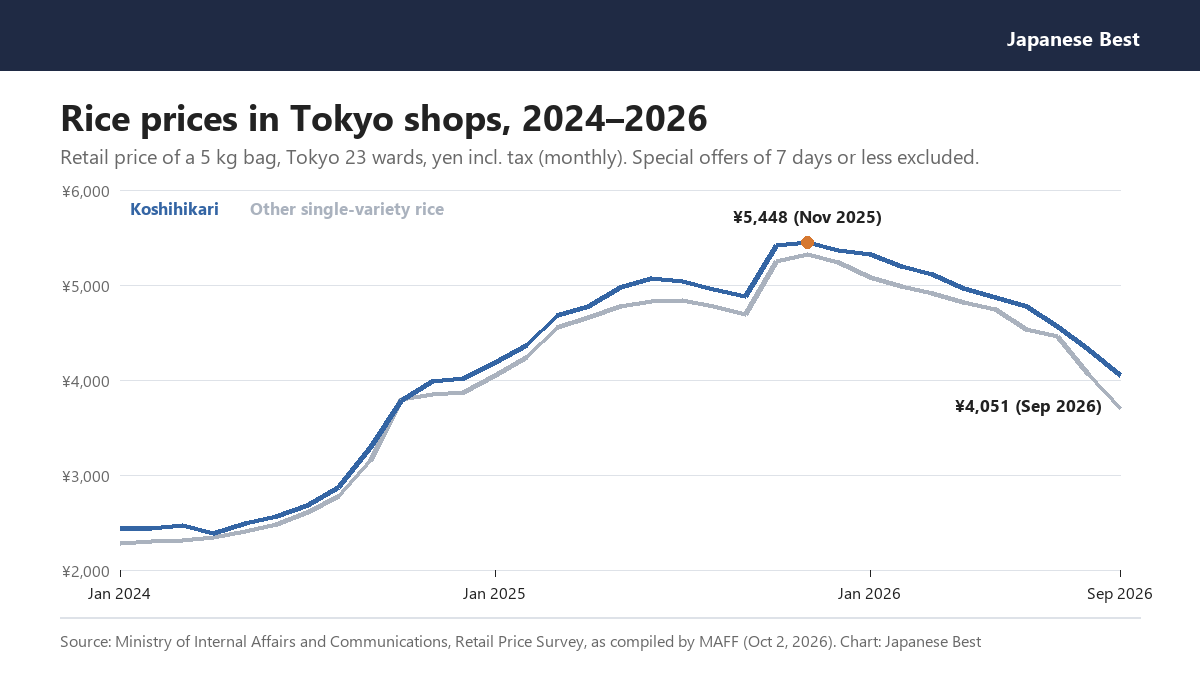
Rice in Japan is getting cheaper again, but it is still far from what it cost before 2024. In the week of October 12–18, 2026, the average price of rice sold in about 1,000 supermarkets was ¥2,821 per 5 kg, a third less than a year earlier. In Tokyo shops, a 5 kg bag of Koshihikari cost ¥4,051 in September 2026, a quarter below its November 2025 peak. That is still about three quarters more than in 2023. This page explains what each figure measures, why they differ, and what the government itself says about the movement.
Two official price series, and why they differ
| Supermarket sales data (KSP-POS) | Retail Price Survey | |
|---|---|---|
| Published by | MAFF, from data bought from KSP-SP Co., Ltd. | Ministry of Internal Affairs and Communications (MIC), compiled by MAFF |
| Where | About 1,000 supermarkets nationwide | Shops in Tokyo’s 23 wards |
| Which rice | Everything sold, converted to a 5 kg price: named varieties and blends, including store brands | Single-variety 5 kg bags (one origin, variety and crop year); Koshihikari and other varieties shown separately |
| Discounts | Actual selling prices | Special offers of seven days or less are excluded |
| Price basis | Yen per 5 kg, tax included | Yen per 5 kg bag, tax and packaging included |
| How often | Weekly | Monthly |
| Figure used on this page | ¥2,821 per 5 kg (week of October 12–18, 2026) | ¥4,051 for Koshihikari, ¥3,700 for other varieties (September 2026) |
The two figures should not be compared directly. They cover different shops (about 1,000 supermarkets nationwide against shops in Tokyo’s 23 wards), different products (all rice sold against single-variety bags), different prices (actual selling prices against prices excluding short special offers) and different periods (one week in October against the month of September). So the gap between ¥2,821 and ¥4,051 is not a Tokyo-versus-national difference, and the published data do not show how much each of these factors contributes. Neither is “the” price of rice. Use the supermarket figure to see the general level and direction, and the Tokyo survey to see what a standard bag of named rice costs in the capital. The supermarket data cover only the stores in the panel, not every shop in Japan, and MAFF does not say whether the same stores report every week.
Two and a half years of rice prices in Tokyo
The chart at the top of this page shows the monthly Tokyo price from January 2024 to September 2026 (Retail Price Survey, as compiled by MAFF on October 2, 2026).
| Tokyo 23 wards, 5 kg Koshihikari | Price |
|---|---|
| 2023 average | ¥2,323 |
| 2024 average | ¥2,951 (+27.0%) |
| 2025 average | ¥4,928 (+67.0%) |
| Peak month: November 2025 | ¥5,448 |
| September 2025 | ¥4,879 |
| September 2026 | ¥4,051 (−17.0% on a year earlier) |
What the numbers show (our calculations where noted):
- From the November 2025 peak to September 2026, the Tokyo price fell by 25.6%.
- September 2026 is still 74.4% above the 2023 average. Prices have come down, but not back to where they were.
- The fall has sped up: the year-on-year change went from +27.0% in January 2026 to −17.0% in September 2026.
- The national Consumer Price Index tells the same story: the index for non-glutinous rice was 80.3 in September 2026 (2025 = 100), 20.6% lower than a year earlier.
The supermarket data, week by week
MAFF’s weekly sheet published October 23, 2026 gives the week of October 12–18 and its own summary of the trend:
- October 12–18, 2026: ¥2,821 per 5 kg on average, ¥16 less than the week before and ¥1,430 (33.6%) less than the same week of 2025 (¥4,251).
- Named varieties (銘柄米): ¥2,872. Blends and similar products, which may include store brands: ¥2,609. MAFF gives their shares as 81% and 19% (its “sales share”, 販売割合; the sheet does not state whether this is by quantity or by value).
- MAFF’s summary of the movement: the average fell for a while from June 2025 as government stockpile rice reached shops; it was above ¥4,000 from September 2025; it turned downward from January 2026; and it went below ¥3,000 in the week of September 7, 2026.
- On quantities, MAFF says sales rose while stockpile rice was on sale, were around normal levels afterwards, and have recently been firm as the new crop reaches shops.
MAFF describes the timing of these movements. Its weekly sheet does not attribute the 2026 fall to any single cause, and we do not either.
What this has to do with convenience-store onigiri
In September 2026, Lawson cut the price of all its hand-rolled onigiri by ¥10 from September 29. It gave the fall in the market price of rice as one reason (see our autumn konbini article). The official figures above confirm that rice prices were falling at the time. They cannot confirm how much Lawson itself pays for rice, which is set in contracts that are not public, so we cannot check how much of the cut comes from rice costs.
If you are buying rice in Japan
- Expect to see a wide range on the shelf. In the week of October 12–18, 2026, blends averaged about ¥260 less per 5 kg than named varieties in the supermarket data.
- A 5 kg bag of Koshihikari in Tokyo shops was about ¥4,050 in September 2026 (other single-variety rice about ¥3,700). The national supermarket average measures something different, as explained above.
- Prices are still moving. Check the date of any figure you read, including the ones on this page.
How we will update this page
MAFF updates the supermarket sheet weekly and the Tokyo retail and CPI sheets monthly. We do not rewrite this page every week. When we update it, we change only the dated figures: the “Figures on this page are as of” line at the top, the supermarket week in the opening paragraph, the comparison table and the week-by-week list; the Tokyo price table and the chart when a new month of the Retail Price Survey is published; and the CPI line. Every figure keeps the date of the data it refers to.
Sources
- MAFF — Rice prices (米の価格), including:
- MAFF — Supermarket sales volumes and prices (KSP-POS data, national, weekly), published October 23, 2026 (PDF, Japanese)
- MAFF — Retail prices in Tokyo’s 23 wards (from MIC’s Retail Price Survey), October 2, 2026 (PDF, Japanese)
- MAFF — Consumer prices, national (from MIC’s Consumer Price Index), October 23, 2026 (PDF, Japanese)
Related: Autumn 2026 at Japan’s convenience stores · What’s in season in Japan: Tokyo market data by month
Comments