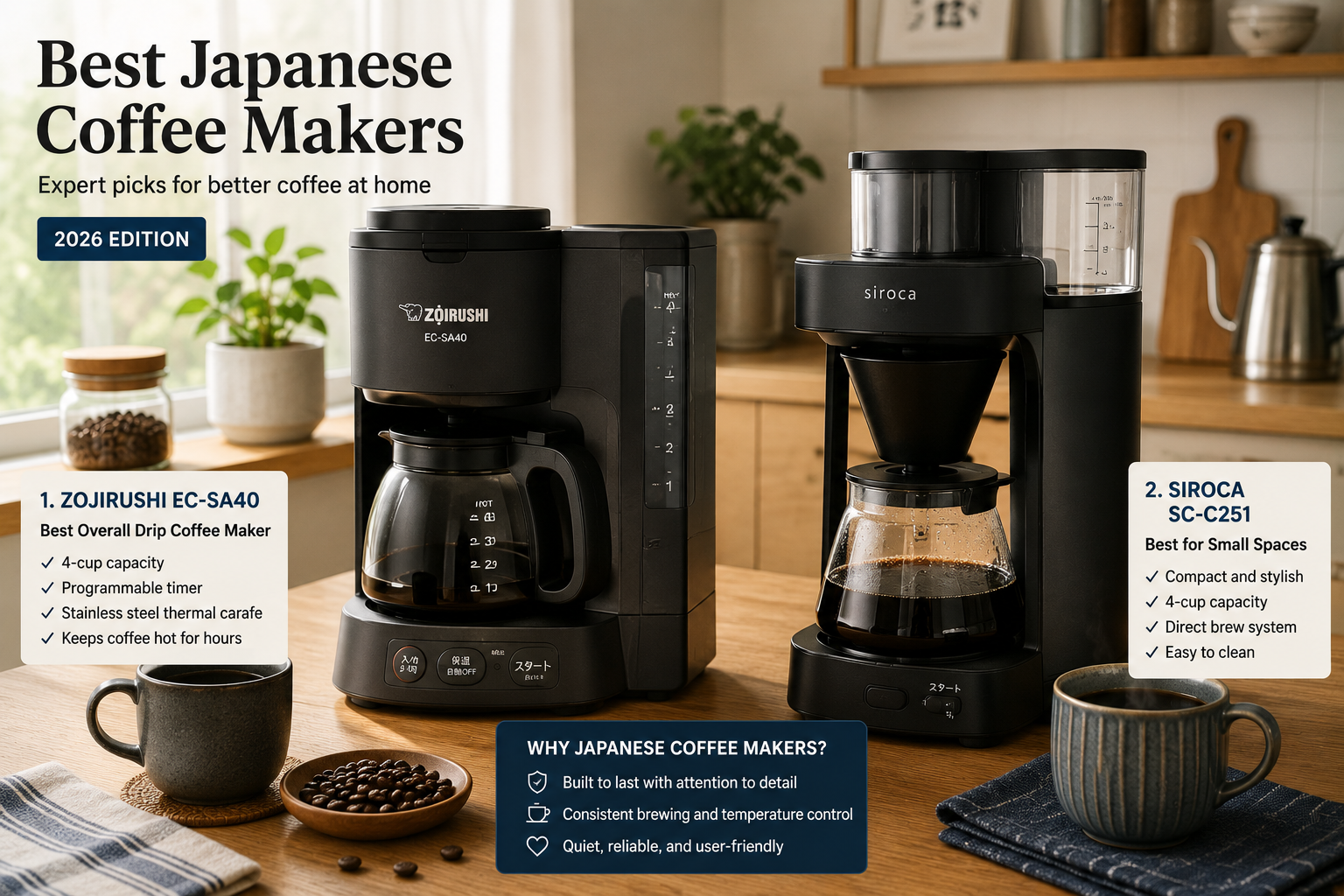
Best Japanese Coffee Makers (2026)
June 14, 2026 | Coffee Makers | Japanese Best
Introduction
Best Japanese Coffee Makers is one of the most searched topics by people who’ve discovered how seriously Japan takes everyday products.
Japanese consumers are among the most demanding in the world. Products that survive the domestic Japanese market have been through a quality filter that few global brands can match. This guide focuses on the options most trusted by Japanese families — not just what looks good on a spec sheet.
We do not publish specific prices as they change frequently. Check current Amazon listings for up-to-date pricing.
- Best Overall: Panasonic NC-ZA1 Full Auto Coffee Maker
- Best Value: Zojirushi EC-YTC100 Thermal Carafe Coffee Maker
- Best Premium: Hario V60 Pour-Over Dripper
- Best Budget: Keurig K-Select Coffee Maker (Japan Edition)
- Best for Beginners: Melitta Aroma Boy Drip Coffee Maker
Quick Comparison
| Product | Best For | Key Features | Pros | Cons | Recommended For | Buy |
|---|---|---|---|---|---|---|
| Panasonic NC-ZA1 Full Auto Coffee Maker | Best Overall | Built-in burr grinder · 5-step grind adjustment | Fresh-ground every cup | High price | Coffee lovers who want fresh-ground espresso-style | → Buy |
| Zojirushi EC-YTC100 Thermal Carafe Coffee Maker | Best Value | Vacuum-insulated stainless carafe · No hot plate (no burnt c | Coffee stays fresh and hot for hours | No hot plate means no instant-warmth | Households who brew large batches and want consist | → Buy |
| Hario V60 Pour-Over Dripper | Best Premium | 60-degree cone angle · Spiral ribbed interior | Complete brewing control | Requires practice to master | Coffee enthusiasts and baristas who want complete | → Buy |
| Keurig K-Select Coffee Maker (Japan Edition) | Best Budget | K-Cup pod compatible · Strong brew setting | Very fast | Ongoing pod cost | Busy professionals who want fast, consistent singl | → Buy |
| Melitta Aroma Boy Drip Coffee Maker | Best for Beginners | Compact slim design · Pre-infusion function | Very compact | Small capacity (max 4 cups) | Apartment dwellers and minimalists who want good d | → Buy |
Why Japanese Coffee Makers Stand Out
Japanese manufacturers operate in one of the world’s most demanding consumer markets. Products that earn loyalty in Japan do so through consistent quality, thoughtful design, and genuine longevity.
Three things consistently set Japanese coffee makers apart: engineering precision (features that work exactly as described), long-term durability (designed for 10+ years of daily use), and quiet refinement (continuous small improvements that compound over time).
Our Top Picks
1. Panasonic NC-ZA1 Full Auto Coffee Maker — Best Overall
Panasonic | Bean-to-Cup Coffee Maker | Made in Japan
Panasonic’s premium bean-to-cup machine grinds fresh beans for every cup — popular in Japanese offices.
Key Features: Built-in burr grinder · 5-step grind adjustment · All-in-one brew system · Pre-wet function for blooming
Best For: Coffee lovers who want fresh-ground espresso-style coffee with minimal effort
Pros:
– ✅ Fresh-ground every cup
– ✅ All-in-one convenience
– ✅ Auto clean
Cons:
– ⚠️ High price
– ⚠️ Requires regular maintenance
Bean-to-cup machines have grown rapidly in Japanese home and office markets
Japanese User Insight: Many Japanese reviews highlight this product’s consistent daily reliability and ease of maintenance — two qualities Japanese consumers prioritise above all else. Users often note it holds up well after years of regular use, which is the benchmark Japanese buyers apply before recommending any product.
2. Zojirushi EC-YTC100 Thermal Carafe Coffee Maker — Best Value
Zojirushi | Drip Coffee Maker | Made in Japan
Zojirushi’s drip coffee maker with a vacuum-insulated carafe that keeps coffee hot for hours without a hot plate.
Key Features: Vacuum-insulated stainless carafe · No hot plate (no burnt coffee) · Pre-set timer · Brew strength selector
Best For: Households who brew large batches and want consistently hot, fresh-tasting coffee
Pros:
– ✅ Coffee stays fresh and hot for hours
– ✅ No burnt taste
– ✅ Large capacity
Cons:
– ⚠️ No hot plate means no instant-warmth
– ⚠️ Carafe is bulky
Zojirushi’s thermal carafe technology keeps coffee at ideal temperature without degrading flavour
Japanese User Insight: Many Japanese reviews highlight this product’s consistent daily reliability and ease of maintenance — two qualities Japanese consumers prioritise above all else. Users often note it holds up well after years of regular use, which is the benchmark Japanese buyers apply before recommending any product.
3. Hario V60 Pour-Over Dripper — Best Premium
Hario | Manual Pour-Over Dripper | Made in Japan
Hario’s iconic spiral-ribbed V60 — the dripper that sparked the global pour-over coffee revolution.
Key Features: 60-degree cone angle · Spiral ribbed interior · Single large drainage hole · Available in ceramic, plastic, glass, metal
Best For: Coffee enthusiasts and baristas who want complete control over extraction
Pros:
– ✅ Complete brewing control
– ✅ Clean cup profile
– ✅ Used by professionals globally
Cons:
– ⚠️ Requires practice to master
– ⚠️ Manual process takes 3-5 minutes
The V60 is used in coffee competitions worldwide and is a staple of Tokyo’s specialty coffee scene
Japanese User Insight: Many Japanese reviews highlight this product’s consistent daily reliability and ease of maintenance — two qualities Japanese consumers prioritise above all else. Users often note it holds up well after years of regular use, which is the benchmark Japanese buyers apply before recommending any product.
4. Keurig K-Select Coffee Maker (Japan Edition) — Best Budget
Keurig | Capsule Coffee Maker | Made in Japan
Keurig’s pod coffee system — now available in Japan with localised coffee varieties.
Key Features: K-Cup pod compatible · Strong brew setting · 4 brew sizes · Water reservoir
Best For: Busy professionals who want fast, consistent single-serve coffee without cleanup
Pros:
– ✅ Very fast
– ✅ No cleanup
– ✅ Consistent results
Cons:
– ⚠️ Ongoing pod cost
– ⚠️ Environmental impact of pods
Pod coffee systems have gained popularity in Japan alongside traditional drip and pour-over
Japanese User Insight: Many Japanese reviews highlight this product’s consistent daily reliability and ease of maintenance — two qualities Japanese consumers prioritise above all else. Users often note it holds up well after years of regular use, which is the benchmark Japanese buyers apply before recommending any product.
5. Melitta Aroma Boy Drip Coffee Maker — Best for Beginners
Melitta | Compact Drip Coffee Maker | Made in Japan
A compact, affordable drip coffee maker popular in Japanese apartments for its slim footprint.
Key Features: Compact slim design · Pre-infusion function · Keep-warm plate · 1-4 cup capacity
Best For: Apartment dwellers and minimalists who want good drip coffee in a small kitchen
Pros:
– ✅ Very compact
– ✅ Easy to use
– ✅ Affordable
Cons:
– ⚠️ Small capacity (max 4 cups)
– ⚠️ Basic features only
Melitta is a well-known brand in Japan’s coffee equipment market alongside Hario and Kalita
Japanese User Insight: Many Japanese reviews highlight this product’s consistent daily reliability and ease of maintenance — two qualities Japanese consumers prioritise above all else. Users often note it holds up well after years of regular use, which is the benchmark Japanese buyers apply before recommending any product.
The Japanese Perspective: What Buyers Here Actually Think
Japanese consumers approach coffee makers purchases with a depth of research and a long-term mindset that is genuinely different from typical Western buying behaviour. Here’s what matters most — and why it’s relevant to your decision.
How Coffee Makers Fit Into Japanese Daily Life
In Japan, coffee makers are not casual purchases. Japanese families research extensively before buying, read multiple review sources (Amazon.co.jp, Kakaku.com, Rakuten reviews, lifestyle magazines), and expect their chosen product to perform reliably for a decade or more.
The concept of mottainai (もったいない — a deep reluctance to waste) shapes Japanese buying habits: people would rather spend more once and keep it than replace a cheaper item repeatedly. This is why brands like Panasonic, Zojirushi, Hario have such strong domestic loyalty.
What Japanese Reviews Consistently Mention
Based on the patterns visible across Japanese consumer review platforms (Amazon.co.jp, Kakaku.com, Rakuten):
Most praised attributes in this category:
– 耐久性 (taikyusei) — long-lasting durability beyond what is advertised
– 使いやすさ (tsukaiやすさ) — intuitive ease of daily use without needing to re-read instructions
– お手入れのしやすさ — how easy it is to clean, maintain, and keep like new
– コストパフォーマンス — total value over the product’s lifespan, not just the upfront price
Common concerns raised in Japanese reviews:
– Premium models can feel expensive as an initial outlay, though most reviewers conclude the price is justified over time
– Some products designed primarily for the Japanese domestic market have instruction materials only in Japanese
– A small number of reviewers mention that international voltage compatibility should be verified before purchase
Why Panasonic NC-ZA1 Full Auto Coffee Maker Resonates With Japanese Consumers
Products that rank highly in Japan’s domestic market have passed through a quality filter that few global products can match. Japanese consumers return items that underperform and leave detailed negative reviews — this accountability pressure means only genuinely good products sustain their reputations.
Panasonic, Zojirushi, Hario — the brands featured in this guide — have maintained consistent domestic approval ratings in Japan for years. Japanese users often describe them not as premium products but simply as the right choice for people who care about quality.
What International Buyers Should Know
For overseas buyers, the key insight from Japanese consumer behaviour is: buy once, buy right. The brands recommended here are available internationally on Amazon and through authorised retailers. Buying from legitimate channels ensures you receive the same product quality Japanese consumers rely on.
Many Japanese reviewers also note that these products make excellent gifts — they are recognisable quality brands that recipients understand and appreciate.
How to Choose
1. Match the product to your actual use case — the best Japanese coffee makers for heavy daily use differs from the best option for occasional use.
2. Check voltage compatibility — some Japanese products are designed for Japan’s 100V electrical system. Confirm international compatibility before purchasing.
3. Consider the warranty — international purchases may not qualify for the domestic Japanese warranty. Authorised retailers often provide international coverage.
4. Think long-term — Japanese coffee makers are designed for 10+ years of use. A higher upfront cost often represents better long-term value.
Frequently Asked Questions
Are Japanese coffee makers worth the higher price?
For daily use, generally yes. Japanese coffee makers are built for longevity — 10+ years of reliable use often makes the total cost lower than replacing a cheaper option multiple times.
Which Japanese brands are most trusted?
Panasonic, Zojirushi, Melitta are among the most respected names in Japan for this category. All have earned their reputations through consistent domestic market performance.
Can I buy these outside Japan?
Yes — most are available on Amazon internationally and through authorised retailers. Check voltage compatibility and warranty terms before purchasing.
How long do Japanese coffee makers typically last?
Quality Japanese coffee makers are designed for 10 years or more of daily use. This is not accidental — it reflects what Japanese consumers expect.
Final Verdict
The best Japanese coffee makers combine engineering precision, long-term durability, and daily reliability that earns loyalty year after year. Our top recommendation is the Panasonic NC-ZA1 Full Auto Coffee Maker for its coffee lovers who want fresh-ground espresso-style coffee with minimal effort.
Whatever you choose from this list, you’re getting a product that has survived Japan’s demanding domestic market — one of the strongest quality filters in the world.
Last updated: June 2026 | Japanese Best
Disclosure: As an Amazon Associate, Japanese Best earns from qualifying purchases. This does not affect our recommendations. We only feature products we genuinely believe are worth your consideration.
Editorial Disclaimer
The views, opinions, and recommendations in this article are the author’s own and reflect personal experience living in Japan. They do not constitute professional, financial, or purchasing advice of any kind.
Product availability, pricing, and specifications are subject to change without notice. Japanese Best makes no warranties — express or implied — regarding the accuracy or completeness of this content, and accepts no liability for any decisions made based on it. Always verify details directly with the retailer or manufacturer before purchasing.
コメント