Best Japanese Frying Pans (2026)
Published on June 13, 2026 | Japanese Best
Introduction
Japan has a reputation for building things that simply work — reliably, quietly, and for a very long time. Nowhere is this more true than in the world of cookware. These products are in everyday use across Japan. Here’s what actually stands out.
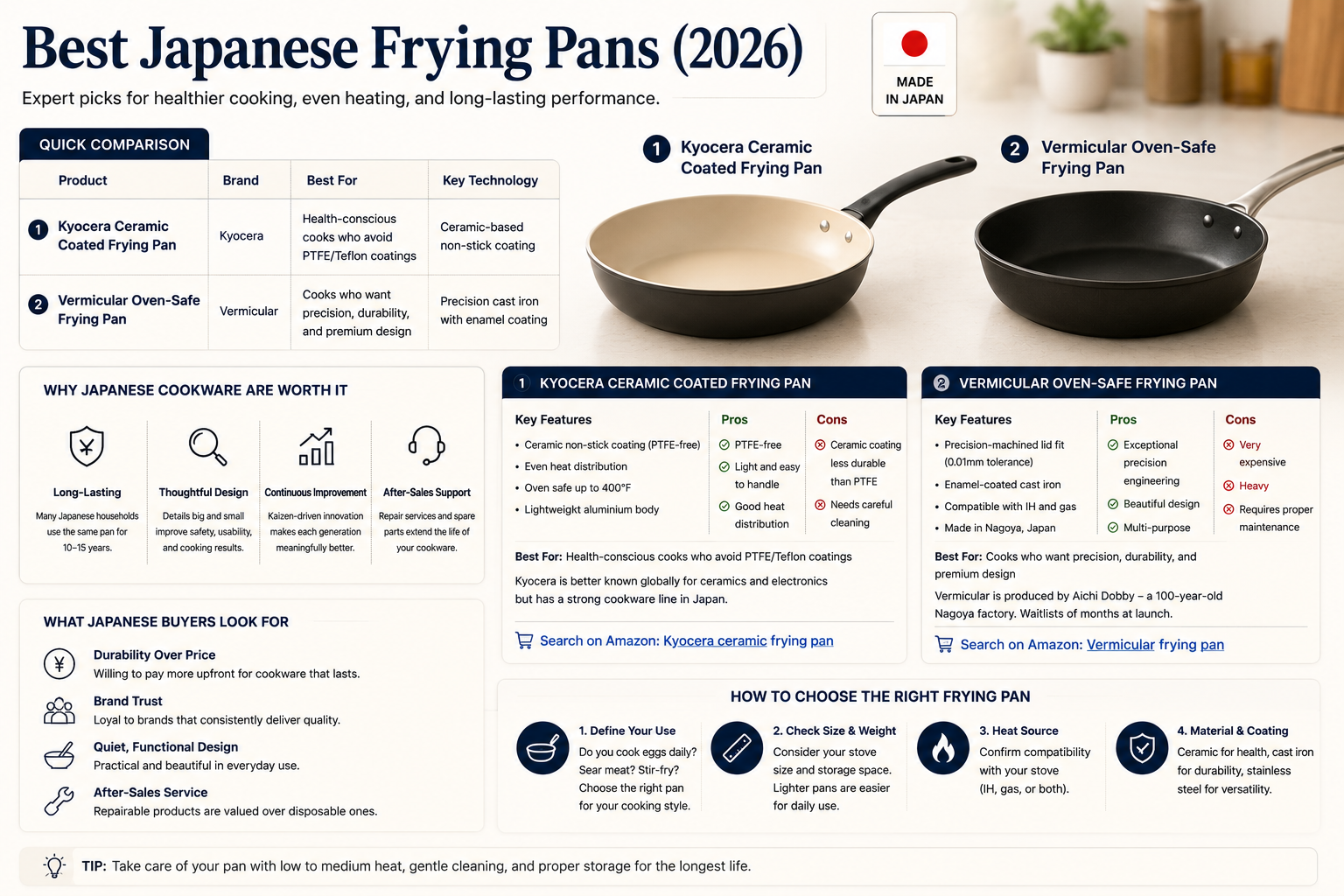
- Japan’s ceramics giant applies its expertise to cookware: Kyocera Ceramic Coated Frying Pan
- Nagoya craftsmen’s ultra-precise cast iron pot: Vermicular Oven-Safe Rice Pot
How These Picks Were Compared
When comparing Japanese Frying Pans, the factors that actually matter are:
- Coating type
- Size
- Oven-safe temperature
- Weight
- Price
Quick Comparison
| Product | Brand | Best For | Key Technology | Buy |
|---|---|---|---|---|
| Kyocera Ceramic Coated Frying Pan | Kyocera | Health-conscious cooks who avoid PTFE/Teflon coatings | Ceramic-based non-stick coating | (check current listings for pricing) |
| Vermicular Oven-Safe Rice Pot | Vermicular | Serious cooks and rice enthusiasts who want the ultimate pot | Precision CNC-machined cast iron with enamel coati | (check current listings for pricing) |
Why Japanese Cookware Are Worth It
Japanese manufacturers have been refining cookware for decades in response to some of the most demanding consumers in the world.
Only designs that hold up under regular use tend to remain popular over time.
A few things consistently set Japanese cookware apart:
- Attention to the smallest details: Features that seem minor — like a lid that seals perfectly or a button that clicks with satisfying precision — are the result of genuine engineering investment.
- Longevity: Many Japanese households use the same appliance or product for 10–15 years. Products are designed for that kind of use.
- Quiet quality: Japanese brands rarely shout about their products. The quality speaks through daily use, not through marketing.
- Continuous improvement (Kaizen): Each product generation makes small, meaningful improvements rather than chasing trendy features.
These products are commonly used in real kitchens, bags, and daily routines, and the difference is noticeable.
Our Top Picks — Detailed Reviews
1. Kyocera Ceramic Coated Frying Pan — Japan’s ceramics giant applies its expertise to cookware
(check current listings for pricing)
Brand: Kyocera | Category: Ceramic Non-Stick Frying Pan | Made in: Japan
Japan’s ceramics giant applies its expertise to cookware — a healthier non-stick alternative.
Key Features:
– Ceramic non-stick coating (PTFE-free)
– Even heat distribution
– Oven safe up to 400°F
– Lightweight aluminium body
Best For: Health-conscious cooks who avoid PTFE/Teflon coatings
Technology: Ceramic-based non-stick coating
- ✅ PTFE-free
- ✅ Light and easy to handle
-
✅ Good heat distribution
-
⚠️ Ceramic coating less durable than PTFE
- ⚠️ Needs careful cleaning
Kyocera is better known globally for ceramics and electronics but has a strong cookware line in Japan
No verified Japanese review summary is available at this stage. Check current Amazon listings for up-to-date buyer feedback.
2. Vermicular Oven-Safe Rice Pot — Nagoya craftsmen’s ultra-precise cast iron pot
(check current listings for pricing)
Brand: Vermicular | Category: Cast Iron / Enamel Pot | Made in: Japan
Nagoya craftsmen’s ultra-precise cast iron pot — the 0.01mm sealed lid traps steam perfectly.
Key Features:
– 0.01mm precision-machined lid seal
– Enamel-coated cast iron
– Compatible with IH and gas
– Multiple sizes
– Made in Nagoya, Japan
Best For: Serious cooks and rice enthusiasts who want the ultimate pot for Japanese home cooking
Technology: Precision CNC-machined cast iron with enamel coating
- ✅ Exceptional precision engineering
- ✅ Beautiful design
-
✅ Multi-purpose
-
⚠️ Very expensive
- ⚠️ Heavy
- ⚠️ Requires proper maintenance
Vermicular is produced by Aichi Dobby — a 100-year-old Nagoya factory. Waitlists of months at launch
No verified Japanese review summary is available at this stage. Check current Amazon listings for up-to-date buyer feedback.
How to Choose: Key Factors
1. Define Your Primary Use Case
Before looking at specs, decide what you’ll primarily use this for. A cookware that’s perfect for one use case may be overkill — or underpowered — for another.
2. Consider Your Budget Range
Japanese cookware span a wide price range. Higher price generally means better materials and longer lifespan, but the best-value option often sits in the mid-range.
3. Check Compatibility
Some Japanese products are designed for 100V Japanese electrical systems. Confirm the product supports 120V (North America) or 220–240V (Europe, UK, Australia) before purchasing.
4. Read the Warranty Terms
International purchases may not qualify for the domestic Japanese warranty. Many brands offer international warranties through authorised retailers.
5. Think Long-Term
Buyers in this category often plan for many years of use. If you’re comparing a Japanese option to a cheaper alternative, factor in likely replacement cost.
Frequently Asked Questions
Are Japanese Cookware worth the higher price?
For many buyers, yes. Japanese Cookware are generally built to last significantly longer than budget alternatives, and the better-designed ones are noticeably more pleasant to use daily. That said, not every Japanese product justifies a premium — use this guide to identify which ones do.
Can I buy Japanese Cookware outside Japan?
Yes — many Japanese brands sell internationally through Amazon and authorised retailers. Check that the voltage is compatible with your country and that international warranty coverage is included.
What Japanese brands are commonly used for Cookware?
Brand trust varies by category, but consistent names include: Vermicular, Kyocera. All have strong domestic reputations built over decades.
Are these products available on Amazon?
Most of the products in this guide are available on Amazon in the US, UK, and select other markets. We’ve included direct Amazon search links for each product.
Final Verdict
The best Japanese cookware combine engineering precision, long-term durability, and a quiet attention to detail that makes daily use genuinely enjoyable. Our top pick is the Kyocera Ceramic Coated Frying Pan for its health-conscious cooks who avoid ptfe/teflon coatings.
Whatever you choose from this list, you’re getting a product that has survived Japan’s demanding domestic market — which is one of the strongest quality filters in the world.
Have questions or want to share your experience? Leave a comment below.
Last updated: June 2026
As an Amazon Associate, we may earn from qualifying purchases. This does not affect our recommendations.
(check current listings for pricing)
Disclosure: As an Amazon Associate, Japanese Best earns from qualifying purchases. This does not affect our recommendations. We only feature products we genuinely believe are worth your consideration.
Editorial Disclaimer
This article does not constitute professional, financial, or purchasing advice of any kind.
Product availability, pricing, and specifications are subject to change without notice. Japanese Best makes no warranties — express or implied — regarding the accuracy or completeness of this content, and accepts no liability for any decisions made based on it. Always verify details directly with the retailer or manufacturer before purchasing.
コメント