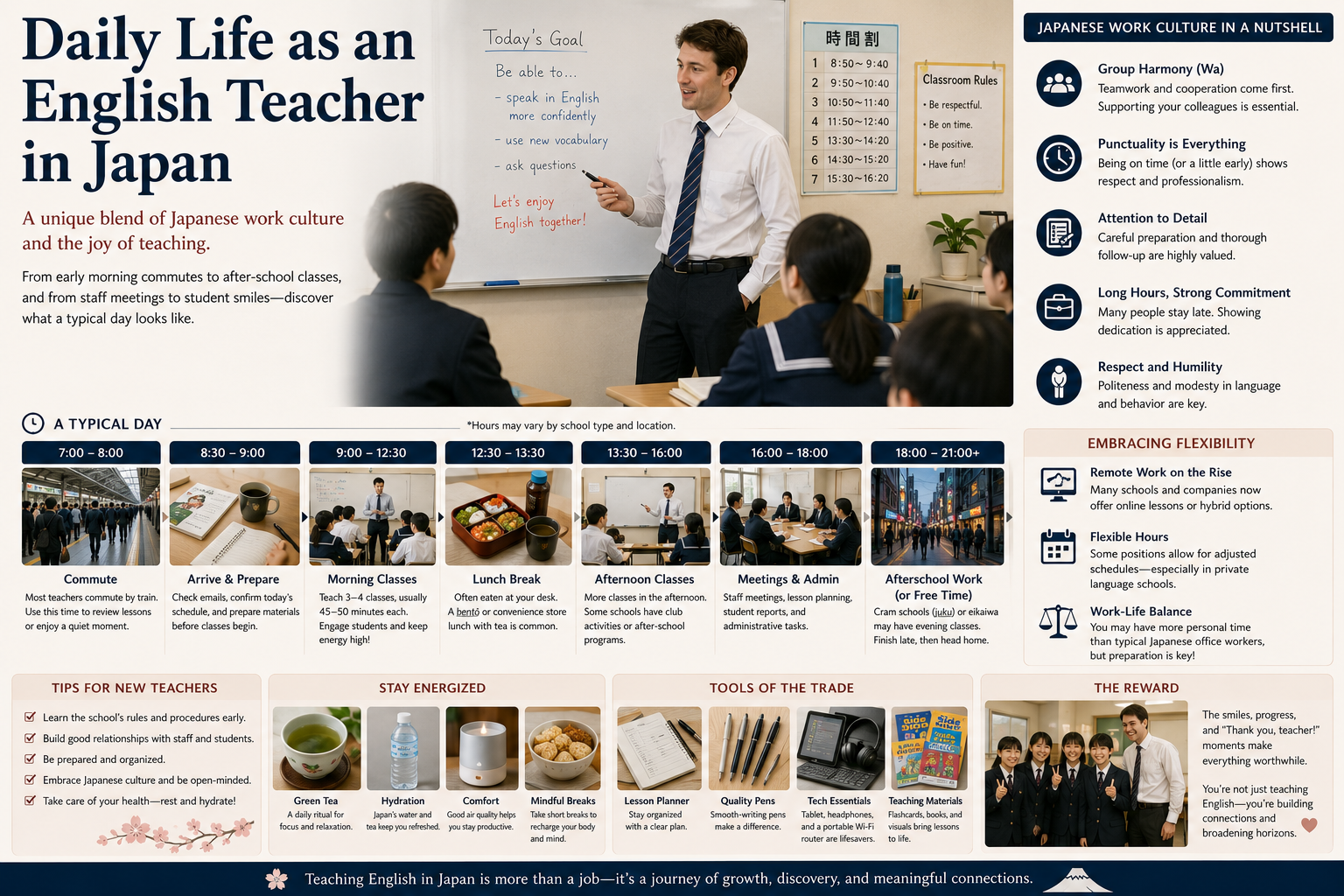
Daily Life as an English Teacher in Japan
July 11, 2026 | Work Life | Japanese Best
Stepping off the train at Shinjuku Station on your first morning as an English teacher in Japan, you feel the weight of expectation settle on your shoulders. Thousands of salarymen in dark suits stream past you, earbuds in, briefcases in hand. You’re about to join them—sort of. Teaching English in Japan offers a unique window into Japanese work culture that few outsiders experience, combining the rigour and structure of Japanese business with the relative informality of English education. Whether you’re teaching at a cram school (juku) in Tokyo, a public school in rural Hokkaido, or a corporate training centre in Osaka, your daily rhythm will reveal how Japan’s famous work ethic actually functions in practice.
Quick Summary
- Japanese work culture emphasises group harmony, long hours, and meticulous attention to detail—even in English teaching
- A typical teaching day spans 8–10 hours, including lessons, staff meetings, and administrative tasks, with lunch often taken at your desk
- English teachers enjoy slightly more flexibility than salaryman colleagues, but still follow strict schedules and protocols
- Remote work and flexible hours are beginning to reshape Japanese offices, though traditional expectations remain strong
- Quality tea, reliable hydration systems, and mindful breaks sustain you through intense working days
🛒 Shop Recommended Products
How Japanese Work Culture Works
Japanese workplaces operate on principles forged over decades: kaisha no tame ni (for the sake of the company), punctuality verging on obsession, and consensus-building before decision-making. As an English teacher, you’re both inside and outside this system. You’ll attend morning meetings where lesson plans are discussed in Japanese, participate in school events, and contribute to staff harmony through small gestures—bringing back omiyage (souvenirs) from your hometown, joining after-work izakaya trips, and respecting the hierarchical seating chart during staff meals.
Expectations run high: students expect fluent, engaging instruction; parents expect visible progress; and management expects you to embody “international professionalism.” Yet you’ll also notice flexibility absent from pure salaryman roles. Your creativity is encouraged in lesson planning, your accent is celebrated rather than corrected, and your “gaijin” (foreigner) status grants you a certain leeway. Still, lateness is unforgivable, taking days off requires weeks of notice, and your workspace—whether a desk in a juku or a classroom in a public school—remains subject to school regulations and observation.
A Typical Japanese Work Day
Your alarm goes off at 6:30 a.m. You shower, dress smartly (no trainers; business casual or business formal depending on your school), and arrive by 8:00 a.m.—fifteen minutes before your first lesson. You check the staffroom bulletin board for any last-minute changes, greet colleagues with a bow, and prepare materials at your desk.
From 8:30 a.m. to 12:30 p.m., you teach back-to-back classes: perhaps three groups of elementary students, two adult conversation classes, or a mix of private and group lessons. There’s no time between lessons for bathroom breaks. At 12:30 p.m., you eat lunch at your desk—a bento box you brought from home or something purchased from the convenience store—while completing administrative paperwork: attendance records, progress notes, and parent communication logs.
Afternoon sessions run 1:00–5:00 p.m., followed by a staff meeting (3:00–4:00 p.m.) where next month’s schedule, school events, and student concerns are discussed entirely in Japanese. You’re expected to contribute, even if you’re still learning the language. At 5:30 p.m., many colleagues begin leaving, but your workday often extends to 6:00 or 7:00 p.m. to finish lesson planning, mark papers, or attend optional professional development sessions. If your school hosts a school festival, sports day, or graduation ceremony, you’ll arrive on Saturday or work extra evenings with no additional pay.
How This Compares to Other Countries
In the UK or USA, English teachers typically enjoy autonomy: you set your own lesson start times (within reason), take lunch breaks away from your desk, and rarely work beyond contract hours. In Japan, your schedule is fixed, your break time is minimal, and “after-hours” work is considered normal and even expected.
However, Japanese schools offer advantages. Job security is exceptional—annual contracts are almost always renewed unless you’ve seriously underperformed. Medical and pension benefits are comprehensive, and you’ll rarely face the redundancy fears that plague Western teachers. Classroom discipline is rarely an issue; students are taught that disrupting lessons is disrespectful to teachers and peers alike. You won’t spend your evening grading papers at home or managing anxious parents via email chains.
The trade-off is cultural: you’re expected to be a representative of English-speaking culture, not just a language technician. You’ll be asked about American Thanksgiving, British politics, and whether you prefer tea or coffee (the latter is safer socially). Your personal life becomes semi-public; colleagues will ask about your dating status, living situation, and salary with a frankness that Western workplaces would deem inappropriate.
How It’s Changing
Post-pandemic, Japanese work culture is slowly evolving. Remote work, once virtually non-existent, is now accepted at some schools and corporate training centres. Some juku have introduced flexible scheduling for part-time teachers. Mental health awareness is rising; schools are beginning to acknowledge karoshi (death from overwork) and burnout.
Yet change is gradual. Most public schools still expect in-person attendance five days a week. The after-work drinking culture persists, though it’s becoming optional in progressive companies. Younger staff members—particularly those who’ve lived abroad—often challenge the “presence equals productivity” mentality. If you’re teaching in Tokyo or Osaka, you’ll encounter this generational shift. In smaller cities, traditional expectations remain stronger.
For English teachers specifically, demand is actually increasing. Japan’s schools are now prioritising English from elementary level, and the 2020 Olympics sparked renewed interest in international communication. This means you’re likely to find steady work, but it also means your employer knows they can find a replacement. Job security comes with reduced negotiating power over hours and pay.
Sustaining Yourself Through the Working Day
Long hours require reliable energy management. Many teachers establish morning rituals: a strong coffee, a moment of quiet before the chaos begins. Throughout the day, staying hydrated is essential. A Zojirushi CV-DCC40 VE Hybrid Water Boiler kept in the staffroom ensures you always have hot water for tea at the precise temperature you prefer—no waiting, no electricity waste. Japanese teachers frequently drink tea between lessons, and having this reliable system means you can maintain your own ritual without depending on school facilities.
For afternoon slumps, Ito En Oi Ocha Premium Green Tea by Ito En is Japan’s most trusted option. Unlike coffee, green tea provides gentle caffeine without the jitters, and it’s deeply woven into Japanese workplace culture. Keeping premium packets at your desk shows respect for Japanese tradition and gives you a mental break between lessons—even five minutes of mindful tea drinking shifts your focus.
Many teachers also develop meditation or mindfulness practices to manage stress. If you’re inclined toward tea ceremony culture as a way of finding calm, Uji Matcha Ceremonial Grade from Japan’s most prestigious matcha region near Kyoto offers that meditative practice. Preparing matcha properly—whisking it with bamboo tools, tasting it slowly—transforms a caffeine break into a moment of intentional calm, counterbalancing the rush of Japanese workday demands.
FAQ
Q: Do English teachers work longer hours than Japanese colleagues?
A: Not typically. You’ll work the same core hours, though salaryman colleagues may stay even later. Your main advantage is that “extra” tasks (attending industry conferences, mentoring new staff) aren’t usually expected of you.
Q: Is it normal to feel isolated as a foreign teacher?
A: Yes, initially. You’re welcomed for your foreignness but also slightly set apart. Building genuine relationships takes time. Joining staff activities—even if they feel awkward—accelerates acceptance.
Q: What’s the salary like?
A: English teachers earn ¥2.5–4 million annually depending on experience and location. Tokyo pays more; rural areas pay less. Compared to UK or US teachers, it’s modest, but living costs are reasonable, and you’ll have minimal expenses (no car, excellent public transport).
Q: Can I negotiate working hours?
A: Limited flexibility. Public schools have set timetables. Private juku may offer slightly more negotiation, particularly if you’re experienced or willing to teach evening/weekend classes.
Recommended Japanese Products
The products below are directly relevant to this article and used by Japanese families.
| Product | Brand | Best For | Link |
|---|---|---|---|
| Ito En Oi Ocha Premium Green Tea | Ito En | Green tea newcomers and regular tea drinkers who want reliable, authentic sencha | Ito En Oi Ocha Premium Green Tea |
| Uji Matcha Ceremonial Grade (Various Brands) | Various Uji Brands | Matcha ceremony enthusiasts and people who want the highest-quality matcha experience | Uji Matcha Ceremonial Grade (Various Brands) |
| Zojirushi CV-DCC40 VE Hybrid Water Boiler | Zojirushi | Families who drink tea or coffee frequently and want instant hot water at the right temperature | Zojirushi CV-DCC40 VE Hybrid Water Boiler |
Ito En Oi Ocha Premium Green Tea
Japan’s #1 green tea brand brings premium sencha to the world — grassy, refreshing, authentic.
Best for: Green tea newcomers and regular tea drinkers who want reliable, authentic sencha
🛒 Ito En Oi Ocha Premium Green Tea on Amazon
Uji Matcha Ceremonial Grade (Various Brands)
Uji, near Kyoto, is Japan’s most prestigious matcha-producing region — a regional designation, not a brand.
Best for: Matcha ceremony enthusiasts and people who want the highest-quality matcha experience
🛒 Uji Matcha Ceremonial Grade (Various Brands) on Amazon
Zojirushi CV-DCC40 VE Hybrid Water Boiler
Zojirushi’s premium keep-warm boiler — uses vacuum insulation to maintain temperature without constant heating.
Best for: Families who drink tea or coffee frequently and want instant hot water at the right temperature
🛒 Zojirushi CV-DCC40 VE Hybrid Water Boiler on Amazon
More From Japanese Best
- Cost of Living in Tokyo in 2025: A Real Breakdown
- What Japanese Families Eat for Dinner
Disclosure: As an Amazon Associate, Japanese Best earns from qualifying purchases. This does not affect our recommendations. We only feature products we genuinely believe are worth your consideration.
Editorial Disclaimer
The views, opinions, and recommendations in this article are the author’s own and reflect personal experience living in Japan. They do not constitute professional, financial, or purchasing advice of any kind.
Product availability, pricing, and specifications are subject to change without notice. Japanese Best makes no warranties — express or implied — regarding the accuracy or completeness of this content, and accepts no liability for any decisions made based on it. Always verify details directly with the retailer or manufacturer before purchasing.
コメント