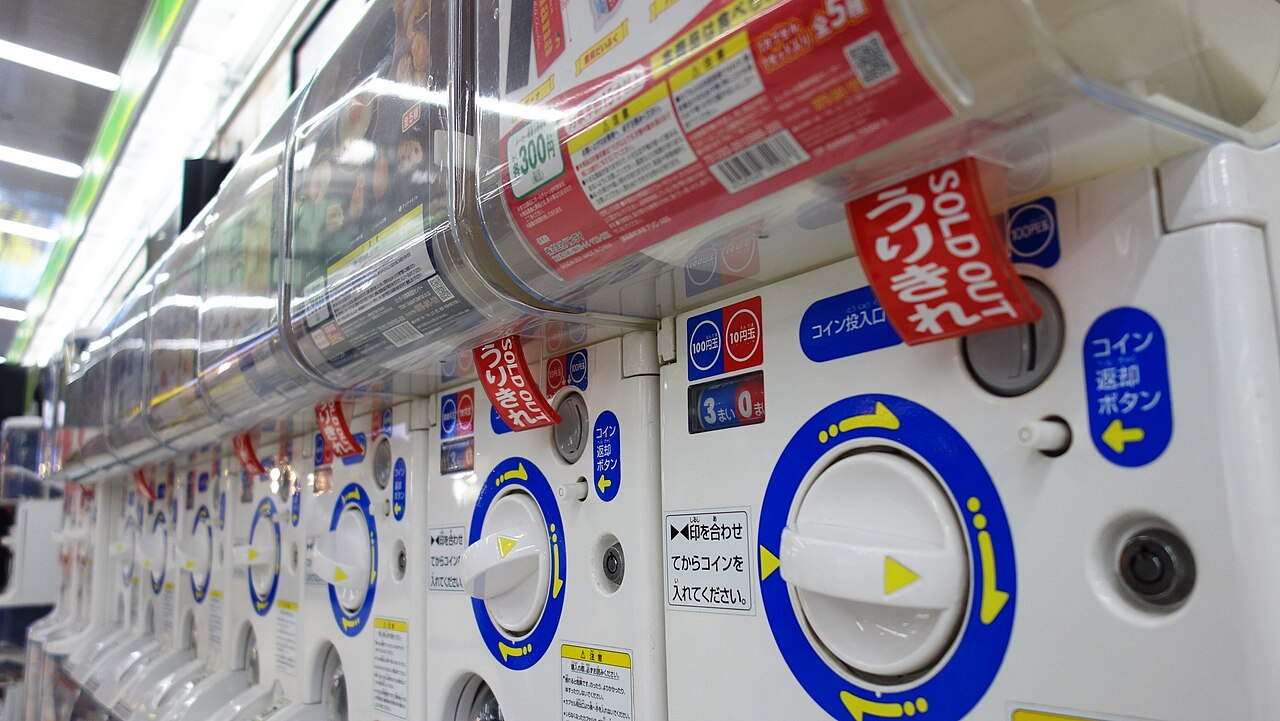
Data: Japan Capsule Toy Association surveys for fiscal years 2022–2025 (latest published February 19, 2026). Checked October 23, 2026. The photos on this page were taken in 2021 and 2018; they show the shop format, not the shops as they are in 2026.
Walk through a Japanese shopping mall or station building in 2026 and you may find a shop that sells nothing but capsule toys: rows of coin-operated machines, each holding a different set of small figures, keyrings or miniature everyday objects, usually for ¥300 to ¥500 a turn. The industry calls them capsule toys; many people call them gacha or gachapon, after the sound of the handle.
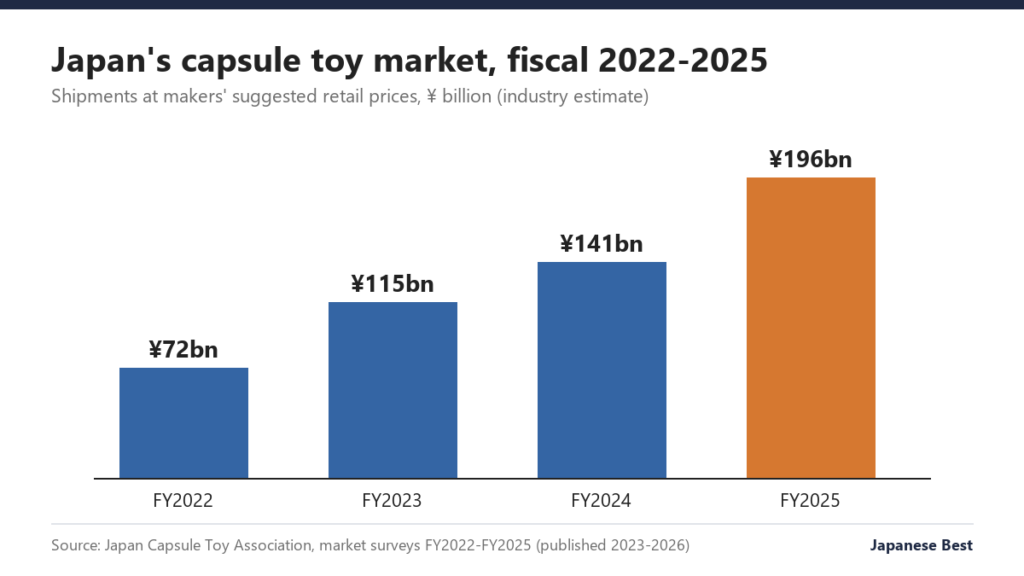
The industry association says the market has nearly tripled in three years. This page looks at what is actually in the machines, where the shops are, why prices went up, and what the headline figures can and cannot tell you about the boom.
What’s in the machines now
The Japan Capsule Toy Association (日本カプセルトイ協会, JACTA) describes the main themes in its annual reports:
- Heisei-era nostalgia. Its 2025 report says a “Heisei girls’ boom” (平成女児ブーム) was running hot, with revivals of characters such as Sanrio’s and Tamagotchi, and collaborations with brands that were popular in the early Heisei years (the 1990s).
- Goods for fans. Oshi-katsu (推し活), spending on a favourite character or performer, became a fixture among the main buyers, women in their twenties and thirties, and “oshi-katsu goods” sell well in capsule form.
- Company collaborations. Miniature versions of real food, household goods, cosmetics and fashion-brand products grew in 2024 as companies began to treat capsule machines as an advertising medium. By 2025, JACTA says, this category was saturated and sales slowed.
- Niche and creator goods. In 2025 operators set themselves apart with products made by independent creators and aimed at narrow fan groups.
- Bigger capsules. New machines that dispense 90 mm capsules (9 cm across) allow larger figures and plush toys that did not fit before.
- Anime films. Films popular overseas, such as Demon Slayer and Jujutsu Kaisen in 2025, drove capsule toy sales.
You can see the range in one building. Nakano City’s official tourism site listed 21 places selling capsule toys across the basement to third floors of Nakano Broadway in 2022, from a few machines outside a shop to a shop filled entirely with machines.
From the corner of a supermarket to dedicated shops
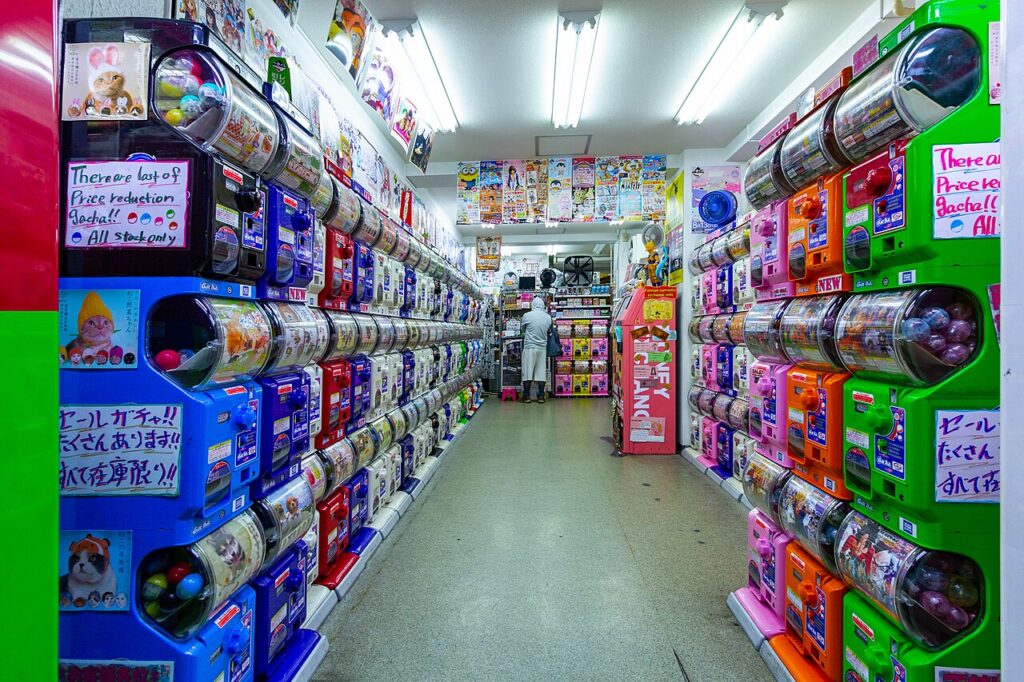
Capsule machines used to stand in small groups outside supermarkets and toy shops. JACTA says that from around 2020–2021, shop-style capsule toy specialist stores, with hundreds of machines under one roof, became the main format. Its 2022 report links this to empty units in large shopping centres during the pandemic, which landlords offered to capsule toy operators.
JACTA counted 917 specialist shops run by 12 operators as of January 31, 2026, more than 200 up on the previous year:
| Region | Shops | Share (our calculation) |
|---|---|---|
| Kantō (incl. Tokyo) | 329 | 36% |
| Chūbu | 138 | 15% |
| Kinki (incl. Osaka, Kyoto) | 138 | 15% |
| Kyūshū | 94 | 10% |
| Hokkaidō | 82 | 9% |
| Tōhoku | 55 | 6% |
| Chūgoku | 46 | 5% |
| Shikoku | 28 | 3% |
| Okinawa | 7 | 1% |
| Total | 917 | 100% |
The largest operator in the table runs 257 shops. In early 2025, JACTA reported that shops around major cities in the Tokyo area were reaching saturation and expected growth to move to regional cities. For 2026 it expects more than 100 further shops, including more street-front shops rather than mall tenants.
How big the market is
JACTA estimates the market each year by interviewing capsule toy makers. Its figure is shipments valued at the makers’ suggested retail prices, adjusted by the association for sales conditions, for products made for capsule machines in Japan.
| Fiscal year | Market size | Change | Makers surveyed |
|---|---|---|---|
| 2022 | about ¥72 billion | — | 30 |
| 2023 | about ¥115 billion | +59.7% | 34 |
| 2024 | about ¥141 billion | +22.6% | 35 |
| 2025 | about ¥196 billion | +39.0% | 41 |
Our calculation: about 2.7 times in three years, an average of roughly 40% a year.
Three cautions from the association itself. The survey covers only products for capsule machines; including capsule goods sold at events or made as company promotions, JACTA thinks the 2025 market was above ¥200 billion. Each maker reports its own most recent year, so the periods do not line up exactly. And this is a shipments figure: for fiscal 2023, JACTA estimated that about 10% of the goods were still sitting in machines or in operators’ stock, putting actual sales nearer ¥100 billion than ¥115 billion.
For scale, the Japan Toy Association puts Japan’s whole toy market at a record ¥1.166 trillion in fiscal 2025 (April 2025 to March 2026). The two surveys count different things, so the capsule figure should not be read as a share of that total.
What the growth is made of
A bigger market figure does not by itself mean that each shopper is buying more. JACTA’s own reports point to three things that push the figure up:
| Driver | What JACTA reports |
|---|---|
| More places to buy | 200+ specialist shops opened in fiscal 2023; 700+ shops by early 2025; 917 by January 2026 |
| More products | About 400 new products a month in fiscal 2022, 500+ in 2023 and about 700 in 2024 |
| Higher prices | ¥100 capsules had “almost disappeared” by 2023 and ¥200 capsules by 2024, as the weak yen and higher material, labour and shipping costs pushed prices up |
The prices of new releases in calendar 2025 (excluding re-releases) show where things stand:
| Price | New products (SKUs) | Share |
|---|---|---|
| ¥100 | 69 | 0.9% |
| ¥200 | 557 | 7.6% |
| ¥300 | 3,192 | 43.4% |
| ¥400 | 2,345 | 31.9% |
| ¥500 | 1,194 | 16.2% |
| Total | 7,357 |
¥300 is still the most common single price, but ¥400 and ¥500 together make up 48.1%.
What we cannot tell from the data. Three figures are easy to mix up: the market size, the estimated number of capsules, and actual sales.
| Figure | What it is | A count of actual sales? |
|---|---|---|
| About ¥196 billion (fiscal 2025) | Makers’ shipments valued at suggested retail prices, adjusted by JACTA for sales conditions | No. It estimates shipments, not what shoppers bought |
| About 550 million capsules | JACTA’s calculation: the market size divided by the average price | No. It is derived from the market estimate |
| Four to five capsules per person a year | The 550 million divided by Japan’s population | No. It is derived from the same estimate |
| Actual sales | Not published. For fiscal 2023 only, JACTA estimated that about 10% of shipments were still unsold, putting sales nearer ¥100 billion | Only this rough estimate, for one year |
So there is no independent count of how many capsules people buy. If the market estimate is too high or too low, the capsule count and the per-person figure move with it.
What does point to demand beyond more machines and higher prices: JACTA describes buyers spreading across all ages and genders, more than 70 makers now in the business, several mergers and acquisitions among capsule toy companies in 2025, and visitors from abroad making up more than half of customers at shops near popular tourist spots. Against that, the association itself warned in early 2025 that competition in the Tokyo area was intense and that some shops would start to close as profits fell.
Visitors from abroad
JACTA reports that a fall in Chinese group tours in the second half of 2025 reduced customer numbers slightly but did not have a large effect on makers’ sales. In its 2023 report the association suggested that, to visitors, capsule toys have become a modern version of Japan’s long-standing image as a country of miniatures; that is the association’s interpretation, not a survey result.
Why it matters
Capsule toys are a small purchase, but they show a real change in how Japanese malls and shopping streets use space: a format that once filled a few machines by a supermarket entrance now fills whole shops, in every region. How much of the money growth comes from more shoppers, rather than more machines and higher prices, the published numbers cannot say.
Not surveyed on site: we have not visited the shops or bought capsules for this article. All figures come from the industry associations’ published reports and Nakano City’s tourism site.
Sources
- Japan Capsule Toy Association — FY2025 capsule toy market survey (PDF, February 19, 2026)
- Japan Capsule Toy Association — FY2024 survey (PDF, February 13, 2025)
- Japan Capsule Toy Association — FY2023 survey (PDF, February 15, 2024)
- Japan Capsule Toy Association — FY2022 survey (PDF, January 26, 2023)
- Japan Toy Association — Japanese toy market size, FY2015–FY2025 (PDF, June 2026)
- Nakano City official tourism site “Marutto Nakano” — Nakano Broadway feature, including capsule toy spots (PDF of the March 2022 page)
Related: Nakano Station in 2026, next to Nakano Broadway
Top photo: “Capsule toy machine 20211229 142535” by Ka23 13 (Wikimedia Commons), CC BY 4.0; resized by Japanese Best. Other photos and charts are credited in their captions.


Comments