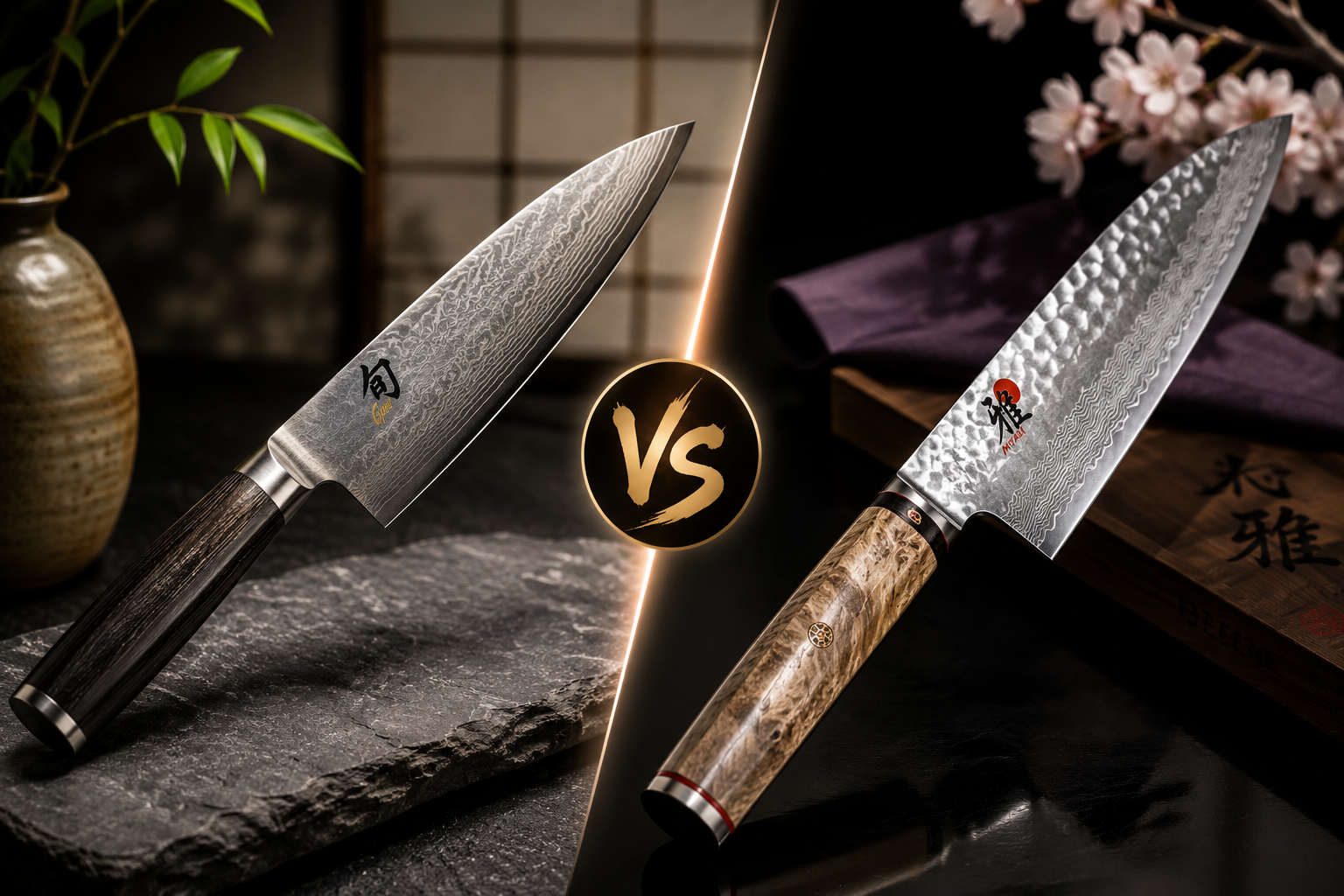
Shun vs Miyabi Kitchen Knives (2026)
Published on June 13, 2026 | Japanese Best
Introduction
Both brands have strong reputations in Japan and abroad. But reputation alone doesn’t tell you which one to buy. Here’s an honest, side-by-side look at what each offers, who each one is best for, and where each falls short.
A Note from Tokyo: In my experience shopping at places like Yodobashi Camera and Loft in Tokyo, Japanese kitchen knives are not a luxury purchase — they’re the everyday baseline. Japanese households simply expect this level of quality, which means manufacturers have no room to cut corners.
Specs at a Glance
| Feature | Shun | Miyabi |
|---|---|---|
| Product | Shun Classic 8-inch Chef’s Knife | Miyabi Birchwood 8-inch Chef’s Knife |
| Technology | VG-MAX cutting core with Damascus layering | SG2 powder metallurgy steel, Cryodur ice-hardening |
| Best For | Home cooks who want a premium everyday chef’s knif | Gift buyers and collectors who want the finest mat |
| Made In | Japan | Japan |
Option 1: Shun — Shun Classic 8-inch Chef’s Knife
An iconic Japanese knife that marries traditional craftsmanship with a Western-style blade.
Technology: VG-MAX cutting core with Damascus layering
Key Features:
– VG-MAX steel core
– 68-layer Damascus cladding
– D-shaped Pakkawood handle
– 16° cutting edge
– Handcrafted in Seki, Japan
Strengths:
– ✅ Exceptional sharpness
– ✅ Beautiful Damascus pattern
– ✅ Balanced weight
Limitations:
– ⚠️ Requires hand washing
– ⚠️ Premium price
Seki City is Japan’s equivalent of Solingen — the world’s cutlery capital
Option 2: Miyabi — Miyabi Birchwood 8-inch Chef’s Knife
Zwilling’s premium Japanese line with a stunning Birchwood handle and SG2 powder steel.
Technology: SG2 powder metallurgy steel, Cryodur ice-hardening
Key Features:
– SG2 micro-carbide powder steel
– 101-layer Damascus
– Birchwood handle
– Honbazuke hand-honing
– Ice-hardened blade
Strengths:
– ✅ Stunning aesthetics
– ✅ Extremely hard blade
– ✅ Premium feel
Limitations:
– ⚠️ Very high price
– ⚠️ Blade hardness makes it more brittle
Miyabi is made in Seki by Zwilling and represents a German-Japanese collaboration
Head-to-Head Comparison
| Dimension | Shun | Miyabi |
|---|---|---|
| Technology | VG-MAX cutting core with Damascus layering | SG2 powder metallurgy steel, Cryodur ice-hardening |
| Best For | Home cooks who want a premium everyday chef’s | Gift buyers and collectors who want the fines |
| Made In | Japan | Japan |
Performance: Both perform well in everyday use. Shun’s advantage lies in vg-max steel core. Miyabi leads in sg2 micro-carbide powder steel.
Build Quality: Both brands are serious about durability. Japanese consumers expect products to last — and both companies have reputations to protect in their domestic market.
Value: Neither is a budget option. Compare current Amazon pricing for the most accurate picture, as prices vary by region and timing.
What Japanese Buyers Look For
Japanese consumers approach purchasing kitchen knives differently from many Western buyers.
Here are the patterns I’ve observed in Tokyo households and through Japanese consumer reports:
Durability over initial cost: Japanese buyers frequently choose a more expensive option upfront if it means the product will last 10 years rather than 3. The concept of mono no aware — appreciation for enduring things — extends to everyday objects.
Brand trust built over generations: Brands like Shun, Miyabi have earned trust through decades of consistent quality. Japanese buyers are often loyal to a single brand and purchase the next generation without comparison shopping.
Quiet, functional design: Flashy aesthetics are less important than clean lines and intuitive use. Products that look modest but function flawlessly are valued.
After-sales support: In Japan, manufacturers offer repair services for many products — not just replacement. This shapes buying decisions toward brands with strong domestic service networks.
Japanese buyers often praise products in this category for their durability and ease of use. For the most current buyer sentiment, we recommend checking Amazon reviews filtered to verified purchases.
Which One Should You Buy?
Choose Shun if: Home cooks who want a premium everyday chef’s knife with stunning aesthetics
Choose Miyabi if: Gift buyers and collectors who want the finest materials and striking appearance
Both are genuinely good products. The decision usually comes down to your specific use case and which features matter most to your daily routine.
Frequently Asked Questions
Are Japanese Kitchen Knives worth the higher price?
For many buyers, yes. Japanese Kitchen Knives are generally built to last significantly longer than budget alternatives, and the better-designed ones are noticeably more pleasant to use daily. That said, not every Japanese product justifies a premium — use this guide to identify which ones do.
Can I buy Japanese Kitchen Knives outside Japan?
Yes — many Japanese brands sell internationally through Amazon and authorised retailers. Check that the voltage is compatible with your country and that international warranty coverage is included.
What Japanese brands are most trusted for Kitchen Knives?
Brand trust varies by category, but consistent names include: Shun, Miyabi. All have strong domestic reputations built over decades.
Are these products available on Amazon?
Most of the products in this guide are available on Amazon in the US, UK, and select other markets. We’ve included direct Amazon search links for each product.
Conclusion
Both brands represent the best of Japanese manufacturing — and the right choice depends entirely on your priorities.
Compare Shun Classic 8-inch Chef’s Knife and Miyabi Birchwood 8-inch Chef’s Knife on Amazon to check current pricing and availability before deciding.
Last updated: June 2026
Related Guides
As an Amazon Associate, we may earn from qualifying purchases. This does not affect our recommendations.
Disclosure: As an Amazon Associate, Japanese Best earns from qualifying purchases. This does not affect our recommendations. We only feature products we genuinely believe are worth your consideration.
Editorial Disclaimer
The views, opinions, and recommendations in this article are the author’s own and reflect personal experience living in Japan. They do not constitute professional, financial, or purchasing advice of any kind.
Product availability, pricing, and specifications are subject to change without notice. Japanese Best makes no warranties — express or implied — regarding the accuracy or completeness of this content, and accepts no liability for any decisions made based on it. Always verify details directly with the retailer or manufacturer before purchasing.
コメント