Japanese Recycling Rules Explained Simply
July 11, 2026 | Family Life | Japanese Best
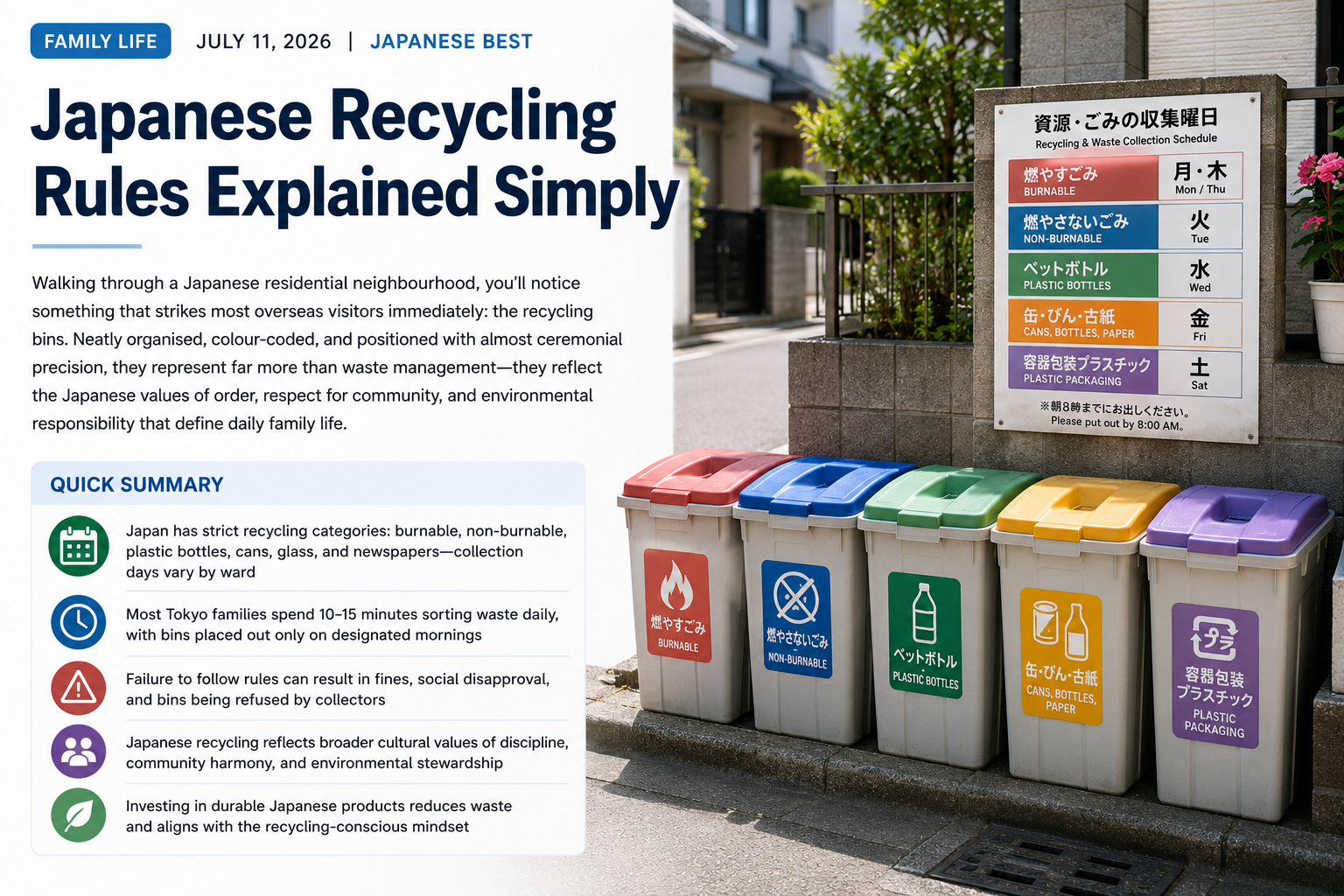
Walking through a Japanese residential neighbourhood, you’ll notice something that strikes most overseas visitors immediately: the recycling bins. Neatly organised, colour-coded, and positioned with almost ceremonial precision, they represent far more than waste management—they reflect the Japanese values of order, respect for community, and environmental responsibility that define daily family life. If you’re planning to move to Japan, working with a Japanese family, or simply curious about how Japanese households actually operate, understanding recycling rules is essential. It’s the perfect window into Japanese culture itself.
Quick Summary
- Japan has strict recycling categories: burnable, non-burnable, plastic bottles, cans, glass, and newspapers—collection days vary by ward
- Most Tokyo families spend 10–15 minutes sorting waste daily, with bins placed out only on designated mornings
- Failure to follow rules can result in fines, social disapproval, and bins being refused by collectors
- Japanese recycling reflects broader cultural values of discipline, community harmony, and environmental stewardship
- Investing in durable Japanese products reduces waste and aligns with the recycling-conscious mindset
🛒 Shop Recommended Products
The Basics: What Most Japanese Families Do
Japanese recycling isn’t optional—it’s a legal and social expectation. Every municipality publishes a detailed waste separation guide, typically available in Japanese and English. The standard categories are: moerogomi (burnable waste), moenai gomi (non-burnable waste), purasuチック (plastic bottles), kan (cans), bin (glass bottles), and shimbun (newspapers and cardboard).
Each category has its own collection day, usually once or twice weekly. In Tokyo’s Shibuya ward, for example, burnable waste is collected twice weekly, while glass bottles are collected once monthly. Families receive a detailed calendar at the start of the year showing exact collection schedules. Bins must be placed out by 8 a.m. on collection day—not earlier, not later. Violation of these rules isn’t taken lightly; persistent offenders may face warnings from the ward office or have their rubbish refused by collectors entirely.
A Typical Week in a Japanese Household
Monday morning in a Tokyo family home begins with the weekly ritual. The previous evening, the household has sorted their waste into designated containers. Tuesday is burnable day in most central wards, so Monday night preparation is crucial. Plastic wrapping from food packaging goes into the plastic category; metal lids are removed and placed in the non-burnable bin; glass jars are rinsed thoroughly to prevent odours.
Wednesday evening might mean preparing glass bottles for Friday’s collection. Residents must rinse bottles, remove labels, and separate coloured glass from clear glass—different containers for each. Thursday brings the neighbourhood’s biggest undertaking: sorting newspapers, magazines, and cardboard, tying them into neat bundles with twine (not plastic), ready for Friday collection. It sounds exhausting, but most Japanese families simply integrate these tasks into their weekly routine, the same way they might do laundry or meal planning.
What This Looks Like in a Real Tokyo Home
Picture Tanaka-san’s apartment in Minato ward, Tokyo. Her kitchen features five separate bins, each labelled clearly in Japanese and English. One slim bin holds burnable waste (food scraps, tissues, soiled paper); another holds rigid plastics and non-burnable items. A tall, narrow container stores plastic bottles—compressed and stacked vertically to save space. On the balcony, two larger bins hold glass bottles (separated by colour) and cans.
Every evening, Tanaka-san spends roughly five minutes sorting that day’s waste. Rice cooker bags, worn-out tea bags, and uneaten food scraps go into the burnable bin. Plastic yoghurt containers are rinsed and placed in the plastic bin. Empty aluminium cans are crushed slightly and placed in the can bin. When Tuesday arrives, she places her burnable bin on the pavement by 7:45 a.m. If she misses the window, that waste waits until the following Tuesday. It’s disciplined, but Tanaka-san sees this not as burden but as civic duty—part of living respectfully in a shared community.
How Japanese Recycling Differs From Other Countries
Unlike many Western countries where residents simply place mixed recycling into a single bin, Japan demands granular separation at the household level. The council doesn’t sort—residents must. This places responsibility squarely on families and reflects a cultural philosophy: prevention and responsibility matter more than correction. It also explains why Japanese people tend to adopt sustainable habits naturally; the system trains them from childhood.
Furthermore, Japan’s recycling extends to product design. Japanese manufacturers build items with longevity and repairability in mind, reducing waste at source. When you invest in quality Japanese products—a durable water bottle, a reliable commuter mug, or long-lasting electronics—you’re participating in this same philosophy. For daily commuters, the Zojirushi SM-SHE60AG Stainless Mug is designed to last years, eliminating disposable cup waste. Similarly, the Tiger MMZ-A502 Stainless Bottle with its durable wide-mouth design reduces reliance on single-use plastics—a philosophy deeply embedded in Japanese culture.
The Deeper Cultural Context
Recycling in Japan isn’t truly about waste management; it’s about mottainai—the concept of regret over waste. It’s about respecting resources and acknowledging that nothing should be carelessly discarded. This mindset extends beyond rubbish bins into how Japanese families approach consumption, repair, and community responsibility. Breaking recycling rules isn’t just illegal; it’s culturally shameful, a visible rejection of community values.
For those working remotely or frequently commuting in Japan, maintaining this mindset is easier with reliable Japanese tools. The Sony WH-1000XM5 noise-cancelling headphones are engineered for years of daily use, reducing the technological waste that plagues disposable-culture countries. Quality products align with Japanese environmental values.
Frequently Asked Questions
What happens if I get it wrong?
First-time mistakes are usually forgiven, especially for foreigners. However, repeated violations can result in warnings from your ward office or refusal of collection. Neighbours may also politely correct you.
Can I use any bags?
Most wards require semi-transparent or clear bags so collectors can verify contents. Dark or opaque bags are often refused. Bags typically cost ¥100–200 per pack.
What about large items?
Furniture, appliances, and bicycles require separate collection. You must contact your local ward office, pay a fee (typically ¥1,000–3,000), and arrange pickup. This prevents illegal dumping.
Do different wards have different rules?
Yes. Tokyo’s 23 wards each set their own schedules and categories. Always check your specific ward’s guide—these are available online and at ward offices.
Recommended Japanese Products
The products below are directly relevant to this article and used by Japanese families.
| Product | Brand | Best For | Link |
|---|---|---|---|
| Zojirushi SM-SHE60AG Stainless Mug | Zojirushi | Daily commuters who want reliable, durable coffee/tea on the go | Zojirushi SM-SHE60AG Stainless Mug |
| Tiger MMZ-A502 Stainless Bottle | Tiger | Active users, hikers, and gym-goers who need a rugged easy-fill bottle | Tiger MMZ-A502 Stainless Bottle |
| Sony WH-1000XM5 | Sony | Frequent travellers, remote workers, and audiophiles who want the best ANC | Sony WH-1000XM5 |
Zojirushi SM-SHE60AG Stainless Mug
Zojirushi’s most popular commuter mug — slim, spill-proof, and keeps drinks hot for 6 hours.
Best for: Daily commuters who want reliable, durable coffee/tea on the go
🛒 Zojirushi SM-SHE60AG Stainless Mug on Amazon
Tiger MMZ-A502 Stainless Bottle
Tiger’s wide-mouth design makes it easy to add ice and clean thoroughly.
Best for: Active users, hikers, and gym-goers who need a rugged easy-fill bottle
🛒 Tiger MMZ-A502 Stainless Bottle on Amazon
Sony WH-1000XM5
Sony’s flagship ANC headphones — industry-leading noise cancellation and exceptional sound.
Best for: Frequent travellers, remote workers, and audiophiles who want the best ANC
More From Japanese Best
- [INTERNAL_LINK: cost-of-living-in-tokyo-2025]
- [INTERNAL_LINK: what-japanese-families-eat-every-week]
Disclosure: As an Amazon Associate, Japanese Best earns from qualifying purchases. This does not affect our recommendations. We only feature products we genuinely believe are worth your consideration.
Editorial Disclaimer
The views, opinions, and recommendations in this article are the author’s own and reflect personal experience living in Japan. They do not constitute professional, financial, or purchasing advice of any kind.
Product availability, pricing, and specifications are subject to change without notice. Japanese Best makes no warranties — express or implied — regarding the accuracy or completeness of this content, and accepts no liability for any decisions made based on it. Always verify details directly with the retailer or manufacturer before purchasing.
コメント