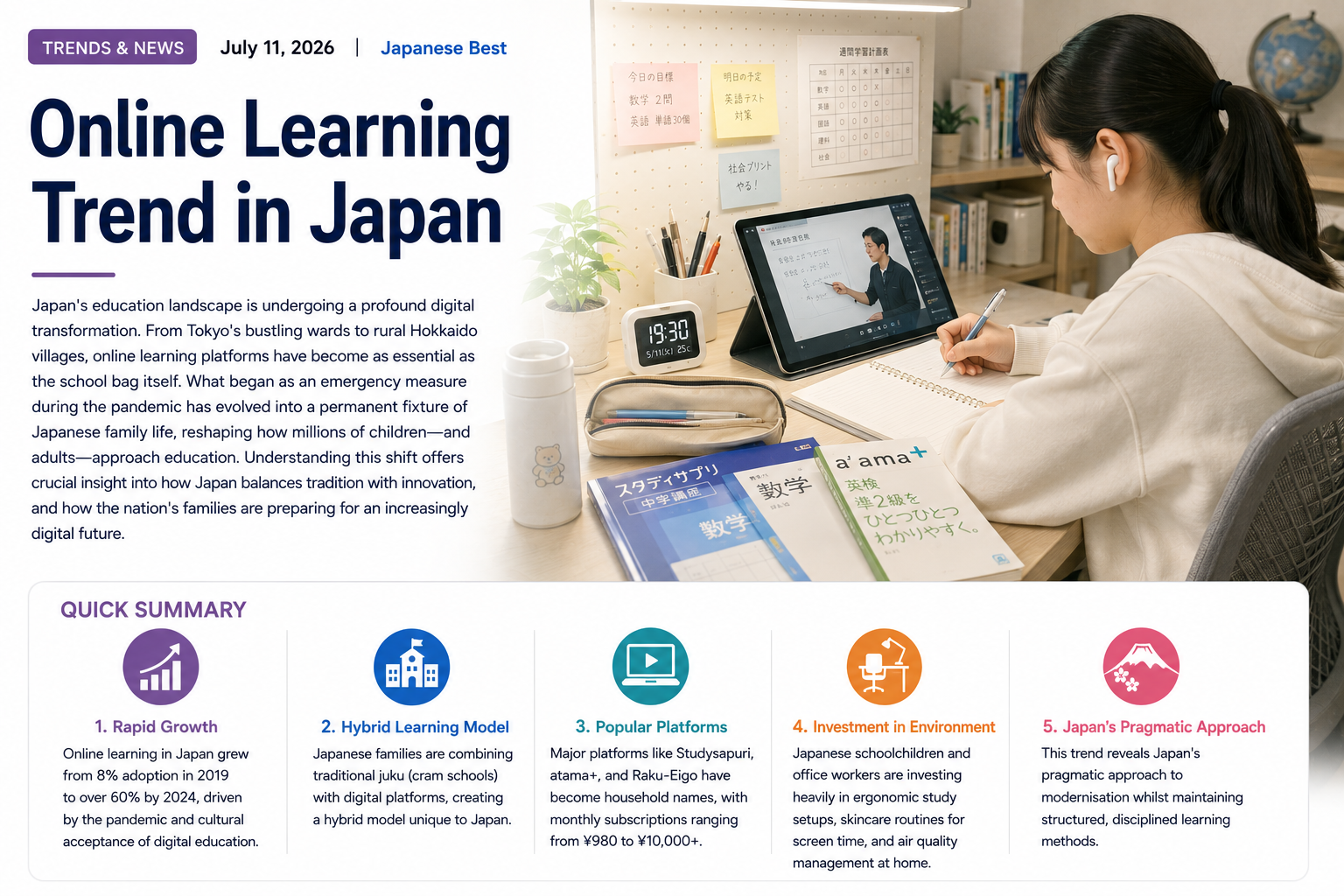
Online Learning Trend in Japan
July 11, 2026 | Trends & News | Japanese Best
Japan’s education landscape is undergoing a profound digital transformation. From Tokyo’s bustling wards to rural Hokkaido villages, online learning platforms have become as essential as the school bag itself. What began as an emergency measure during the pandemic has evolved into a permanent fixture of Japanese family life, reshaping how millions of children—and adults—approach education. Understanding this shift offers crucial insight into how Japan balances tradition with innovation, and how the nation’s families are preparing for an increasingly digital future.
Quick Summary
- Online learning in Japan grew from 8% adoption in 2019 to over 60% by 2024, driven by the pandemic and cultural acceptance of digital education
- Japanese families are combining traditional juku (cram schools) with digital platforms, creating a hybrid model unique to Japan
- Major platforms like Studysapuri, atama+, and Raku-Eigo have become household names, with monthly subscriptions ranging from ¥980 to ¥10,000+
- Japanese schoolchildren and office workers are investing heavily in ergonomic study setups, skincare routines for screen time, and air quality management at home
- This trend reveals Japan’s pragmatic approach to modernisation whilst maintaining structured, disciplined learning methods
🛒 Shop Recommended Products
The Background
The catalyst was unmistakable: school closures during 2020–2021 forced Japanese education into the digital realm almost overnight. Unlike Western countries that embraced Zoom chaos, Japan’s response was methodical. The Ministry of Education launched the GIGA School Initiative, distributing tablets and laptops to every primary and secondary school student across the nation. By 2022, this had created unprecedented infrastructure for remote learning.
However, the real story lies deeper. Japan’s culture of kodomo no tame ni (doing things for the child’s sake) meant parents didn’t abandon online learning once schools reopened. Instead, families recognised that digital tools could complement—not replace—Japan’s rigorous educational tradition. Tokyo saw the first wave: affluent families in Minato and Shibuya wards signed their children up for premium platforms. Within two years, the trend had spread to Osaka, Kyoto, and beyond. Today, according to the Japan Online Education Association, over 60% of Japanese families use some form of online learning, whether for language study, exam preparation, or skill development.
How Japanese Families Are Responding
Japanese parents have adapted online learning with characteristic thoroughness. Rather than viewing it as a substitute for traditional schooling, families are creating a hybrid model—combining face-to-face juku (cram schools) with digital platforms for convenience and cost-effectiveness.
Studysapuri, Benesse’s flagship offering, now serves over 2 million subscribers, many of them combining it with after-school tutoring. Parents appreciate the recorded lessons, which allow children to learn at their own pace—a concept that aligns with Japan’s respect for individual diligence. Families in smaller cities like Kanazawa and Nagasaki, where access to top-tier tutors is limited, have embraced platforms as equalizers, giving their children access to Tokyo-standard instruction.
The social dimension matters too. Many online platforms now include live classes and community features, addressing Japanese parents’ concern that learning should build social bonds. The investment is significant: a typical family might spend ¥5,000–¥15,000 monthly across multiple subscriptions, but this remains cheaper than traditional juku fees of ¥30,000+ per month.
What Products and Services Are Popular Because of This
The online learning boom has created secondary markets. Standing desks and ergonomic chairs have become popular in Japanese homes, with brands like Flexspots and Bauhutte seeing sales double since 2021. Parents are investing in proper lighting, blue-light filtering glasses, and most notably, they’re prioritising home air quality.
A Panasonic F-VXR70 nanoe X Air Purifier has become standard in Japanese households with school-age children. The nanoe X technology actively combats airborne viruses and allergens—particularly important during long study sessions when windows remain closed. At around ¥80,000, it’s a considered investment, but for families managing both schoolwork and health-conscious living, it’s become non-negotiable.
Skincare, too, has seen unexpected growth. Extended screen time causes digital fatigue and skin dehydration, prompting parents to invest in hydrating products for their children. The Hada Labo Gokujyun Hyaluronic Acid Lotion by Rohto has become a bestseller among Japanese families managing this trend. Its five-layer hyaluronic acid formula provides the deep hydration that dehydrated, screen-tired skin requires, without irritants or unnecessary complexity.
For actual study tools, nothing has been more revolutionary than the Pilot FriXion Clicker 0.5mm pen. Digital learning hasn’t eliminated handwriting in Japan; if anything, it’s reinforced it. Students use these erasable pens to annotate PDFs (printed or on tablets), revise notes, and practise kanji without waste. The smooth gel feel and heat-erasable design align perfectly with Japan’s efficiency-focused mindset, and the pen has become ubiquitous in study rooms nationwide.
What This Tells Us About Japan
Japan’s approach to online learning reveals something fundamental about the culture: the nation doesn’t abandon tradition in favour of innovation—it synthesises them. Whilst other countries debated whether online learning should replace in-person education, Japan asked, “How do we use technology to strengthen existing structures?”
This explains the coexistence of AI-powered adaptive learning platforms (like atama+, which uses machine learning to personalise maths and English lessons) alongside the continued dominance of juku. It explains why Japanese mothers still attend parent-teacher conferences in person, why handwritten notes remain valued, and why physical textbooks haven’t disappeared—they’ve simply become one tool among many.
The trend also reflects Japan’s aging society. Whilst younger families embrace online learning for their children, adult learners are using platforms to upskill in English, programming, and business skills. Companies like Raku-Eigo (楽英語) specialise in conversational English for office workers—a direct response to Japan’s need for English-proficient talent in a globalised economy.
FAQ
Is online learning in Japan replacing traditional schools?
No. Schools remain central to Japanese education. Online learning supplements and enhances, rather than replaces, in-person instruction.
What’s the average cost of online learning subscriptions in Japan?
Most platforms range from ¥980 (budget options) to ¥10,000+ monthly for premium services. Many families subscribe to multiple platforms.
Which age groups are using online learning most?
Primary and secondary students (ages 6–18) lead adoption, but adult learners are growing rapidly, particularly those studying English or professional skills.
Are Japanese schools providing digital devices?
Yes, the GIGA School Initiative ensured every student has access to tablets or laptops, though home subscriptions and supplementary tools remain the family’s responsibility.
Japan’s online learning revolution isn’t a story of technology replacing tradition—it’s a distinctly Japanese narrative of thoughtful integration. Families are combining digital platforms with time-honoured study methods, investing in both educational subscriptions and the physical wellness tools that make long study sessions sustainable. From air purifiers to erasable pens, from hydrating skincare to ergonomic furniture, each product reflects Japan’s holistic approach to learning: one that values not just what you learn, but how you learn and the environment in which you thrive. As this trend continues to mature, it will undoubtedly shape educational practices across Asia and beyond.
Seen in Everyday Life in Tokyo

A Real-Life Note from Japan

What I Often See in Japanese Stores

Recommended Japanese Products
The products below are directly relevant to this article and used by Japanese families.
| Product | Brand | Best For | Link |
|---|---|---|---|
| Hada Labo Gokujyun Hyaluronic Acid Lotion | Hada Labo (Rohto) | Anyone who wants deep, lasting hydration without irritants | Hada Labo Gokujyun Hyaluronic Acid Lotion |
| Panasonic F-VXR70 nanoe X Air Purifier | Panasonic | Families concerned about allergens, pollen, and indoor air quality in Japanese cities | Panasonic F-VXR70 nanoe X Air Purifier |
| Pilot FriXion Clicker 0.5mm | Pilot | Students, planners, and anyone who needs flexibility to correct mistakes | Pilot FriXion Clicker 0.5mm |
Hada Labo Gokujyun Hyaluronic Acid Lotion
Japan’s bestselling toner — layers up to 5 types of hyaluronic acid for intense hydration.
Best for: Anyone who wants deep, lasting hydration without irritants
🛒 Hada Labo Gokujyun Hyaluronic Acid Lotion on Amazon
Panasonic F-VXR70 nanoe X Air Purifier
Panasonic’s top-of-line air purifier with nanoe X technology targets viruses and allergens.
Best for: Families concerned about allergens, pollen, and indoor air quality in Japanese cities
🛒 Panasonic F-VXR70 nanoe X Air Purifier on Amazon
Pilot FriXion Clicker 0.5mm
The world’s bestselling erasable pen — writes like a smooth gel but rubs out cleanly with heat.
Best for: Students, planners, and anyone who needs flexibility to correct mistakes
🛒 Pilot FriXion Clicker 0.5mm on Amazon
More From Japanese Best
- What Japanese Families Eat for Dinner
- What to Buy at Daiso: A Practical Guide
Disclosure: As an Amazon Associate, Japanese Best earns from qualifying purchases. This does not affect our recommendations. We only feature products we genuinely believe are worth your consideration.
Editorial Disclaimer
The views, opinions, and recommendations in this article are the author’s own and reflect personal experience living in Japan. They do not constitute professional, financial, or purchasing advice of any kind.
Product availability, pricing, and specifications are subject to change without notice. Japanese Best makes no warranties — express or implied — regarding the accuracy or completeness of this content, and accepts no liability for any decisions made based on it. Always verify details directly with the retailer or manufacturer before purchasing.
コメント