Japan’s Electric Vehicle Adoption for Families (2026)
June 28, 2026 | Trends & News | Japanese Best
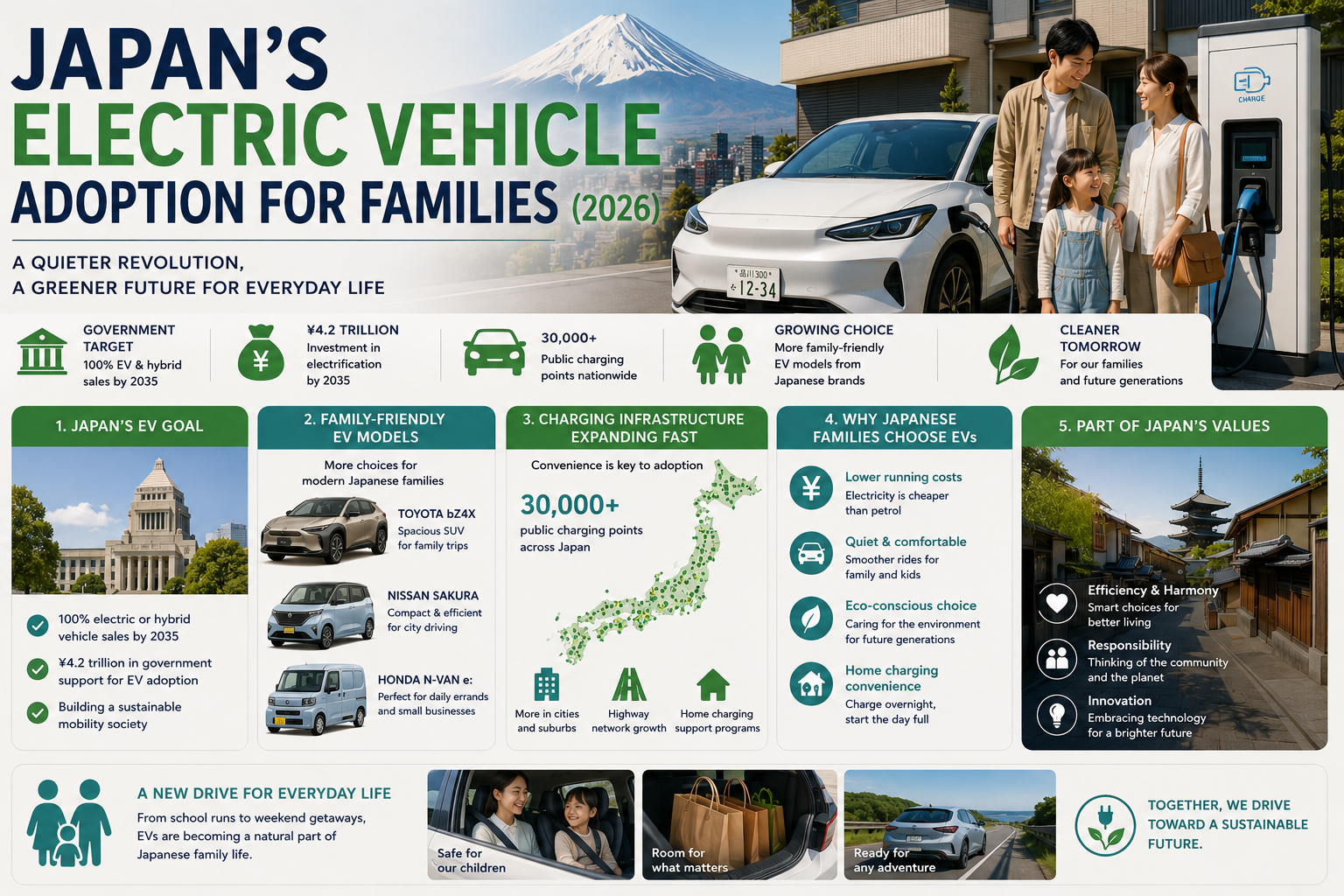
Japan’s automotive landscape is undergoing a quiet but profound transformation. Where petrol stations once reigned supreme across Tokyo’s sprawling suburbs and Kyoto’s narrow streets, charging points are now multiplying rapidly. The Japanese government has committed ¥4.2 trillion to electrification by 2035, aiming for all new vehicles sold to be electric or hybrid. But this isn’t merely a policy story—it’s reshaping how ordinary Japanese families think about commuting, holiday trips, and even their relationship with cars themselves.
Quick Summary
- Japan’s government targets 100% electric or hybrid vehicle sales by 2035, with ¥4.2 trillion in support funding
- Major manufacturers including Toyota, Nissan, and Honda are releasing affordable family-focused EV models
- Charging infrastructure is expanding dramatically, with over 30,000 public charging points now available nationwide
- Japanese families are increasingly adopting EVs for daily commuting, particularly in urban areas like Tokyo and Osaka
- EV adoption reflects deeper Japanese values around efficiency, environmental responsibility, and technological innovation
The Background
Japan’s automotive industry has long symbolised the nation’s engineering excellence. Yet until recently, electric vehicles remained a niche interest for early adopters rather than a mainstream family choice. The turning point came around 2020–2022, when battery costs plummeted globally and Japanese manufacturers realised they couldn’t ignore the EV revolution any longer.
The Japanese government’s strategic push accelerated this shift. The Green Growth Strategy, announced in 2020, positioned EVs as central to Japan’s carbon neutrality goal by 2050. Toyota, historically cautious about full electrification, began aggressively developing models beyond its celebrated Prius. Nissan ramped up Leaf production. Honda introduced the e:NY series. By 2023, EV sales in Japan reached approximately 230,000 units annually—still modest compared to Europe, but growing rapidly. This context matters: Japan’s adoption isn’t driven by hype alone, but by calculated industrial strategy and government coordination that feels very characteristically Japanese.
How Japanese Families Are Responding
The response has been surprisingly enthusiastic, particularly among urban families in Tokyo, Osaka, and other metropolitan areas where charging infrastructure is densest. Many Japanese families appreciate EVs for the same reasons they value other domestic technologies: reliability, quietness, and low maintenance costs.
The appeal becomes clearer when you consider Japanese lifestyle patterns. Most families drive relatively short distances—the average daily commute is around 50 kilometres. This fits perfectly within the 300–400 kilometre range of modern family EVs. Parents appreciate the safety features found in newer models, the smooth acceleration that feels premium, and the negligible engine noise that makes family journeys more peaceful.
Charging at home has proven crucial. Japanese homes with parking, particularly in suburbs like Kawasaki and Saitama, increasingly install wall-mounted chargers. Apartment dwellers in central Tokyo face steeper challenges, though many buildings now feature shared charging facilities. A full home charge costs roughly ¥1,000–¥1,500, compared to ¥6,000–¥8,000 for equivalent petrol driving—a saving that resonates with Japanese families’ pragmatic approach to household budgets.
What Products and Services Are Popular Because of This
The EV boom has spawned a supporting ecosystem. Home charging installation companies are booked months in advance. Apps like EVsmart and Nippon Charging Service help drivers locate the nearest charging point, and their user bases have grown exponentially. Insurance companies have introduced EV-specific policies accounting for different risk profiles.
Toyota’s bZ4X, Nissan’s Ariya, and Honda’s e:NY1 have become the practical choices for families seeking proven reliability with electric powertrains. These vehicles, priced between ¥4.5 million and ¥6.5 million before subsidies, represent genuine family transport—not compromises. Government subsidies up to ¥850,000 per vehicle have made ownership more accessible, particularly for families purchasing their first EV.
Battery recycling has emerged as an unexpected growth area, reflecting Japan’s historical strengths in waste management and resource efficiency. Companies are developing second-life uses for EV batteries in home energy storage systems.
What This Tells Us About Japan
Japanese EV adoption reveals something fundamental about the culture: a preference for gradual, systematic change over disruption. Unlike some nations where EV adoption has sparked fierce ideological debates, Japan has largely embraced it as a technical problem to be solved methodically. The government, industry, and consumers coordinate rather than conflict.
This reflects deeper values. Japanese society prioritises environmental responsibility (kankyō ishiki) and efficiency (kōritsu). EVs align perfectly with both. They also appeal to Japan’s love of gadgetry and cutting-edge technology—the quiet sophistication of an electric motor resonates with Japanese aesthetic preferences more than the raw noise of combustion engines.
Geographically, adoption concentrates in affluent urban and suburban areas, which speaks to Japan’s economic disparities and infrastructure realities. Rural prefectures lag behind, where vehicle ownership remains necessary but charging infrastructure remains sparse. This uneven adoption mirrors broader patterns of Japanese regional development.
FAQ
Are used EVs common in Japan?
Yes, increasingly. The used EV market is growing, with vehicles from 2018–2020 now available at lower price points, particularly through dealers in Tokyo and Osaka.
What about long-distance family trips?
The charging network makes road trips feasible but requires planning. Families typically break journeys at expressway service areas, many equipped with rapid chargers. Travel to rural destinations remains challenging.
Do Japanese families worry about battery degradation?
Some do, but manufacturers’ 8–10 year battery warranties have reduced anxiety considerably.
Is petrol car ownership dying in Japan?
Not dying—declining. Most families still own petrol vehicles, but EV market share is accelerating annually.
Japan’s electric vehicle adoption tells us a story about a nation transitioning thoughtfully toward a cleaner future. Rather than revolutionary upheaval, Japanese families are making pragmatic choices that balance environmental values with economic sense. As infrastructure improves and prices continue falling, EVs will likely become the default choice for most Japanese households within a decade. What’s remarkable isn’t the technology itself—it’s how typically Japanese this transformation feels: methodical, coordinated, and grounded in everyday family needs.
Seen in Everyday Life in Tokyo
A Real-Life Note from Japan
What I Often See in Japanese Stores
Is it worth buying Japanese trends over cheaper alternatives?
For most use cases, yes — if you plan to use the product daily or for many years. Japanese trends tend to have a longer useful lifespan, which often makes the total cost of ownership lower than a cheaper alternative replaced every 2–3 years. That said, always match the product to your actual needs.
How long do Japanese trends typically last?
With proper care, quality Japanese trends are designed for 10 years or more of daily use. This is not incidental — it reflects what Japanese domestic consumers expect.
Where can I buy authentic Japanese trends online?
The safest options are Amazon (from the brand’s official store or well-reviewed sellers), direct brand websites, or authorised international retailers. Avoid unverified marketplace listings for high-value items.
Shop Japanese Products
If you’re inspired by what Japanese families use in this area, you can find a wide range of authentic Japanese products on Amazon:
Shop Related Japanese Products on Amazon
More From Japanese Best
Disclosure: As an Amazon Associate, Japanese Best earns from qualifying purchases. This does not affect our recommendations. We only feature products we genuinely believe are worth your consideration.
Editorial Disclaimer
The views, opinions, and recommendations in this article are the author’s own and reflect personal experience living in Japan. They do not constitute professional, financial, or purchasing advice of any kind.
Product availability, pricing, and specifications are subject to change without notice. Japanese Best makes no warranties — express or implied — regarding the accuracy or completeness of this content, and accepts no liability for any decisions made based on it. Always verify details directly with the retailer or manufacturer before purchasing.
コメント