Last checked: October 3, 2026 | Buy from Japan | Japanese Best
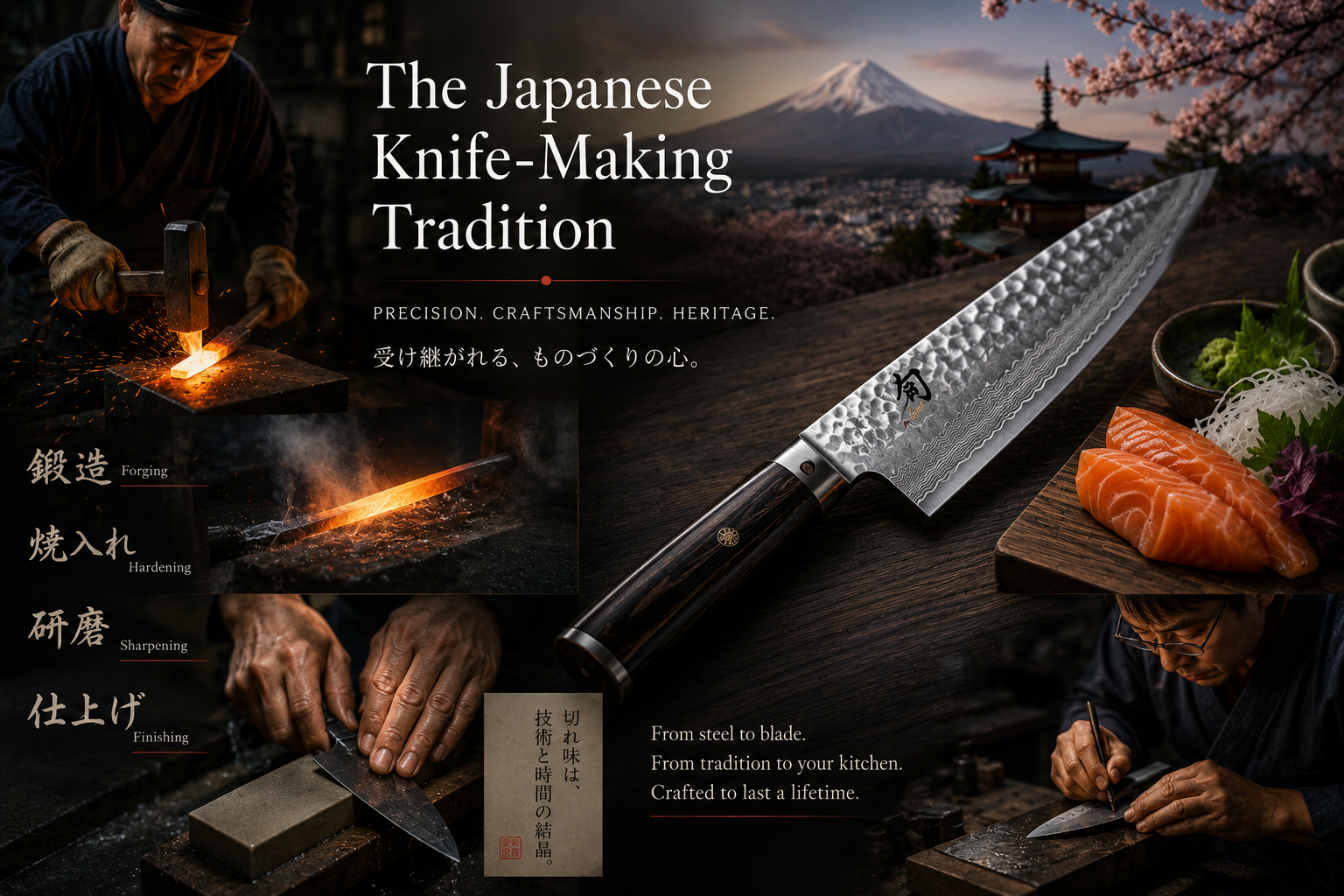
This guide looks at where Japanese kitchen knives come from and how they are built. This guide uses Seki City in Gifu Prefecture as the example, because its cutlery history is documented by the prefecture’s own industry research, compares it with Sakai, and then sets out knife types, blade materials and whetstone grades from makers’ and official sources.
Seki City: from swords to household cutlery
According to the Seki cutlery promotion site, swordsmithing in Seki began in the Kamakura period, when the swordsmiths Motoshige and Kaneshige are said to have settled there, and the number of swordsmiths exceeded 300 in the Muromachi period. The same source credits local conditions — clay for hardening, pine charcoal for the forge and water from the Nagara and Tsubo rivers.
A 2021 report by the Gifu Prefecture Industrial Economy Promotion Center describes how the town changed:
- Mid-Edo period: demand for swords fell, and many swordsmiths moved into general blade-making.
- Meiji period: after the sword-abolition edict (Haitōrei), most swordsmiths switched to practical household cutlery. Production of Western-style pocket knives began, followed by forged kitchen knives.
- 1918: the prefecture approved the Seki cutlery trade association, marking cutlery as the town’s established local industry.
Central Japan’s regional tourism site (Go Central Japan) describes Seki as one of the world’s top three cutlery producers. That comparison is about cutlery centres worldwide, not a ranking of producing regions inside Japan.
A second producing area: Sakai (Osaka)
Osaka Prefecture lists Sakai Uchihamono (堺打刃物) as a Traditional Craft designated by the Minister of Economy, Trade and Industry (designated March 5, 1982). According to the prefecture, tobacco-knife making began in Sakai in the Azuchi-Momoyama period, and deba and other cooking knives were being made there by the early Edo period.
| Seki (Gifu) | Sakai (Osaka) | |
|---|---|---|
| Origin given by official sources | Swordsmiths from the Kamakura period | Tobacco knives from the Azuchi-Momoyama period |
| Kitchen knives | After the Meiji sword ban (Gifu industry report) | Deba and cooking knives by the early Edo period (Osaka Prefecture) |
| Official status | Described by a regional tourism site as one of the world’s top three cutlery producers | National Traditional Craft (1982) |
Honyaki and kasumi: what the terms mean
The Sakai cutlery association explains the terms like this. In Sakai, a honyaki (本焼き) knife usually has its cutting bevel finished on a wooden-mounted stone (木砥仕上げ). A laminated knife (合わせ, steel forged onto a softer iron body) usually has a kasumi (霞) finish, a hazy white finish made with stones and stone powder. So “kasumi” and “hon-kasumi” generally indicate a laminated knife. The association adds that “kasumi” is strictly a finishing technique, and that grades such as nami-, chū-, jō- and hon-kasumi are each shop’s own ranking names, not a common standard.
In practice, the honyaki or kasumi label tells you how a traditional knife was made and finished. The material table below (stainless, carbon steel, three-layer) is more useful for judging how much care a knife needs.
Knife types compared
From Kai Corporation’s official knife guide (Japanese-style and Western-style knives). Kai notes that Western-style knives are double-bevelled, while Japanese-style knives are basically single-bevelled.
| Knife (Japanese name) | Style / bevel | Blade length (Kai’s guide) | Main use (Kai’s description) |
|---|---|---|---|
| Santoku (三徳) | Japanese-developed Western style, double | about 165 mm to under 180 mm | All-purpose: meat, seafood and vegetables |
| Gyūto (牛刀, chef’s knife) | Western, double | generally 180 mm or more | All-purpose; longer blades suit cutting meat |
| Petty knife | Western, double | 120–150 mm | Hand-held and fine work |
| Nakiri (菜切り) | Japanese, double | various sizes | Vegetables: chopping, peeling, bevelling edges |
| Deba (出刃) | Japanese, single | — | Thick at the heel with a thin, sharp tip; filleting and chopping fish |
| Yanagiba / sashimi (柳刃) | Japanese, single | 180 mm or more | Slicing sashimi; single bevel gives a clean cut surface |
Blade materials compared
| Material | Ease of sharpening | Rust resistance | Notes (Kai Corporation) |
|---|---|---|---|
| Stainless steel | Good | Good | The most common material for household knives because it resists rust and is easy to maintain |
| Carbon steel (hagane, 鋼) | Good | Poor | Very sharp but rusts easily; needs care after each use |
| Three-layer (carbon core clad in stainless) | Good | Fair | Combines a sharp edge with rust resistance, but the exposed edge is carbon steel |
| Ceramic | Fair | Excellent | Does not rust and stays sharp, but is very hard and difficult to re-sharpen at home |
Kai’s FAQ adds that carbon-steel knives should have food residue washed off quickly and be dried thoroughly with a cloth.
Looking after the edge: Japanese whetstone grades
Japanese knives are usually maintained on rectangular whetstones (toishi). Kai Corporation, a Seki-based knife maker, groups whetstones by grit size into four grades:
| Grade (Japanese name) | Typical grit (Kai Corporation) | What it is used for |
|---|---|---|
| Coarse (arato, 荒砥石) | #200–#400 | Removing rust, repairing chips, reshaping the edge |
| Medium (nakato, 中砥石) | #800–#2000 | Ordinary re-sharpening |
| Finishing (shiageto, 仕上砥石) | #3000–#4000 | Smoothing the edge after a medium stone |
| Super-finishing (超仕上げ砥石) | #6000 and above | Further refining a finished edge |
Kai recommends a medium #1000 stone as the first stone to own, and a finishing #4000 stone as a useful second. When a blade is chipped or badly worn, the order is coarse → medium → finishing. Grit boundaries differ slightly between makers, so check the number printed on the stone rather than the grade name alone. Kai also notes that sharpening a knife always wears a dip into a rectangular stone, so the stone should be flattened each time with a flattening stone. A stone that is not flat will not give a good edge.
What to check when choosing a Japanese knife
- Construction: honyaki or kasumi (or a modern stainless or laminated blade) tells you what level of care to expect.
- Steel: carbon steels need drying and rust prevention; stainless steels need less.
- Maker and region: a named maker and producing area is a more specific signal than a generic “Made in Japan” label.
- Maintenance: plan for at least a medium-grit whetstone if you buy a traditional Japanese knife.
Sources
- Seki cutlery promotion site — History of Seki cutlery (関の刃物の歴史) (accessed 2026-10-03)
- Gifu Prefecture Industrial Economy Promotion Center — Cutlery industry report (FY2020/2021, PDF)
- Osaka Prefecture — Sakai Uchihamono (traditional craft)
- Sakai Cutlery Association — Q&A (honyaki, kasumi)
- Go Central Japan (Shoryudo) — Seki Sword Tradition Museum
- Kai Corporation — Types of whetstones and how to choose them (砥石の種類と選び方) (accessed 2026-10-03)
- Kai Corporation knife guide: Japanese-style knives · Western-style knives · blade materials · sharpening tools · knife FAQ

Comments