Data basis: figures as of the dates shown in each table | Last checked: October 3, 2026 | Live in Japan | Japanese Best
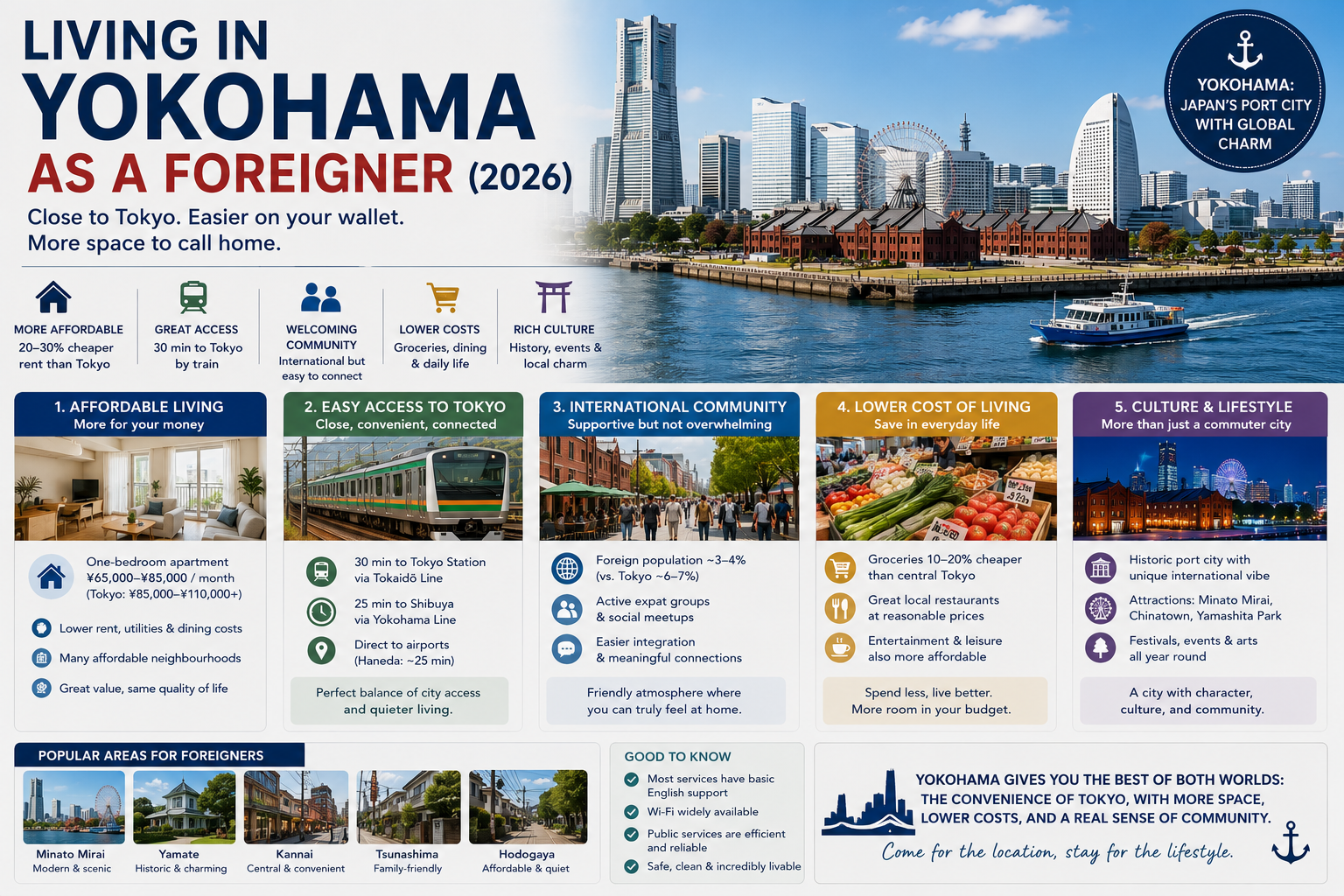
Yokohama had an estimated 3,757,388 residents on September 1, 2026, according to the city, so it is far too big to treat as one neighbourhood. This page compares three central areas for people who work in Tokyo or Yokohama. For each one it covers the commute into central Tokyo, what residents pay in rent compared with Tokyo, who the foreign residents are, and what the city provides. Everything comes from public data, with sources and dates.
The three areas compared
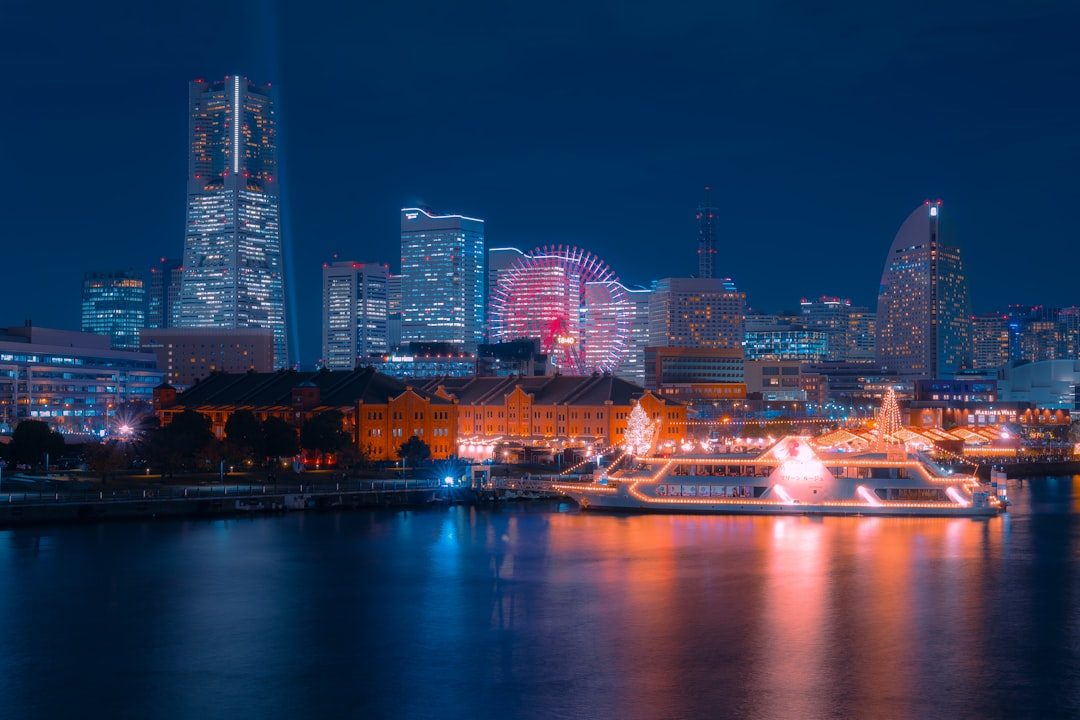
- Yokohama Station area (Nishi Ward).
- Sakuragichō / Kannai / Minato Mirai (Naka and Nishi wards): the waterfront office and city-hall district.
- Shin-Yokohama (Kōhoku Ward): the Shinkansen stop, also served by the Tokyu Shin-Yokohama Line.
Commute into central Tokyo
Fastest route for a weekday departure around 08:00 (Wednesday, October 7, 2026), IC-card fare, excluding the Shinkansen. Times run from departure to arrival and include transfers. Looked up on Yahoo! Japan Transit on October 3, 2026; fares are the IC fares it showed for that date.
| From | To Tokyo | To Shinagawa | To Shibuya | To Shinjuku | To Ōtemachi |
|---|---|---|---|---|---|
| Yokohama | 30 min, direct, ¥528 | 19 min, direct, ¥341 | 29 min, direct, ¥440 | 34 min, direct, ¥616 | 40 min, 1 transfer, ¥706 |
| Sakuragichō | 38 min, 1 transfer, ¥616 | 28 min, 1 transfer, ¥440 | 36 min, 1 transfer, ¥616 | 41 min, 1 transfer, ¥616 | 48 min, 2 transfers, ¥794 |
| Shin-Yokohama | 48 min, 1 transfer, ¥616 | 38 min, 1 transfer, ¥528 | 31 min, direct, ¥358 | 46 min, 2 transfers, ¥735 | 47 min, direct, ¥578 |
One-month commuter passes on the same routes include Yokohama–Tokyo ¥15,600, Yokohama–Shinagawa ¥10,480, Shin-Yokohama–Shibuya ¥13,360 and Shin-Yokohama–Ōtemachi ¥22,700 (same source).
What it means: Yokohama Station is the only one of the three with direct trains to all of Tokyo, Shinagawa, Shibuya and Shinjuku. Shin-Yokohama has direct trains to Shibuya and Ōtemachi on the Tokyu Shin-Yokohama Line, but needs a transfer to reach Tokyo Station on conventional lines. Note that the JR Yokohama Line from Shin-Yokohama runs to Higashi-Kanagawa and Hachiōji, not into central Tokyo.
Rent compared with Tokyo
Average monthly rent actually paid by renting households, from the 2023 Housing and Land Survey (Table 112-3, survey date October 1, 2023). All home sizes and landlord types are included, so use these figures to compare areas, not to price a specific flat. The last column is our calculation.
| Area | Average monthly rent | Compared with Tokyo 23-ward average |
|---|---|---|
| Tokyo 23 wards | ¥94,853 | — |
| Yokohama City (all 18 wards) | ¥75,381 | about 21% lower |
| Nishi Ward (Yokohama Station) | ¥82,439 | about 13% lower |
| Naka Ward (Kannai, Chinatown) | ¥91,874 | about 3% lower |
| Kōhoku Ward (Shin-Yokohama) | ¥85,469 | about 10% lower |
| For reference: Shinagawa Ward, Tokyo | ¥102,811 | about 8% higher |
| For reference: Ōta Ward, Tokyo | ¥84,489 | about 11% lower |
What it means: the citywide Yokohama average is well below Tokyo’s, but the three central areas above are much closer to it. Naka Ward is almost level with the 23-ward average. A large part of Yokohama’s lower citywide figure comes from wards outside these areas.
Move-in costs
In MLIT’s FY2024 Housing Market Trend Survey (moves April 2023–March 2024, the survey’s Tokyo metropolitan area, 首都圏), 67.3% of households who moved into a private rental paid a deposit, 49.0% paid key money and 44.8% paid an agent fee. For each payment the most common amount was exactly one month’s rent. At Yokohama’s average rent of ¥75,381, one month each of all three would be about ¥226,100 before the first month’s rent and insurance (our calculation). See our Tokyo rent and move-in cost guide for how deposits and insurance work.
Who lives here: foreign residents by nationality
Yokohama had 144,357 registered foreign residents at the end of August 2026 (city statistics). Against the September 1 population estimate, that is about 3.8% of residents (our calculation; the two figures are one day apart).
| Nationality | Residents | Share of foreign residents |
|---|---|---|
| China | 50,426 | 34.9% |
| Vietnam | 15,451 | 10.7% |
| South Korea | 12,594 | 8.7% |
| Nepal | 11,266 | 7.8% |
| Philippines | 10,116 | 7.0% |
| Indonesia | 6,302 | 4.4% |
| Myanmar | 5,028 | 3.5% |
| India | 3,838 | 2.7% |
| Taiwan | 3,458 | 2.4% |
| United States | 3,067 | 2.1% |
By ward, Naka Ward had 19,780 foreign residents, Nishi Ward 6,896 and Kōhoku Ward 9,941 (same source). In Naka Ward, residents of Chinese nationality numbered 10,703, about 54% of the ward’s foreign residents. Naka Ward includes Yokohama Chinatown (Yokohama Chūkagai).
Health insurance: what National Health Insurance costs in Yokohama
If you are not covered by an employer’s health insurance, you join National Health Insurance (NHI) through the city. The national rules require you to notify the city within 14 days of becoming eligible. Yokohama’s FY2026 rates are:
| Component | Income-based rate | Flat amount per insured person | Annual cap |
|---|---|---|---|
| Medical | 8.33% | ¥40,870 | ¥670,000 |
| Elderly-care support | 2.62% | ¥13,380 | ¥260,000 |
| Long-term care (ages 40–64 only) | 2.84% | ¥16,200 | ¥170,000 |
| Child-support levy (new in FY2026) | 0.34% | ¥1,770 | ¥30,000 |
Worked example (our calculation): a single person aged 30 whose previous-year salary was ¥3,000,000. Their employment income after the statutory deduction is ¥2,020,000. Subtracting the ¥430,000 resident-tax basic deduction gives an income base of ¥1,590,000. The annual premium is about ¥235,500 (medical ¥173,317 + support ¥55,038 + child levy ¥7,176), or about ¥19,600 a month. Someone aged 40–64 would add about ¥61,400 for the long-term-care component. Reductions for low-income households are not included.
City services in other languages
- Yokohama Multicultural Consultation Center (横浜市多文化共生総合相談センター): free consultation by phone or in person in 12 languages, plus phone interpreting and legal, administrative-scrivener and education consultations. Pacifico Yokohama, Yokohama International Cooperation Center 5F; phone 045-222-1209.
- Municipal transport: city buses charge a flat ¥220 adult fare. A bus one-day ticket costs ¥600, a subway-and-bus one-day ticket ¥830, and an all-line city bus commuter pass ¥9,900 a month.
Childcare
Yokohama reported zero children on the nursery waiting list (待機児童) as of April 1, 2026, the second year in a row. Separately, 1,256 children were counted as “on hold” (保留児童, excluding parents extending childcare leave). These are children who applied but did not get a place they wanted. Zero waiting-list children does not mean every family gets its first-choice nursery.
Hazards: check your address
Flood and landslide risk in Yokohama depends on the exact address. The city publishes ward-level flood hazard maps and an address-search map (Waiwai Bōsai Map). Check the exact address of any flat before you sign. Links for the three wards on this page are in the sources.
Japanese Best summary
- Yokohama Station area has the strongest direct rail links to Tokyo in this comparison, at a ward-average rent about 13% below the 23-ward average.
- Kannai / Sakuragichō has rents close to Tokyo’s average and longer commutes to Tokyo, so it makes most sense if you work in Yokohama itself.
- Shin-Yokohama suits people who travel by Shinkansen or work near Shibuya or Ōtemachi on the Tokyu line. Rents are about 10% below the 23-ward average.
Not yet surveyed on site: supermarket prices, street-level atmosphere and rush-hour crowding. We have not surveyed these on site, so we do not describe them.
Sources
- City of Yokohama — Estimated population (September 1, 2026)
- City of Yokohama — Foreign residents by ward and nationality (end of August 2026)
- Statistics Bureau / e-Stat — 2023 Housing and Land Survey, Table 112-3
- Yahoo! Japan Transit route searches (departure Wed 2026-10-07 08:00, retrieved 2026-10-03): from Yokohama Tokyo · Shinagawa · Shibuya · Shinjuku · Ōtemachi; from Sakuragichō Tokyo · Shinagawa · Shibuya · Shinjuku · Ōtemachi; from Shin-Yokohama Tokyo · Shinagawa · Shibuya · Shinjuku · Ōtemachi
- MLIT — FY2024 Housing Market Trend Survey (PDF)
- City of Yokohama — FY2026 National Health Insurance rates and income base definition
- National Tax Agency — Employment income deduction (No.1410)
- e-Gov — Enforcement Regulations of the National Health Insurance Act, Article 2 (14-day notification)
- City of Yokohama — Multicultural Consultation Center
- City of Yokohama — Municipal bus and subway fares
- City of Yokohama — Nursery waiting list as of April 1, 2026
- City of Yokohama flood hazard maps: Nishi · Naka · Kōhoku · City hazard-map index (incl. Waiwai Bōsai Map)

Comments