Japanese Origami for Adults: More Than Paper Cranes (2026)
June 28, 2026 | Hobbies | Japanese Best
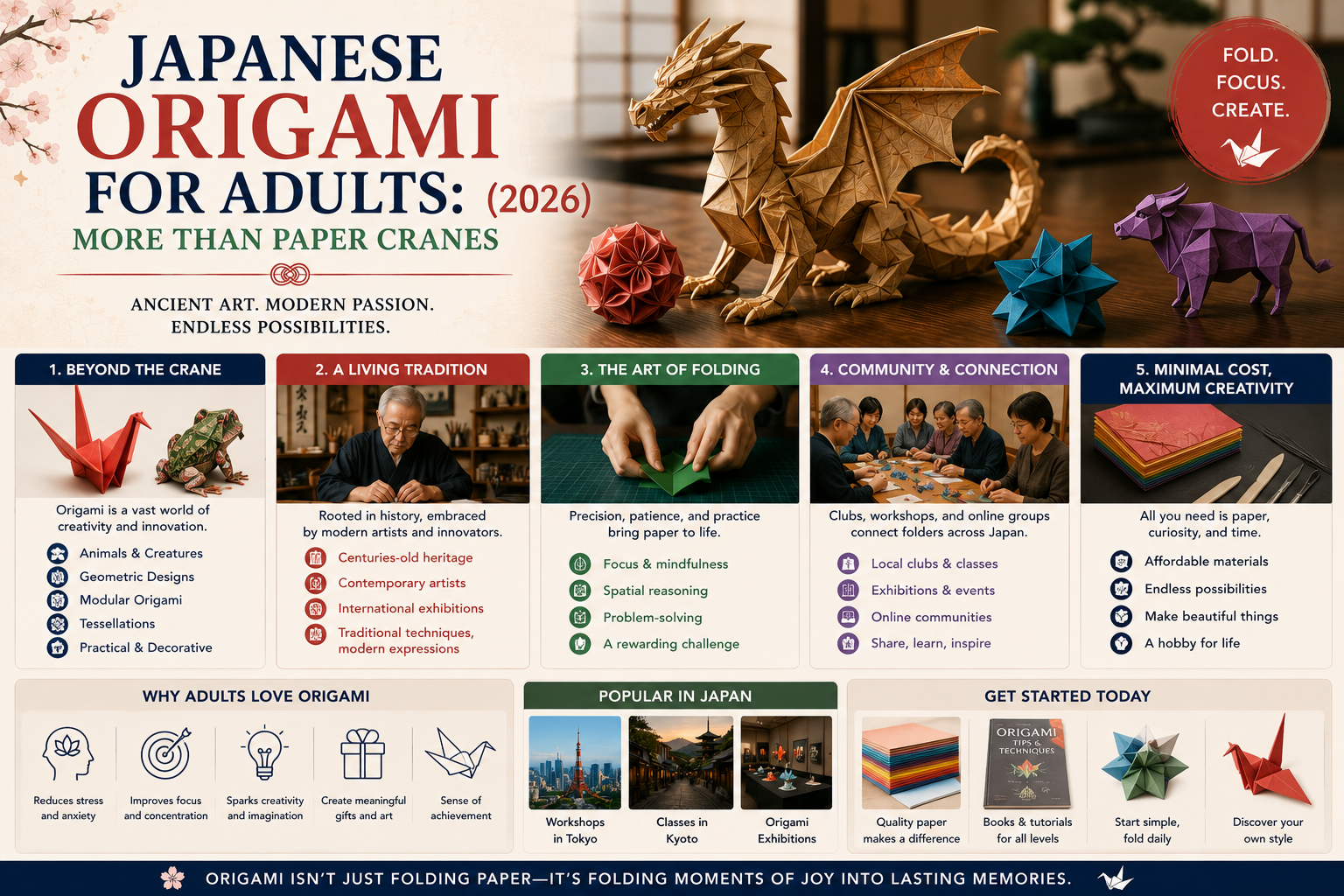
Origami conjures images of delicate paper cranes and childhood craft projects, yet in Japan, this ancient art form has flourished into a sophisticated hobby pursued by adults of all ages. From intricate geometric tessellations to lifelike animal sculptures, contemporary origami offers intellectual challenge, meditative focus, and genuine artistic expression. Far from being dismissed as a children’s pastime, origami workshops in Tokyo, Kyoto, and beyond attract pensioners, office workers, and creative professionals seeking meaningful leisure time. Understanding this hobby reveals much about Japanese culture: the appreciation for precision, the value placed on quiet craftsmanship, and how tradition adapts to modern life.
Quick Summary
- Origami is a thriving adult hobby in Japan, practised in dedicated studios, community centres, and homes across the country
- Beyond paper cranes, advanced origami includes modular designs, wet-folding techniques, and mathematically complex creations
- Japanese origami masters exhibit work internationally; the hobby bridges ancient tradition with contemporary art
- Communities gather through clubs, exhibitions, and online platforms, creating spaces for skill-sharing and artistic growth
- The hobby requires patience, spatial reasoning, and access to quality paper—minimal financial investment with maximum creative reward
How Popular Is This Hobby in Japan?
Origami occupies a unique position in Japanese leisure culture. Unlike hobbies that peaked decades ago, adult origami participation has grown steadily. The Japan Origami Association, established in 1972, now boasts thousands of members and organises annual exhibitions attracting visitors nationwide. Tokyo’s Roppongi Hills and various community centres host regular origami workshops where seats fill months in advance. Prices for classes typically range from ¥2,000 to ¥5,000 per session, making it accessible compared to other Japanese hobbies.
Public libraries in urban areas dedicate shelf space to origami instruction books, indicating sustained cultural interest. Museums occasionally feature origami exhibitions—recent displays at the National Art Center in Tokyo drew substantial crowds. Significantly, practitioners span all ages and backgrounds. Retired individuals often pursue origami seriously, whilst younger professionals discover it through social media communities. The hobby’s growth reflects broader Japanese trends: seeking mindfulness amidst digital overload, valuing handmade objects, and preserving cultural heritage through active participation rather than passive consumption.
How Japanese People Do It
Japanese origami enthusiasts approach the hobby with characteristic methodical precision. Beginners typically start with foundational folds—the mountain fold, valley fold, and basic crease patterns—progressing through increasingly complex designs. However, modern Japanese origamists rarely limit themselves to traditional cranes and butterflies. Many explore wet-folding, a technique where dampened paper creates curved, organic forms impossible with dry-folding alone. This method produces remarkably lifelike animal sculptures.
Advanced practitioners engage with modular origami, constructing elaborate three-dimensional structures from dozens of identical folded units. Master folders like Akira Yoshizawa and contemporary artists such as Satoshi Kamiya represent the pinnacle, creating designs requiring hours of concentrated work. Japanese practitioners emphasise the importance of quality paper—washi (Japanese handmade paper), tant, and specialised origami paper from brands like Toyo and Daiso are preferred. Many join clubs meeting weekly in community halls, where experienced folders mentor newcomers. The process remains largely hands-on; whilst YouTube tutorials exist, Japanese culture values in-person teaching and learning by observation. Sessions often blend social connection with technical skill-building, turning folding into a meditative group experience.
Community and Culture Around It
The origami community in Japan thrives through formal and informal networks. The Japan Origami Association organises exhibitions, publishes technical journals, and maintains standards for the hobby. Beyond this, local origami circles meet in neighbourhoods—Tokyo’s Shibuya ward hosts at least five active groups meeting fortnightly. These gatherings function as social anchors, particularly for retired individuals and those seeking purposeful activity outside employment.
Online communities have expanded reach significantly. Japanese origami enthusiasts share designs, troubleshoot techniques, and organise meetups through dedicated forums and social media groups. International exhibitions featuring Japanese folders demonstrate origami’s cultural ambassadorial role. When Japanese origami masters travel abroad—showcasing work at museums in New York, London, or Paris—they represent Japanese aesthetic values: simplicity, precision, and transformation of humble materials into art.
Cultural festivals frequently feature origami demonstrations. During summer matsuri (festivals) and year-end craft fairs, practitioners set up stalls teaching visitors. This public presence normalises origami as a legitimate adult pursuit, not merely children’s entertainment. The community values patience, respects mastery achieved through repetition, and celebrates both classical designs and innovative contemporary interpretations. This balance between tradition and creativity defines Japanese origami culture.
FAQ
What paper should I use as a beginner?
Start with standard origami paper (kami) available at Japanese stationers or online. Once comfortable with basic folds, explore washi or specialised papers from Japanese suppliers.
How long does it take to become proficient?
Basic competency requires 2–3 months of regular practice. Creating genuinely impressive work takes years of dedicated study, reflecting the Japanese concept of shokunin (craftsperson) spirit.
Are there origami competitions in Japan?
Yes. The Japan Origami Association organises competitions annually, with regional preliminaries held throughout the country.
Can I learn origami online from Japanese sources?
Many Japanese instructors offer online lessons. Websites like Origami no Heya (Origami Room) provide video tutorials in Japanese with international reach.
Is origami expensive?
Remarkably affordable. Quality origami paper costs ¥100–500 per pack, and single sheets cost mere yen. The primary investment is time, not money.
Japanese origami for adults represents far more than nostalgic craft. It embodies enduring cultural values—craftsmanship, meditative focus, and artistic transformation—whilst remaining accessible to anyone willing to learn. Whether pursued in community studios across Kyoto, quiet home corners, or international workshops, origami connects practitioners to centuries of Japanese tradition whilst offering contemporary relevance. For overseas enthusiasts curious about Japanese hobbies and lifestyle, origami provides an authentic window into how Japan balances preservation of heritage with creative innovation. The hobby thrives because it demands nothing except patience, paper, and presence—precisely what modern life often lacks.
Seen in Everyday Life in Tokyo
A Real-Life Note from Japan

What I Often See in Japanese Stores
Is it worth buying Japanese hobbies over cheaper alternatives?
For most use cases, yes — if you plan to use the product daily or for many years. Japanese hobbies tend to have a longer useful lifespan, which often makes the total cost of ownership lower than a cheaper alternative replaced every 2–3 years. That said, always match the product to your actual needs.
How long do Japanese hobbies typically last?
With proper care, quality Japanese hobbies are designed for 10 years or more of daily use. This is not incidental — it reflects what Japanese domestic consumers expect.
Where can I buy authentic Japanese hobbies online?
The safest options are Amazon (from the brand’s official store or well-reviewed sellers), direct brand websites, or authorised international retailers. Avoid unverified marketplace listings for high-value items.
Shop Japanese Products
If you’re inspired by what Japanese families use in this area, you can find a wide range of authentic Japanese products on Amazon:
Shop Related Japanese Products on Amazon
More From Japanese Best
Disclosure: As an Amazon Associate, Japanese Best earns from qualifying purchases. This does not affect our recommendations. We only feature products we genuinely believe are worth your consideration.
Editorial Disclaimer
The views, opinions, and recommendations in this article are the author’s own and reflect personal experience living in Japan. They do not constitute professional, financial, or purchasing advice of any kind.
Product availability, pricing, and specifications are subject to change without notice. Japanese Best makes no warranties — express or implied — regarding the accuracy or completeness of this content, and accepts no liability for any decisions made based on it. Always verify details directly with the retailer or manufacturer before purchasing.


コメント