The Japanese Skincare Routine for Beginners (2026)
June 28, 2026 | Skincare | Japanese Best
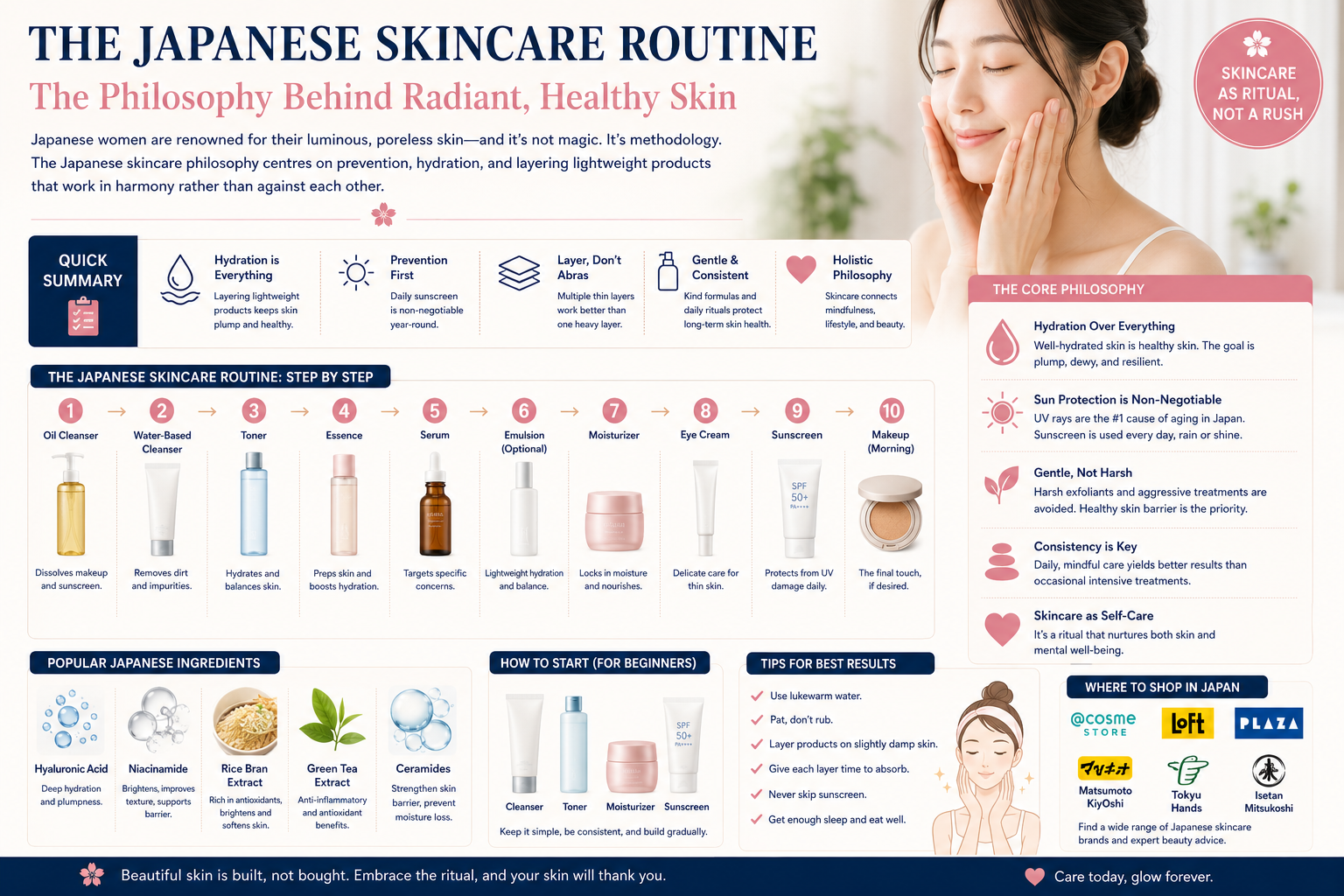
Japanese women are renowned for their luminous, poreless skin—and it’s not magic. It’s methodology. The Japanese skincare philosophy centres on prevention, hydration, and layering lightweight products that work in harmony rather than against each other. This approach, called “skincare as ritual,” has become a global phenomenon, and for good reason: it delivers results without requiring expensive procedures or harsh treatments.
If you’ve wondered why Japanese skincare seems different from Western routines, you’re right. The philosophy prioritises long-term skin health over quick fixes, emphasises sun protection as non-negotiable, and treats cleansing as an art form. Whether you’re living in Japan or simply curious about why Tokyo’s beauty counters are so different from those in London or New York, understanding these principles will transform how you think about skincare. This guide covers exactly how to build a japanese skincare routine from scratch.
Quick Summary
- Japanese skincare focuses on hydration and layering lightweight products in a specific order
- The routine typically includes double cleansing, toning, essences, serums, and sunscreen
- Prevention—especially UV protection—is prioritised over treatment
- Products are often multifunctional and designed to work synergistically
- Starting with a simplified version (cleanser, toner, moisturiser, sunscreen) is perfectly adequate for beginners
🛒 Shop Recommended Products
Key Factors: What Makes the Japanese Skincare Routine Different
Japanese skincare philosophy stems from three core beliefs: prevention before treatment, hydration as foundation, and texture-based layering. Unlike Western routines that often focus on actives like retinol or strong acids, Japanese skincare builds a resilient skin barrier first.
The concept of “moist skin” (潤い肌, uruoi hada) is central to Japanese beauty culture. You’ll hear dermatologists and beauty advisors in Shinjuku or Ginza emphasise that healthy skin must be deeply hydrated at the cellular level. This means using lightweight products in succession, allowing each layer to absorb before applying the next—a practice that feels meditative compared to the Western “apply and go” approach. For general background, see Wikipedia’s entry on skin care.
Sun protection is treated as a daily essential, not a summer-only concern. Japanese women use SPF year-round, indoors and out, viewing UV damage as the primary accelerant of ageing. This preventative mindset means fewer corrective treatments needed later.
Types Explained: Building Your Japanese Routine
A full Japanese skincare routine can have 8–10 steps, but beginners needn’t feel overwhelmed. Here’s how each category works:
Double Cleansing removes makeup and impurities in two stages: an oil-based cleanser breaks down makeup, followed by a water-based cleanser for a thorough finish. This prevents residue that can clog pores.
Toners and Essences hydrate and prepare skin for serums. Hada Labo Gokujyun Hyaluronic Acid Lotion is Japan’s bestselling toner—it layers up to five types of hyaluronic acid for intense, lasting hydration without irritants, making it ideal for anyone starting out.
Essences are lightweight liquids that sit between toner and serum. SK-II Facial Treatment Essence, powered by Pitera (fermented sake yeast), is the iconic Japanese essence beloved for improving skin tone and reducing pore appearance.
Serums and Treatments target specific concerns. Rohto Melano CC Vitamin C Serum is a cult favourite for fading dark spots and post-acne marks quickly, whilst Shiseido Ultimune Power Infusing Serum strengthens skin’s inner defence for long-term anti-ageing resilience.
Moisturisers seal everything in. Japanese moisturisers tend to be lighter than Western equivalents—a gel or milky lotion rather than heavy creams.
Sunscreen is non-negotiable. Biore UV Aqua Rich Watery Essence SPF50+ is Japan’s favourite daily sunscreen—ultra-lightweight with no white cast, it’s beloved by people who find Western sunscreens too thick and greasy.
What to Avoid: Common Beginner Mistakes
Don’t skip sunscreen thinking you’ll “make up for it” later. UV damage is cumulative and invisible; by the time you notice it, it’s already embedded in your skin.
Avoid jumping straight to 8–10 steps. This overwhelms your skin and your budget. Start with cleanser, toner, moisturiser, and sunscreen. Add treatments gradually as you learn what your skin needs.
Don’t use products in the wrong order. In Japanese routines, you apply lightest to heaviest—toners before serums, serums before oils. This ensures proper absorption.
Resist the urge to use multiple actives at once. Japanese skincare values balance; combining vitamin C, retinol, and acids simultaneously will irritate rather than improve your skin.
Finally, don’t expect overnight results. Japanese skincare is about consistency. Most people see noticeable improvements within 4–6 weeks of dedicated routine.
Recommended Options for Beginners
Budget-Friendly Starter Routine (¥3,000–5,000 total)
Begin with a gentle cleanser from Cetaphil or Neutrogena, the Hada Labo toner, a lightweight moisturiser like Aveeno, and a sunscreen. This covers all essentials without overwhelm.
Mid-Range Routine (¥8,000–12,000)
Upgrade to a dedicated Japanese cleanser (Fancl or Muji), Hada Labo toner, a serum like Melano CC for targeted concerns, a richer moisturiser, and Biore sunscreen. This allows for targeted treatment whilst maintaining simplicity.
Premium Investment Routine (¥15,000+)
Combine SK-II essence, Shiseido Ultimune serum, and a luxury moisturiser with your chosen cleanser and sunscreen. This approach prioritises long-term skin health and visible results.
FAQ
How long should I wait between steps?
Allow 20–30 seconds for each product to absorb—roughly the time to apply the next product to your neck and décolletage.
Can I use Japanese skincare if I have sensitive skin?
Yes. Many Japanese products are formulated for sensitive skin, but introduce new items slowly (one every two weeks) to monitor for reactions.
Do I need to buy all Japanese brands?
No. The philosophy matters more than the origin. You can mix Japanese and Western products as long as you follow the layering principle.
What’s the difference between toner and essence?
Toners are more hydrating and prep the skin; essences are thinner, nutrient-dense liquids that target specific concerns.
Is the routine different in summer and winter?
Many Japanese people use lighter products in summer and richer ones in winter, but hydration remains consistent year-round.
The Japanese skincare routine isn’t about complexity—it’s about respect for your skin’s needs. By understanding prevention, hydration, and layering, you’re adopting a philosophy that has kept generations of Japanese women’s skin looking radiant. Start simple, stay consistent, and let your skin teach you what it needs.
Seen in Everyday Life in Tokyo
A Real-Life Note from Japan
What I Often See in Japanese Stores
Is it worth buying Japanese skincare over cheaper alternatives?
For most use cases, yes — if you plan to use the product daily or for many years. Japanese skincare tend to have a longer useful lifespan, which often makes the total cost of ownership lower than a cheaper alternative replaced every 2–3 years. That said, always match the product to your actual needs.
How long do Japanese skincare typically last?
With proper care, quality Japanese skincare are designed for 10 years or more of daily use. This is not incidental — it reflects what Japanese domestic consumers expect.
Where can I buy authentic Japanese skincare online?
The safest options are Amazon (from the brand’s official store or well-reviewed sellers), direct brand websites, or authorised international retailers. Avoid unverified marketplace listings for high-value items.
Related Japanese Products
The products below came up naturally in the context of this article. We only recommend items that genuinely connect to the topic.
| Product | Brand | Best For | Amazon |
|---|---|---|---|
| Hada Labo Gokujyun Hyaluronic Acid Lotion | Hada Labo (Rohto) | Anyone who wants deep, lasting hydration without irritants | Search on Amazon |
| SK-II Facial Treatment Essence | SK-II | Skin tone improvement, pore appearance reduction, and overall radiance | Search on Amazon |
| Biore UV Aqua Rich Watery Essence SPF50+ | Biore (Kao) | Daily sunscreen wearers who hate the thick feel of Western sunscreens | Search on Amazon |
| Shiseido Ultimune Power Infusing Serum | Shiseido | Long-term skin health investment, especially people 30+ looking for anti-ageing prevention | Search on Amazon |
| Rohto Melano CC Vitamin C Serum | Rohto | People targeting dark spots, post-acne marks, and uneven skin tone | Search on Amazon |
Hada Labo Gokujyun Hyaluronic Acid Lotion
Japan’s bestselling toner — layers up to 5 types of hyaluronic acid for intense hydration.
Best for: Anyone who wants deep, lasting hydration without irritants
SK-II Facial Treatment Essence
The iconic essence powered by Pitera — fermented from sake yeast, beloved by Japanese women.
Best for: Skin tone improvement, pore appearance reduction, and overall radiance
Biore UV Aqua Rich Watery Essence SPF50+
Japan’s favourite daily sunscreen — ultra-lightweight, no white cast, SPF50+.
Best for: Daily sunscreen wearers who hate the thick feel of Western sunscreens
Shiseido Ultimune Power Infusing Serum
Shiseido’s flagship serum — aims to strengthen your skin’s inner defence for long-term resilience.
Best for: Long-term skin health investment, especially people 30+ looking for anti-ageing prevention
Rohto Melano CC Vitamin C Serum
Rohto’s cult-favourite vitamin C spot serum — popular for fading dark spots quickly.
Best for: People targeting dark spots, post-acne marks, and uneven skin tone
Disclosure: As an Amazon Associate, Japanese Best earns from qualifying purchases. This does not affect our recommendations. We only feature products we genuinely believe are worth your consideration.
Editorial Disclaimer
The views, opinions, and recommendations in this article are the author’s own and reflect personal experience living in Japan. They do not constitute professional, financial, or purchasing advice of any kind.
Product availability, pricing, and specifications are subject to change without notice. Japanese Best makes no warranties — express or implied — regarding the accuracy or completeness of this content, and accepts no liability for any decisions made based on it. Always verify details directly with the retailer or manufacturer before purchasing.
コメント