Last checked: October 3, 2026 | Live in Japan | Japanese Best
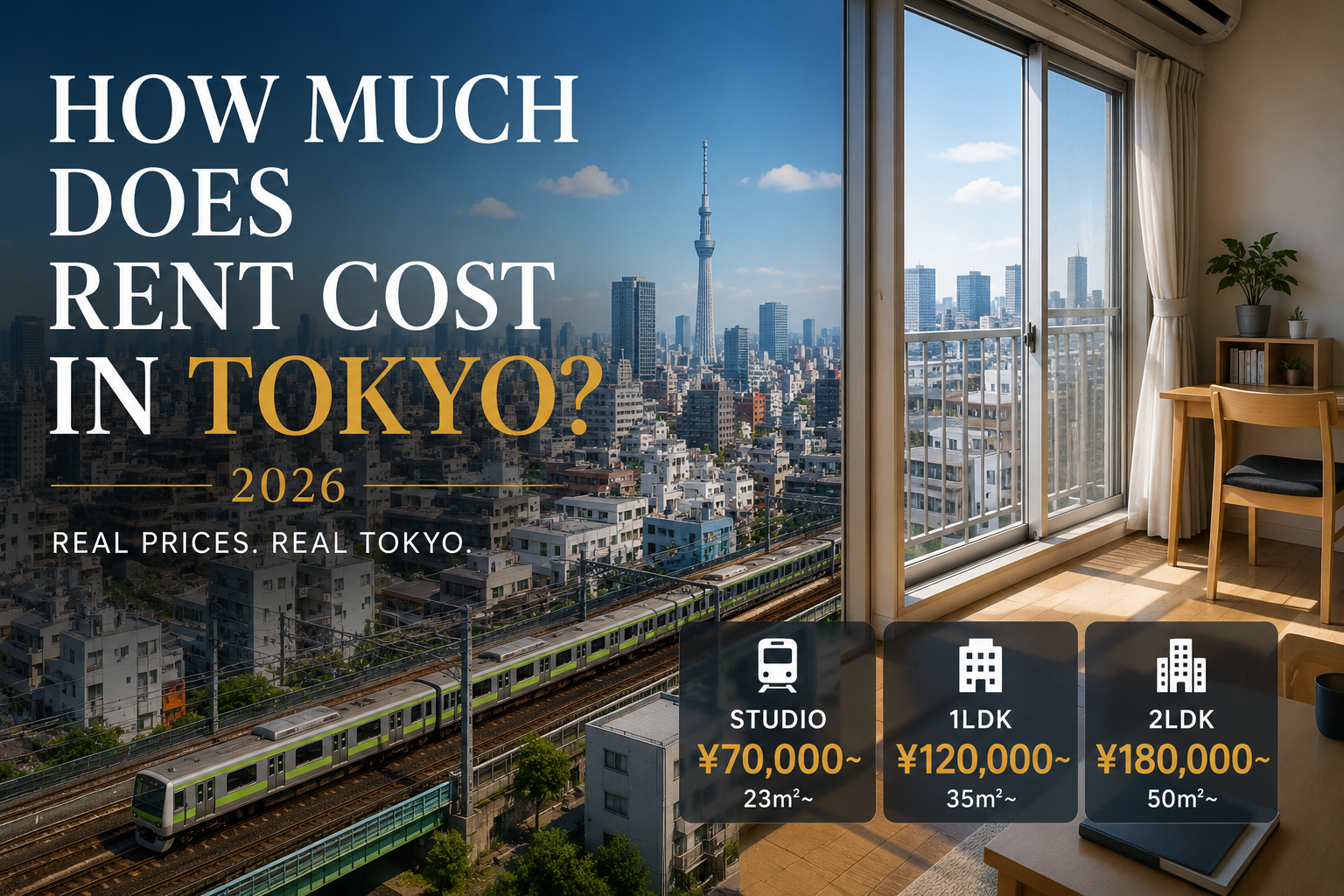
This page answers two questions with Japanese government data. How much do people actually pay in rent in each Tokyo ward? And what else do you have to pay when you sign a lease? Every figure has a source and a date. Where the data does not exist, we say so instead of guessing.
What the rent figures measure
The rent figures come from the 2023 Housing and Land Survey (令和5年住宅・土地統計調査), carried out by the Statistics Bureau of Japan as of October 1, 2023. We use Table 112-3: the average monthly rent of rented dwellings used only as homes, excluding dwellings with zero rent. Three things to keep in mind:
- It is the rent households are actually paying, including people who moved in years ago. It is not the asking rent on today’s listings.
- It covers all sizes of rented home and all landlord types, including public and corporate housing. It is not a 1K or 1LDK price.
- The survey does not publish rent by station. Ward and city averages are the finest official level.
Average monthly rent by ward (2023)
| Area | Average monthly rent | vs. 23-ward average |
|---|---|---|
| Minato | ¥196,160 | 207% |
| Chiyoda | ¥151,637 | 160% |
| Chūō | ¥145,610 | 154% |
| Shibuya | ¥130,960 | 138% |
| Meguro | ¥129,690 | 137% |
| Bunkyō | ¥112,934 | 119% |
| Shinjuku | ¥112,012 | 118% |
| Shinagawa | ¥102,811 | 108% |
| Setagaya | ¥100,331 | 106% |
| Tokyo 23 wards (all) | ¥94,853 | 100% |
| Toshima | ¥91,320 | 96% |
| Suginami | ¥88,047 | 93% |
| Kōtō | ¥87,224 | 92% |
| Nakano | ¥86,553 | 91% |
| Nerima | ¥84,766 | 89% |
| Ōta | ¥84,489 | 89% |
| Kita | ¥78,963 | 83% |
| Edogawa | ¥76,659 | 81% |
| Itabashi | ¥74,657 | 79% |
| Katsushika | ¥69,004 | 73% |
| Adachi | ¥67,017 | 71% |
For comparison, the same table gives ¥91,615 for Musashino City (Kichijōji), ¥79,273 for Kawasaki City (¥89,747 for its Nakahara Ward, which includes Musashi-Kosugi) and ¥75,381 for Yokohama City.
What the table shows: across the 23 wards, the average runs from ¥67,017 in Adachi to ¥196,160 in Minato. That is about 2.9 times higher at the top. Ten of the 23 wards sit within ±15% of the overall average, so outside the central business wards the ward averages are fairly close together. Because the averages mix all home sizes, use them to compare areas, not to estimate the rent for a particular flat.
What you pay when you sign: deposit, key money and agent fee
The Ministry of Land, Infrastructure, Transport and Tourism (MLIT) surveys households who moved into private rented homes. Its FY2024 Housing Market Trend Survey (moves between April 2023 and March 2024) gives these shares for the Tokyo metropolitan area (首都圏):
| Payment | Share of households who paid it | Most common amount |
|---|---|---|
| Deposit (shikikin / hoshōkin) | 67.3% | Exactly 1 month’s rent (64.6% of those who paid) |
| Key money (reikin) | 49.0% | Exactly 1 month’s rent (64.0% of those who paid) |
| Agent fee (chūkai tesūryō) | 44.8% | Exactly 1 month’s rent (63.5% of those who paid) |
Key money varies by region. In the same survey, 49.0% of Tokyo-area households paid it, compared with 41.9% in the Kinki area and 20.0% in the Chūkyō (Nagoya) area.
A worked example
For a flat at the 23-ward average rent of ¥94,853, the “most common” case in the table (one month each of deposit, key money and agent fee) means about ¥284,600 at signing, before the first month’s rent, insurance or any guarantor-company fee. If none of the three applied, the figure would be zero. The survey shows that many households did not pay all three, so treat this as a common case to check against, not a fixed rule.
The deposit is legally refundable; key money is not
- Since the 2020 revision, Japan’s Civil Code (Article 622-2) defines a deposit as money that secures the tenant’s obligations. When the lease ends and the home is returned, the landlord must return the deposit minus any unpaid amounts the tenant owes.
- MLIT’s guideline on restoration disputes (原状回復をめぐるトラブルとガイドライン) explains that ordinary wear and tear and ageing are generally treated as covered by the rent. A lease clause that makes the tenant pay for them is valid only if specific conditions are met, such as the tenant clearly understanding and agreeing to it.
- Key money is not a deposit. It is a payment to the landlord that is not returned.
Insurance when you rent
The General Insurance Association of Japan’s consumer Q&A explains the basic structure:
- A landlord’s fire insurance covers the landlord’s own property. It does not cover the tenant’s belongings. A tenant who wants that cover takes out fire insurance on their own household contents (家財).
- To cover your legal liability to the landlord if you accidentally damage the flat (for example by fire), you add a tenant’s liability rider (借家人賠償責任補償特約) to that contents policy.
- Earthquake insurance can only be bought together with fire insurance. Its cover is set at 30–50% of the fire-insurance amount, up to ¥10 million for contents.
Earthquake premium example (our calculation): the Ministry of Finance base rate for Tokyo and Kanagawa, non-wooden buildings, is ¥27,500 a year per ¥10 million of cover. Contents fire cover of ¥3 million with earthquake cover at 50% (¥1.5 million) therefore works out to about ¥4,125 a year before any discounts. Your insurer’s quote will depend on the building and the discounts that apply.
Sources
- Statistics Bureau of Japan / e-Stat — 2023 Housing and Land Survey, Table 112-3 (average monthly rent by municipality) (survey date 2023-10-01)
- MLIT — FY2024 Housing Market Trend Survey report (令和6年度住宅市場動向調査, June 2025, PDF)
- e-Gov — Civil Code, Article 622-2 (deposits)
- MLIT — Guidelines on restoration disputes (re-revised edition, PDF)
- General Insurance Association of Japan — Q&A: fire insurance for tenants
- General Insurance Association of Japan — Earthquake insurance
- Ministry of Finance — Earthquake insurance base rates
Related: Living in Yokohama: commute, rent and city data · Tokyo garbage rules by ward
This page gives general information, not legal or insurance advice. Lease terms differ, so read your own contract.

Comments