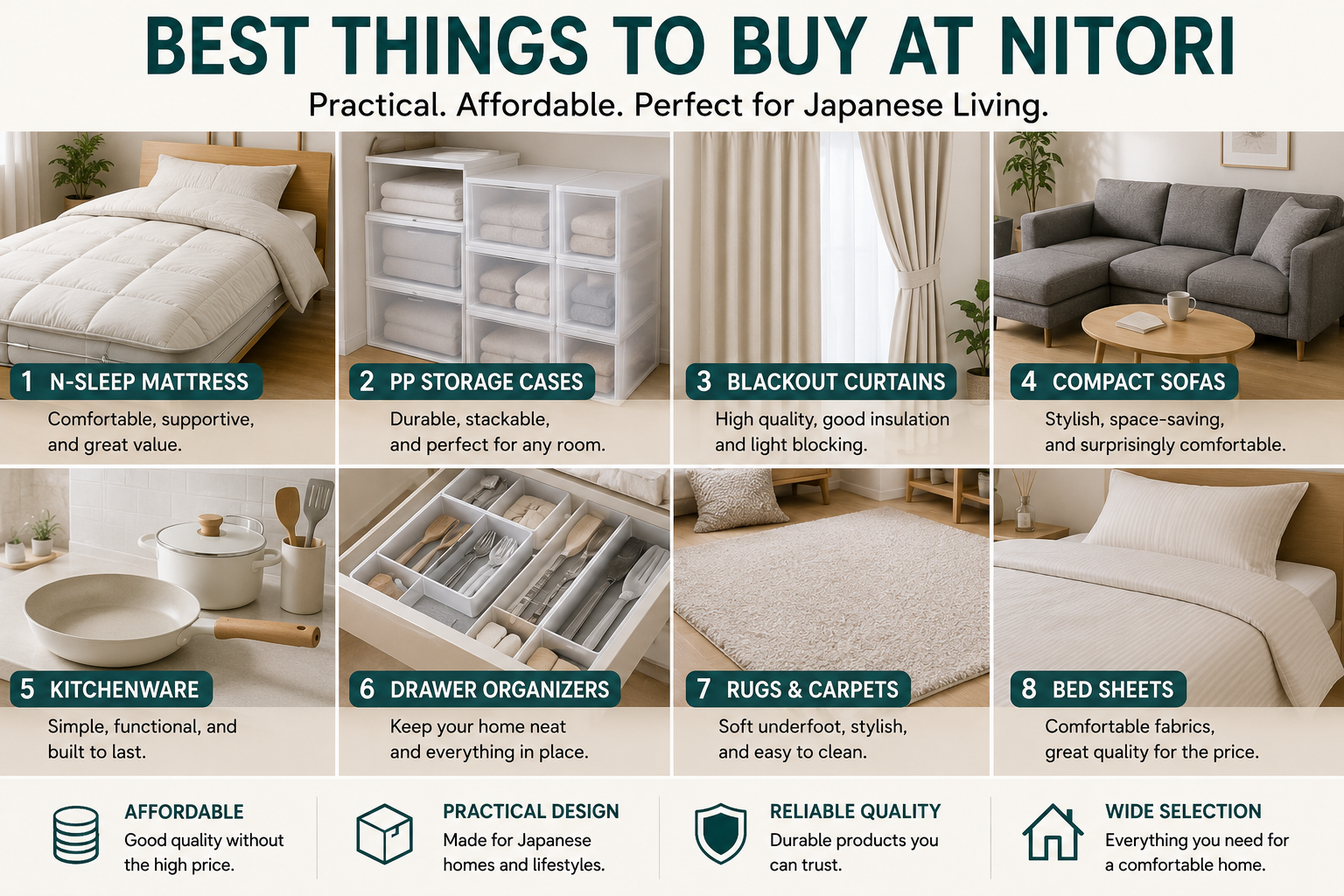
Best Things to Buy at Nitori (2026)
June 13, 2026 | Updated July 2026 | Shopping | Japanese Best
Introduction
Nitori is often called “the IKEA of Japan,” but its actual business model and history explain more about why specific product categories are worth buying there than the nickname does on its own.
Nitori’s Actual History and Business Model
Nitori was founded in Sapporo in 1967 by Akio Nitori. In 1972, following a pivotal research trip to the United States that exposed the founder to American furniture retail practices, the company formally incorporated as Nitori Furniture Wholesale Center Co., Ltd., operating two stores in Sapporo at the time. The company grew into a vertically-integrated retailer — designing, manufacturing (largely through its own supply chain), and selling its own private-label furniture and home goods, rather than reselling other brands. This vertical integration is the actual mechanism behind Nitori’s lower prices relative to import-heavy competitors, not a vague “efficiency” claim.
What’s Actually Worth Buying There
Given that business model, Nitori’s genuine strengths are concentrated in a few categories:
- Furniture — Nitori’s core original category, where the private-label manufacturing model has the most direct effect on price versus imported furniture brands.
- Home textiles — bedding, curtains, and cushions are a long-standing strength, benefiting from the same in-house design-and-manufacture approach.
- Seasonal bedding — cooling mats and blankets for Japan’s humid summers, and warming bedding for winter, are specifically well-regarded categories tied to Japan’s climate.
Smaller decor items and kitchenware are also sold, but the price advantage there is less pronounced than in furniture and textiles, where the vertically-integrated model has the most room to matter.
How Nitori Compares to Other Japanese Retailers
Where Daiso and Seria specialize in low-cost small goods, and MUJI focuses on minimalist design at a moderate price point, Nitori’s specific niche is larger home furnishings at a lower price than furniture-focused competitors — a distinction based on what each retailer actually manufactures and sells, not a general ranking of “best Japanese store.”
Frequently Asked Questions
Why is Nitori called “the IKEA of Japan”?
Because of a broadly similar model: affordable, largely self-assembled furniture and home goods, with Nitori also offering delivery/assembly service for larger items. The comparison is about business model, not a claim that the two companies are otherwise identical.
What does Nitori’s vertically-integrated model actually mean for prices?
Nitori designs and manufactures much of its own product line rather than reselling other brands, which removes a layer of markup compared to import-heavy furniture retailers — a concrete pricing mechanism, not just a general reputation for value.
Conclusion
Nitori’s value proposition traces to a specific business model — vertically-integrated private-label furniture and home-goods manufacturing, built since its 1967 founding in Sapporo — rather than a general “good Japanese store” reputation. Furniture, home textiles, and seasonal bedding are where that model shows up most clearly in the price and quality you’ll actually find.
Last updated: July 2026 | Japanese Best
More From Japanese Best
As an Amazon Associate, we may earn from qualifying purchases. This does not affect our recommendations.
Official Sources
Disclosure: As an Amazon Associate, Japanese Best earns from qualifying purchases. This does not affect our recommendations. We only feature products we genuinely believe are worth your consideration.
Editorial Disclaimer
This article does not constitute professional, financial, or purchasing advice of any kind.
Product availability, pricing, and specifications are subject to change without notice. Japanese Best makes no warranties — express or implied — regarding the accuracy or completeness of this content, and accepts no liability for any decisions made based on it. Always verify details directly with the retailer or manufacturer before purchasing.
コメント