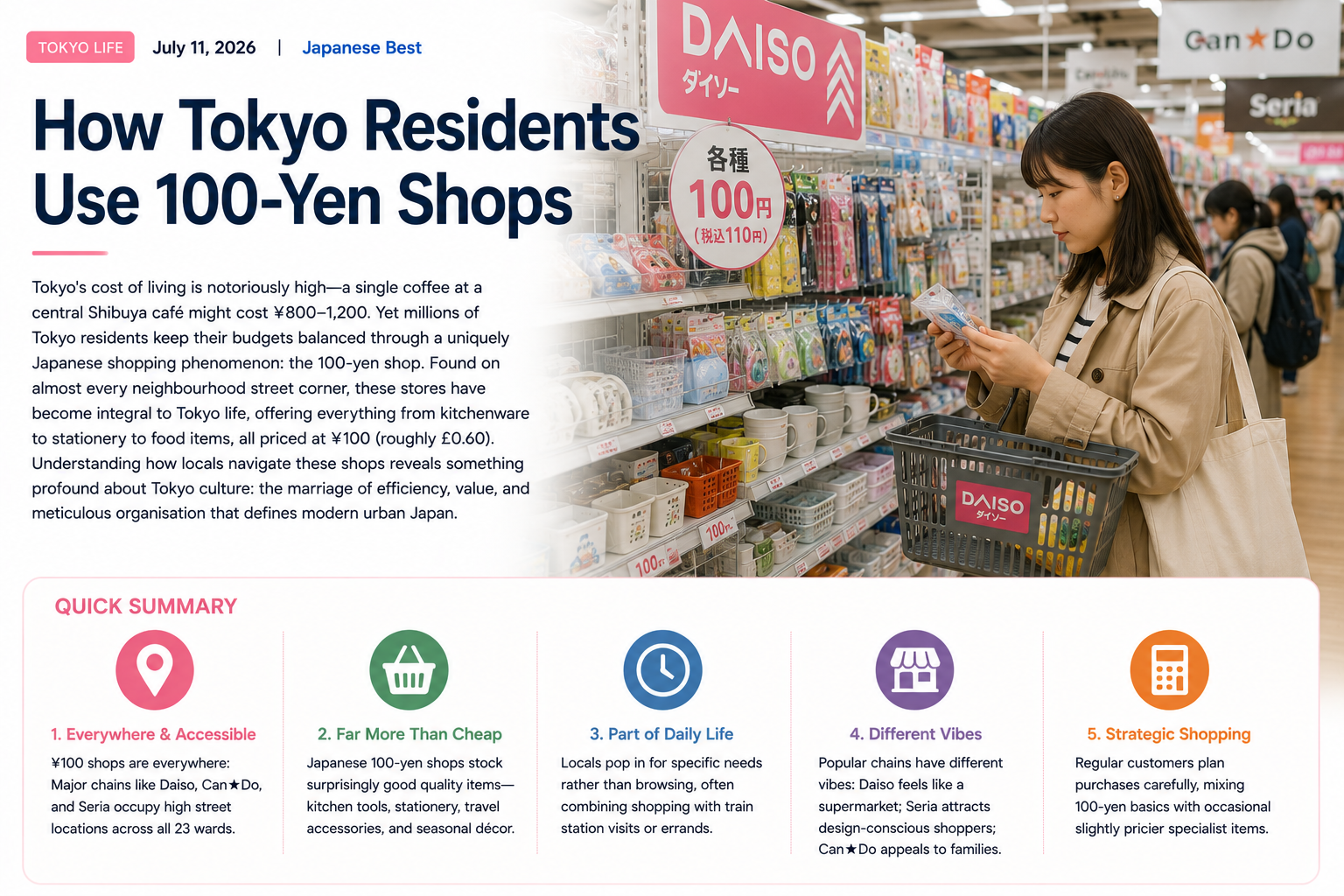
How Tokyo Residents Use 100-Yen Shops
July 11, 2026 | Tokyo Life | Japanese Best
Tokyo’s cost of living is notoriously high—a single coffee at a central Shibuya café might cost ¥800–1,200. Yet millions of Tokyo residents keep their budgets balanced through a uniquely Japanese shopping phenomenon: the 100-yen shop. Found on almost every neighbourhood street corner, these stores have become integral to Tokyo life, offering everything from kitchenware to stationery to food items, all priced at ¥100 (roughly £0.60). Understanding how locals navigate these shops reveals something profound about Tokyo culture: the marriage of efficiency, value, and meticulous organisation that defines modern urban Japan.
Quick Summary
- ¥100 shops are everywhere: Major chains like Daiso, Can★Do, and Seria occupy high street locations across all 23 wards
- Far more than cheap goods: Japanese 100-yen shops stock surprisingly good quality items—kitchen tools, stationery, travel accessories, and seasonal décor
- Built into daily routine: Locals pop in for specific needs rather than browsing, often combining shopping with train station visits or errands
- Popular chains have different vibes: Daiso feels like a supermarket; Seria attracts design-conscious shoppers; Can★Do appeals to families
- Strategic shopping wins: Regular customers plan purchases carefully, mixing 100-yen basics with occasional slightly pricier specialist items
🛒 Shop Recommended Products
What You’ll Actually Find and Experience
Walk into any Tokyo 100-yen shop and you’ll immediately notice the density of organisation. Unlike Western pound shops that feel chaotic, Japanese 100-yen stores are methodically arranged into clear sections: kitchenware on the left, stationery and office supplies in the middle, cleaning products along the back wall, and seasonal items near the entrance.
The merchandise quality surprises first-time visitors. You’ll find plastic food storage containers that rival department store equivalents, travel-sized toiletries, phone cables, extension cords, greeting cards, and even small electronics like USB hubs. The stationery section is particularly impressive—highlighters, mechanical pencils, sticky notes, and organiser sets that Japanese students and office workers rely on daily.
Seasonal sections rotate constantly. During summer, you’ll find cooling towels and portable fans. In autumn, Halloween decorations appear weeks in advance. By November, Christmas items proliferate. This predictability appeals to organised Tokyo residents who plan purchases around seasons.
Food and beverage items range from instant noodles and canned goods to snacks and baking supplies. Daiso locations in Shinjuku and Shibuya even stock fresh produce, though availability varies by location and time of day.
The Details: Prices, Hours, and Practical Information
Nearly everything costs exactly ¥100—though some larger items may be marked ¥200 or ¥300. This fixed pricing is part of the psychological appeal: customers can calculate their bill instantly and leave with predictability that Tokyo’s pace demands.
Operating hours typically run 10am–9pm on weekdays, with extended hours in central locations. Shinjuku’s massive Daiso (8 floors) stays open until 10pm. Most shops close by 8pm in residential neighbourhoods like Shimokitazawa or Kichijoji.
The big three chains dominate: Daiso has over 2,700 locations and feels like a general discount supermarket; Seria focuses on design-forward items and appeals to younger demographics; Can★Do caters to families with a mix of practical and fun products. Smaller chains like Flet’s and Natural Kitchen occupy niche positions.
Payment methods are thoroughly modern—cash, IC cards (Suica/Pasmo), and mobile payments (PayPay, LINE Pay) are all accepted. This reflects Tokyo’s hybrid approach to payment culture: tradition meets technology.
What Locals Actually Think
Ask Tokyoites about 100-yen shops and you’ll hear genuine affection mixed with practical appreciation. Many treat them as “emergency shops”—places to grab a forgotten item without paying central Tokyo markup prices. A university student rushing to an exam who needs a pen grabs one from Seria instead of a convenience store (which would cost ¥150–200). A parent needing craft supplies for a weekend project finds everything at Daiso for ¥400 total.
Office workers, particularly those in salaried positions across Marunouchi and Hibiya lines, use 100-yen shops strategically. One purchase might be cheap storage boxes for desk organisation; another, a replacement umbrella after leaving one on the train (a common enough occurrence that trains have designated “forgotten umbrella” sections).
There’s also a social dimension. Teenage friends meet at Seria in Harajuku not to shop but to kill time; older residents use 100-yen shop visits as neighbourhood social interaction, chatting with staff they recognise.
Online communities and YouTube channels dedicated to “100-yen shop hauls” demonstrate that this isn’t seen as downmarket shopping—it’s smart shopping. Discovering a quality item at ¥100 that normally costs ¥500 elsewhere is celebrated as a victory.
Tips for Visitors and New Residents
If you’re moving to Tokyo or visiting long-term, 100-yen shops should become part of your mental map. First-time apartment residents often furnish entire kitchens and bathrooms with ¥10,000 (roughly £60) in initial purchases.
For daily commuters, having a small bag from one visit is practical. Consider carrying a Zojirushi SM-SHE60AG Stainless Mug, which keeps tea or coffee hot during your morning commute—a popular choice among Tokyo salarymen who grab breakfast from convenience stores but want to avoid repeatedly buying drinks.
For students and anyone managing schedules across Tokyo’s sprawling neighbourhoods, stationery from these shops is invaluable. The Pilot FriXion Clicker 0.5mm is iconic in Japanese classrooms and offices—an erasable gel pen that writes smoothly but corrects cleanly with heat—and you’ll find similar quality items throughout any Seria location.
Visit during off-peak hours (Tuesday–Thursday mornings) if you prefer less crowded shopping. Weekends turn central Shinjuku and Shibuya locations into packed experiences. Always bring a small bag; shops sell reusable ones for ¥100, which many locals do.
The Bigger Picture: Why 100-Yen Shops Matter to Tokyo Culture
These shops represent something distinctly Japanese: the belief that good value and good design aren’t mutually exclusive. In an expensive city where efficiency matters, 100-yen shops democratise access to everyday essentials. They’re not charity—they’re business models built on volume and margin discipline.
For frequent Tokyo commuters seeking quality audio during trains and buses, professional-grade options like the Sony WH-1000XM5 represent the investment end of the spectrum, with industry-leading noise cancellation. But for quick purchases filling daily needs, 100-yen shops have already provided the answer.
FAQ
Are 100-yen shops cheaper than convenience stores?
Yes, significantly. A convenience store pen costs ¥150–200; identical quality at a 100-yen shop is ¥100. For food, pricing is comparable, but selection is broader at 100-yen shops.
Which chain is best for beginners?
Daiso for comprehensive range, Seria for design quality, Can★Do for family items.
Can you use foreign credit cards?
Yes, most major locations accept Visa and Mastercard, though cash remains common. Mobile payment apps are increasingly standard.
Are items actually quality?
Most are genuinely good quality. Japanese manufacturers supply these shops specifically, so standards remain high. Occasionally items feel cheap, but the ratio of quality to price is exceptional.
What’s the busiest time?
Weekends 1pm–6pm; weekday mornings are quietest.
Tokyo’s 100-yen shops represent urban Japan at its most practical and democratic. They solve everyday problems cheaply without sacrificing quality or organisation—values that define Tokyo itself. Whether you’re moving to the city, visiting long-term, or simply curious about how millions navigate one of the world’s most expensive cities, understanding the 100-yen shop phenomenon unlocks a window into Tokyo life that’s both financially savvy and culturally revealing. Regular Tokyoites wouldn’t think of their weekly routine without checking what their nearest Daiso, Seria, or Can★Do might offer.
Recommended Japanese Products
The products below are directly relevant to this article and used by Japanese families.
| Product | Brand | Best For | Link |
|---|---|---|---|
| Zojirushi SM-SHE60AG Stainless Mug | Zojirushi | Daily commuters who want reliable, durable coffee/tea on the go | Zojirushi SM-SHE60AG Stainless Mug |
| Pilot FriXion Clicker 0.5mm | Pilot | Students, planners, and anyone who needs flexibility to correct mistakes | Pilot FriXion Clicker 0.5mm |
| Sony WH-1000XM5 | Sony | Frequent travellers, remote workers, and audiophiles who want the best ANC | Sony WH-1000XM5 |
Zojirushi SM-SHE60AG Stainless Mug
Zojirushi’s most popular commuter mug — slim, spill-proof, and keeps drinks hot for 6 hours.
Best for: Daily commuters who want reliable, durable coffee/tea on the go
🛒 Zojirushi SM-SHE60AG Stainless Mug on Amazon
Pilot FriXion Clicker 0.5mm
The world’s bestselling erasable pen — writes like a smooth gel but rubs out cleanly with heat.
Best for: Students, planners, and anyone who needs flexibility to correct mistakes
🛒 Pilot FriXion Clicker 0.5mm on Amazon
Sony WH-1000XM5
Sony’s flagship ANC headphones — industry-leading noise cancellation and exceptional sound.
Best for: Frequent travellers, remote workers, and audiophiles who want the best ANC
More From Japanese Best
- What Japanese Families Eat for Dinner
- What to Buy at Daiso: A Practical Guide
Disclosure: As an Amazon Associate, Japanese Best earns from qualifying purchases. This does not affect our recommendations. We only feature products we genuinely believe are worth your consideration.
Editorial Disclaimer
The views, opinions, and recommendations in this article are the author’s own and reflect personal experience living in Japan. They do not constitute professional, financial, or purchasing advice of any kind.
Product availability, pricing, and specifications are subject to change without notice. Japanese Best makes no warranties — express or implied — regarding the accuracy or completeness of this content, and accepts no liability for any decisions made based on it. Always verify details directly with the retailer or manufacturer before purchasing.
コメント